
Development
Research roundup: 7 cool science stories we almost missed
September 2, 2026 Development Source: Ars Technica
Share this article



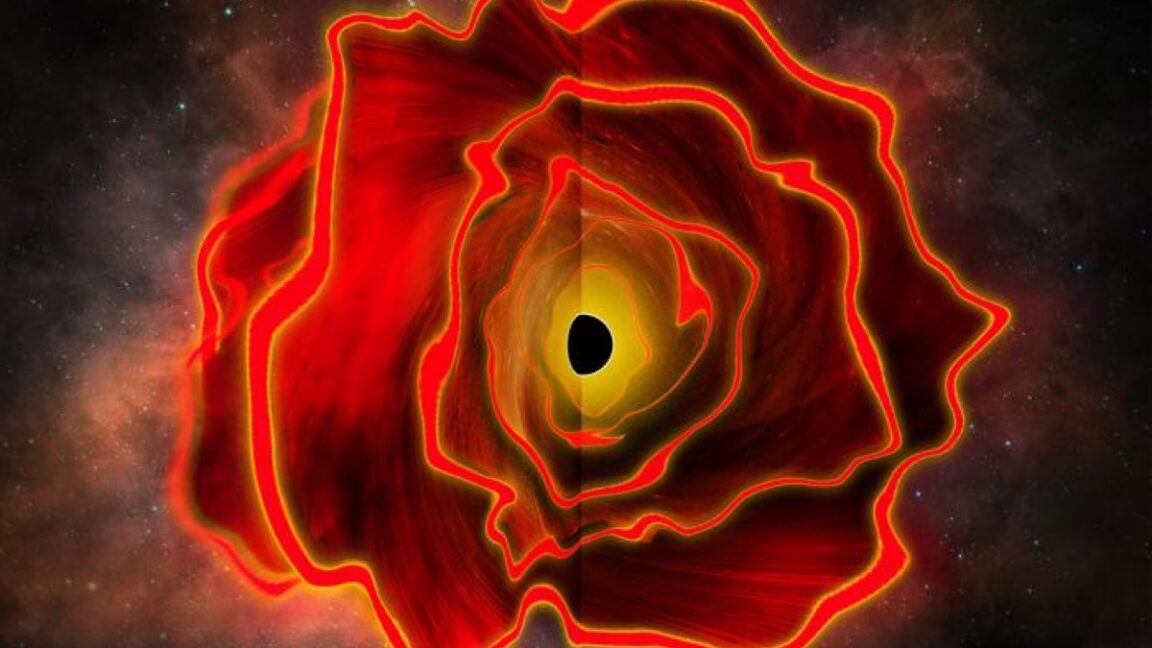
The authors decided to run computer simulations to determine what could produce this unusual combination of features. They reasoned that the red dot must be a powerful energy source surrounded by a very dense hydrogen cocoon, but the only possible source capable of that degree of brightness (100 billion times brighter than a star) would be an active accreting black hole. The team concluded that MoM-BH*-1, as they’ve named the red dot, is a black hole star: a massive central black hole (about 100 solar masses) surrounded by a dense cocoon of hydrogen the size of our solar system. Astronomers hope the discovery of black hole stars—two more have since been identified—will help them solve the puzzle of how supermassive black holes formed so soon after the Big Bang.
Nature, 2026. DOI: 10.1038/s41586-026-10846-4 (About DOIs).
Credit: SIU Carbondale Communications Credit: SIU Carbondale Communications
The final step: adding fiber, starch, and sweetener and extruding the resulting “dough” through a 3D printer to form little cookies. They’ve dubbed their creation µBites (microbites). The researchers have not yet conducted human taste tests, but subjects reported that the cookies smell delicious and said they would eat them if, say, they were in a situation with very limited food options. That’s not quite a ringing endorsement, but it’s a start. And the team is already working on making the cookies more palatable, with an eye toward the cookies being ready to eat in just a few years.
Physical Review E, 2026. DOI: 10.1103/1mth-rs2j.
Credit: Christopher Necuze/Florida International University Credit: Christopher Necuze/Florida International University
The scientists analyzed the genomes of hundreds of avocado trees. A single gene, SDMYB, was identified as being associated with whether a tree followed an A-type or B-type flowering schedule. There are two alleles (alternative versions) of this gene, similar to the two alternative sex chromosomes found in many other species, one of which is dominant, the other recessive. A-type trees have one copy of each version; B-type trees have two copies of the recessive version.
In fact, the same two versions were found in 26 other related tree species, suggesting the genetic mechanism is not limited to avocado trees. This will also help avocado growers, since they can now test to see which type a given tree is at the seeding stage and stagger their plantings accordingly to ensure pollen is exchanged between the two types of trees throughout the day. Previously, one had to wait until a tree flowered to make that determination, which could take 10 to 15 years after planting.
PNAS, 2026. DOI: 10.1073/pnas.2606876123.
The team designed miniature boats with three cavities tuned to different audible frequencies, enabling them to steer the boat in a particular direction by changing the frequency of the sound waves from a speaker. Their 3D-printed microfliers also had three integrated cavities tuned to ultrasonic frequencies, capable of generating upward thrust or aerodynamic lift, similar to a helicopter.
Science Advances, 2026. DOI: 10.1126/sciadv.aef5620.
Credit: Yi-Ting Hsiau and Jingyuan Xu, KIT/Ella Maru Studio Credit: Yi-Ting Hsiau and Jingyuan Xu, KIT/Ella Maru Studio