
Development
NASA's next "great observatory" begins mission to widen our view of the Universe
August 31, 2026 Development Source: Ars Technica
Share this article



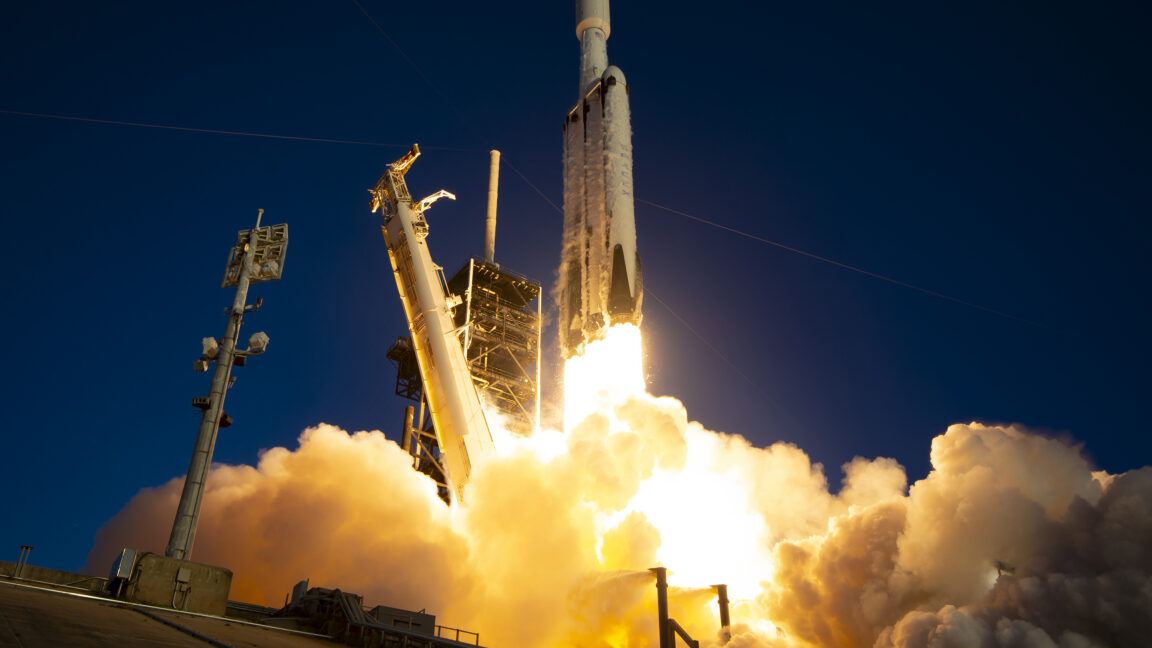
Fully fueled, Roman tipped the scales at some 20,000 pounds (9 metric tons) and filled the Falcon Heavy’s payload fairing. The rocket sent the observatory toward an observation post around the Sun-Earth L2 Lagrange point, a gravitational balance point nearly a million miles (1.5 million kilometers) from Earth.
“This is a big spacecraft,” said Denton Gibson, NASA’s launch director for the Roman mission. “We needed all 5 million pounds of thrust on that Falcon Heavy, which performed flawlessly.”
It will take about three months for Roman to reach its operational orbit around the L2 point. Ground teams will activate and calibrate the observatory during the transit, and scientists aim to have the first science images ready for publication by the end of the year.
“It certainly wasn’t just plug and play,” said Julie McEnery, senior project scientist for the Roman telescope at NASA’s Goddard Space Flight Center.
Roman passed its NASA confirmation review in 2020, and since then, the mission’s development proceeded on budget and faster than expected.
Roman’s Wide Field Instrument gives the observatory its broad vision. This near-infrared camera can take a picture of a pocket of the sky larger than the full Moon, allowing Roman to map megastructures like clusters of galaxies and large-scale filaments of matter and dark matter that make up the cosmic web.
“To put it into perspective, it is as if Hubble and James Webb kind of peered through a keyhole at the Universe, while Nancy Grace Roman will kick the door down,” Fox said. “But Roman isn’t just doing Hubble and Webb science faster. It’s doing fundamentally different science that could not be done by either observatory. Together, these three flagship telescopes will combine their observations to give us a more complete picture of our cosmos, and our place in it.”
Many astronomers are accustomed to downloading data from Hubble and Webb onto personal computers. In most cases, that won’t be possible with Roman. NASA’s new observatory will generate 20 petabytes (20,000 terabytes) of data over its five-year prime mission. By comparison, Hubble has delivered a little more than 400 terabytes of data since its launch in 1990.
Scientists developed a cloud-based platform for astronomers to explore, access, and analyze Roman’s data, with options for astronomers to use preconfigured built-in software or bring their own software for data reduction.