World
Rights groups critical as Venezuela prisoner release scheme 'coming to an end'
April 25, 2026 International Source: BBC World
Share this article



More than 500 political prisoners are thought to still be in jail, despite the releases since the amnesty law was brought in.
Rights groups critical as Venezuela prisoner release scheme 'coming to an end'
Copyright current_year BBC. All rights reserved. The BBC is not responsible for the content of external sites. Read about our approach to external linking.
Copyright current_year BBC. All rights reserved. The BBC is not responsible for the content of external sites.
Read about our approach to external linking.
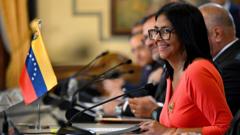
Interim President Delcy Rodríguez said the scheme was "coming to an end"
Venezuela's interim President Delcy Rodriguez smiles during a meeting at the Miraflores Presidential Palace in Caracas
Human rights groups in Venezuela have criticised interim President Delcy Rodríguez for saying a scheme to release political prisoners was "coming to an end", having been in place for just nine weeks.
Nearly 500 political prisoners have been released under the amnesty law brought in by the country's National Assembly, prisoner rights group Foro Penal says, but many more are thought to still be in jail.
The group said Rodríguez lacked the power to end the releases, while watchdog Provea called the move "arbitrary and unconstitutional".
Despite being a lieutenant of former President Nicolás Maduro, Rodríguez has enjoyed the support of Donald Trump since US forces seized Maduro in January.
The US president surprised many by backing Rodríguez over opposition leader María Corina Machado, and the release of political prisoners - including Machado's colleagues - was a key concession to the US by the interim administration.
The president of the National Assembly Jorge Rodríguez - Delcy's brother - who initially announced the law, had said 1,557 political prisoners had applied for amnesty, noting the legislation would eventually cover 11,000 people.
The president of the National Assembly Jorge Rodríguez - Delcy's brother - who initially announced the law, had
said 1,557 political prisoners had applied
for amnesty, noting the legislation would eventually cover 11,000 people.
Foro Penal said that, as of 20 April, 473 people it classifies as political prisoners had been released, while more than 500 are thought to remain incarcerated.
In a meeting of justice officials in the capital, Caracas, on Friday, Delcy Rodríguez said 8,616 people had been freed under the amnesty law, which she credited as being "very successful in terms of its scope and the number of beneficiaries".
She added that for cases that had not been covered by the law, "there are other avenues through which they can be addressed".
Following Rodríguez's remarks, Foro Penal vice-president Gonzalo Himiob said only another legislative act or referendum could undo the amnesty law, which had no expiration date.
"The bodies of the administration of justice, which are part of the same repressive system that made an amnesty necessary, never truly had either the willingness or the capacity to apply the amnesty law while respecting its purpose or principles," he added.
His sentiments were echoed by Provea, which said ending the release of political prisoners "does not contribute to the process of co-existence and peace that has been announced".
"We have stated that, despite its limitations, the Amnesty Law is a first step toward dismantling the repressive framework that has gripped the rights of the Venezuelan population in recent years," it said.
Meanwhile, the Justice, Encounter and Pardon group said the announcement was "a grave assault on the rule of law".
"Unfortunately, this outcome confirms our initial concern: the law ended up being an exercise in political rhetoric rather than a genuine instrument to restore freedom to political prisoners," it said.
Maduro's government used the detention of political prisoners to stamp out dissent and silence critics for years.
Rodríguez, who previously served as Maduro's vice-president, has sought to frame her interim administration as more permissive of political dissent while currying favour with the US.
Earlier this month, Washington lifted sanctions on her, citing progress made "to promote stability, support economic recovery and advance political reconciliation".
, citing progress made "to promote stability, support economic recovery and advance political reconciliation".
Trump's decision to sideline opposition leader Machado in favour of Rodríguez has been cast by analysts as choosing stability over democracy in the short term.
Recently, US Secretary of State Marco Rubio characterised the current situation in Venezuela as a "transition phase" before "free and fair" elections.
Machado herself said she would lead the South American country "when the right time comes".
However, critics of the interim administration have bemoaned the fact there has been little talk of democratic elections in the months since Maduro was seized by US forces and taken with his wife to New York to stand trial on drug trafficking charges.
Venezuela's interim leader Delcy Rodríguez speaks into a microphone during a meeting with US Interior Secretary Doug Burgum, on 4 March. She is wearing a red jacket and black-rimmed glasses.
US lifts sanctions on Venezuelan interim leader Delcy Rodríguez
Venezuelan Interim President Delcy Rodríguez and her brother National Assembly President Jorge Rodríguez
More than 1,500 Venezuelan political prisoners apply for amnesty
Angel Godoy's wife hold up an orange T-short with writing on it, a message her husband scrawled on it while he was in prison in Venezuela
Dirty laundry and chocolate bars: How Venezuelan prisoners smuggled messages out of jail
US President Trump has made clear his desire to change Cuba's leadership and has placed the country under an oil embargo.
The UN is deeply concerned by allegations there have been incidents of torture after Nicolás Maduro's ouster.
Mikola Statkevich, who spent more than five years in prison in his native Belarus, is now recovering from a stroke at home, his wife says.
Gannon Ken Van Dyke allegedly made trades on Polymarket on the basis of classified information, the justice department says.
The move will make it easier for the banks to conduct transactions in dollars.
Chevron is now importing 250,000 barrels of crude per day from Venezuela.
It is the latest sign of warming relations between the US and Venezuela after Nicolás Maduro was seized in a commando raid.
The BBC was in the New York courtroom to watch the ex-Venezuelan leader argue for ability to fund his defence with Venezuelan government funds.