
Development
Xtracycle's Swoop ASM e-bike brings an automatic transmission to cargo bikes
August 26, 2026 Development Source: Ars Technica
Share this article



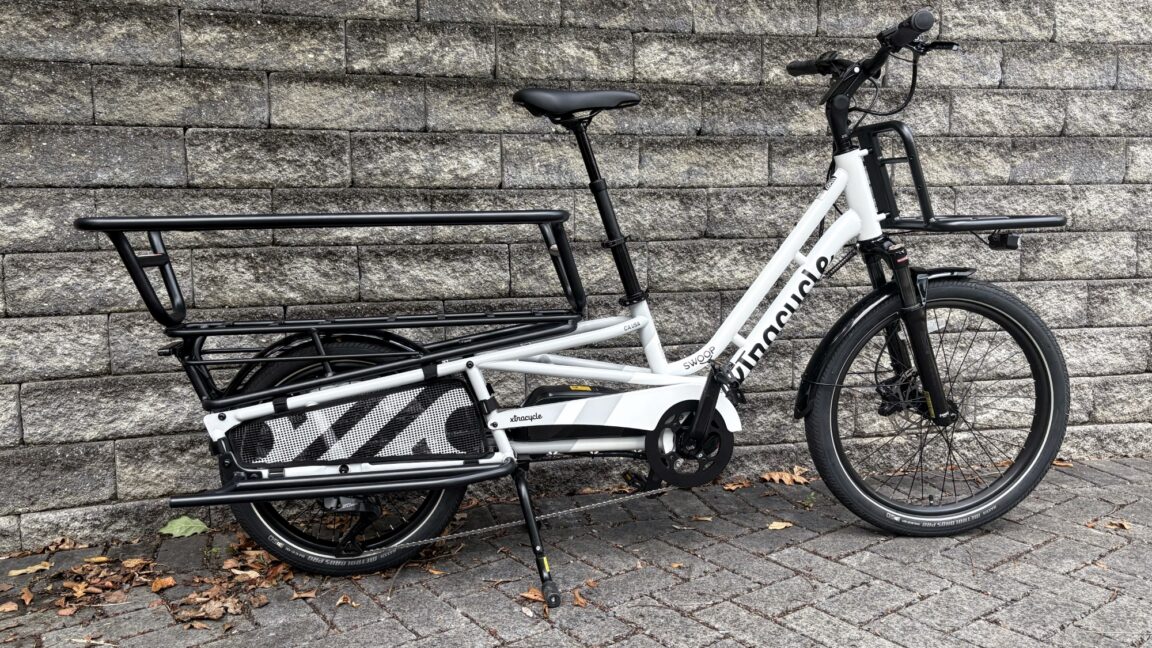
Notably, the bike is built with steel tubes. Most manufacturers’ lineups use a mix of either carbon fiber and aluminum because those two materials can be made into the exact same shape, simplifying manufacturing. But other materials still have their fans, as they can offer distinct combinations of weight, stiffness, and vibration dissipation.
You can also use one of Xtracycle’s bag attachments in this setup; I was provided one that ran the full length of the rear attachment and held a fair amount of cargo. Adding a second would have handled all of my typical shopping needs. (While having only one bag might seem awkward, the bike performed very well with everything I was carrying loaded on one side.)
The only problem is that this hardware makes the rear wheel extremely difficult to reach. I struggled to lock the back tire to anything, and I considered myself fortunate to not have to figure out how to deal with a flat.
The mid-motor offers three levels of assist, adjusted through a controller on the left side that also includes the power button and a simple display. Shifting is controlled by the one on the right, which lacks a display. Separating the two allows each to be fairly minimalist, making it easy to find the control you need by feel.
On its own, the system worked beautifully. Shifting was fuss-free, and each change was blissfully silent. The assist worked well, and its three levels seemed to cover any needs short of going up steep hills with lots of cargo. This is not a bike that lets you skimp on pedaling in hot conditions; there’s no throttle, and even the highest setting of assist still requires you to exert some force on the pedals. But the motor definitely cuts down on the effort you have to make.
The battery, while looking fairly compact, easily handled dozens of miles without needing a recharge, which means several days of typical errands. While the battery lacks a carrying handle, it’s easy to take it out to charge it, as it pivots sideways out of the frame. When in place, it acts as a protector that keeps anything on the left side of the bike from sliding through the frame and getting tangled in the chain.
This is the first Shimano e-bike system I’ve tested, and it was just as good as you’d expect from a company that has come to dominate cycling drivetrains. Shimano Cues may be its lower-end system, but there’s no apparent skimping on the quality. And that’s before the bonus surprises Shimano has included.
Somewhere in one of the controllers, Shimano’s software gathers all the relevant information about your ride: how fast you’re going, how much force your feet are exerting on the cranks, what gear you’re in, and how fast your legs are churning (and possibly more?). And it uses that data to do a couple of interesting things.
One is what it calls Free Shift. Normally, a bike can’t shift to a different gear unless you’re turning the pedals to move the chain, which can potentially create problems. For example, you could move the derailleur down a gear but not complete the shift before stopping, meaning that the shift would be made when you start pedaling again, and the chain is under a lot of tension as you crank away from a full stop. Or you could move the derailleur several gears over without the chain following.
But the whole point of having a motor is to move the chain. So if you shift without pedaling and the bike isn’t stationary, the Cues system will use the motor to move the chain just enough to complete the shift. It does so without speeding up the bike at all.
The Swoop is not an inexpensive bike; at $4,500, it sits somewhere between the Trek Fetch+ 2 and the Urban Arrow Family I’ve reviewed previously. While it lacks the latter’s capacious cargo tub, the longtail form factor provides a much more bicycle-like riding experience. I’d rate its ride as superior to the Trek because of its frame and front suspension made for a more pleasant ride.
I also prefer Shimano’s drive system to the Bosch used by the other two bikes. It just felt better integrated with my pedaling, plus a bit quieter and less intrusive. The electronic shifting is a bonus—it’s not needed, but it definitely makes for a nice experience, and one where Shimano’s integration means you don’t have to worry about the status of the two additional batteries needed by many electronic systems. I don’t think I’d use the automatic shifting, but I could see where a less experienced cyclist might feel they benefit from it.
So while it’s on the pricier side, the cost seems to be in line with the features it offers. If those features are important to you, the Swoop is definitely worth consideration.
In the end, though, I’m not a huge fan of electronic shifting. I hate worrying about battery levels just to ride my bike, and I like the feel of a well-aligned mechanical shifter clicking into place. But even I have to admit that Shimano’s software does a fantastic job of shifting at the right times, and I think the system could really work well for anybody who hasn’t learned to associate a clunky-sounding shift with bad things.