
Development
Volcanoes that made history
August 23, 2026 Development Source: Ars Technica
Share this article



Fast-forward more than a century, and researchers now understand that climate changes, especially rapid ones, have transformed societies by affecting agriculture, public health, and living conditions. With what they’ve learned from Krakatau and other eruptions, volcanologists today are identifying past catastrophic blasts that may have contributed to historic events like droughts, famines, epidemics and societal unrest.
“In so many different ways societies were affected … a failure in harvest or flooding or a cold summer or a really cold winter,” says Katrin Kleemann, an environmental historian at the German Maritime Museum in Bremerhaven.
While they can’t prove an eruption caused the demise of a regime, volcanologists have uncovered some intriguing links, including some that could inform our understanding of how today’s society might react to a rapidly changing climate.
The first challenge in making volcano-society connections is to find physical fingerprints of past eruptions. In the year 536, scribes in Europe, the Middle East, and Asia wrote about bizarre weather, including a haze that shrouded the sun for 18 months. Temperatures plummeted, harvests failed, and within a few years, the first documented global plague began.
These early medieval chronicles strongly suggest a major volcanic eruption—but the hard evidence lies deep in polar ice. Scientists can infer that big eruptions happened at certain times in the past by looking for sulfur and ash deposits in ice cores from Greenland and Antarctica. These cores, drilled into ice sheets, preserve an annual record of whatever was circulating in Earth’s atmosphere as it settled onto the surface each year. Researchers can read these frozen layers back in time like turning the pages of a book.
It turns out that polar ice cores do contain large amounts of sulfur dating to 536, a distinct signal of a major eruption. But which volcano went off at the time remains a mystery. There is no known written record from anyone living close to the eruption—Iceland, where it may have occurred, was not yet populated.
To see how this volcanic activity might have affected climate, an interdisciplinary team led by Ulf Büntgen, a tree-ring specialist at the University of Cambridge, used tree-ring data to confirm that the summers of 1345, 1346, and 1347 were unusually cold and wet in southern Europe.
Büntgen and his colleagues note that as crops failed in the bad weather, Europeans imported grain from farther east. The grain ships arrived with rats harboring Y. pestis, leading the researchers to argue that the mystery volcano erupting in 1345 may have set off a chain of events that ultimately killed tens of millions of people.
Connecting volcanoes to human events may be a challenge even today, but in 1784 an American ambassador to France named Benjamin Franklin was astute enough to link a strange haze that rolled across the countryside in the previous year to a distant eruption.
The source turns out to be Laki, an Icelandic fissure that spewed lava for eight months starting in June 1783. The eruption killed at least one-fifth of Iceland’s people, and much of its livestock, through toxic fog and climate changes that ruined harvests. Though the event was well-documented in Iceland, observers in England, France and elsewhere across Europe who saw the volcano’s haze and sometimes smelled its foul odor could only guess what was going on in a disconnected, pre-electronic world.
“They wouldn’t get news alerts on their phone, they wouldn’t see livestreams of this eruption — they would have no idea,” says Kleemann, who has studied the eruption.
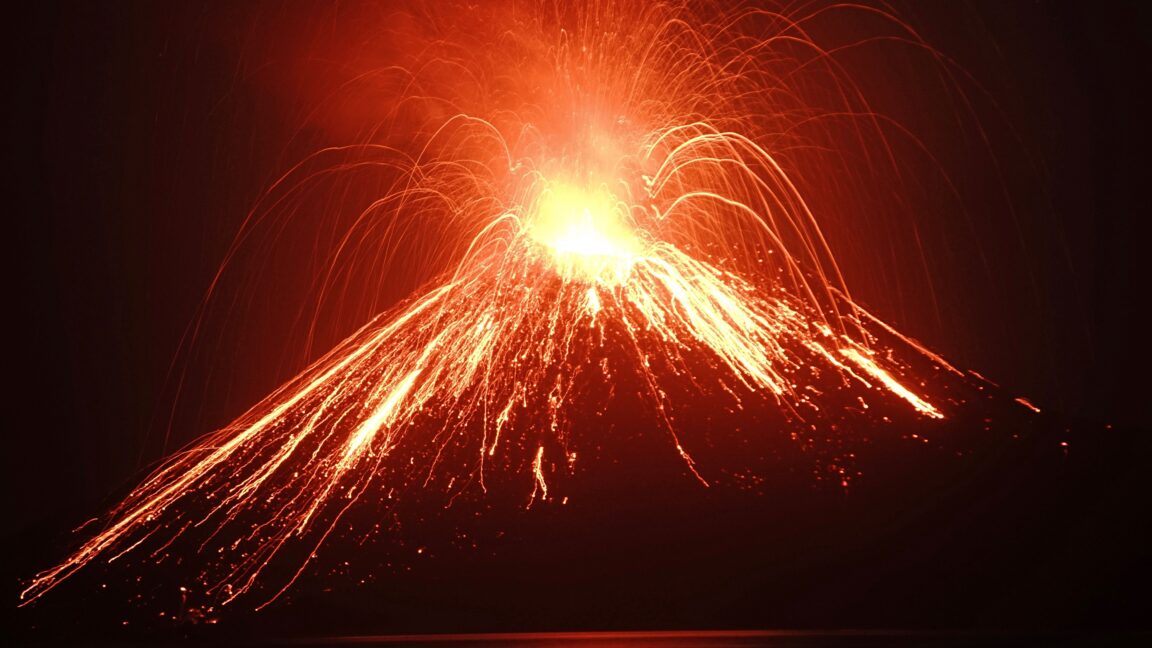
Though it happened just a few decades after Laki, one of the largest eruptions in recorded human history offers a much more detailed picture of how a volcanic climate shock can change history. In 1815, a mountain in Indonesia named Tambora exploded, sending sulfur into the upper atmosphere and triggering broad climatic changes.
Tambora’s eruption caused cooling across much of Europe and North America, where crops failed and 1816 was dubbed the “year without a summer.” The volcanic weather that year kept the writer Mary Shelley cooped up while traveling in Switzerland, where she wrote the novel Frankenstein.
The bad weather brought famine to Switzerland, Ireland, and elsewhere; grain prices and malnutrition soared in parts of Europe, prompting tens of thousands of people to emigrate to North America. Eastern Europe and western Russia, in contrast, had relatively better growing conditions under the post-volcanic climate and enough grain to export it to other nations. Port cities like London and Hamburg enjoyed greater access to imported grains, while prices rose sharply in the hinterlands. Those bright spots show how access to transportation and trade networks can make societies more resilient in the face of disaster.
“Human society has a lot of susceptibilities and vulnerabilities,” says Clive Oppenheimer, a volcanologist at the University of Cambridge who coauthored a 2026 Annual Review of Earth and Planetary Sciences paper on volcanoes, climate and society with Büntgen. “Some climate shocks will come and go…. At other times, the climate shock will come … when there are greater societal vulnerabilities.”
These lessons may hold particular relevance today, because researchers see the historical fallout of past eruptions as a clue to how humanity might respond to present-day climate change. Big volcanic eruptions cool the planet rather than warm it, but they represent the same sort of rapid planetwide shocks that societies are coping with now as Earth heats up.
And as historical volcanology teaches, it is only a matter of time before the next big blast. In the era of satellites and social media saturation, the whole world will know the moment it happens—but it is only by studying past events like Krakatau and Tambora that we can have an idea of what will happen next.
This story originally appeared in Knowable Magazine.