
Development
Rocket Report: SpaceX makes its mark on the Moon; ULA names new boss
August 21, 2026 Development Source: Ars Technica
Share this article



Ukraine strikes Russian rocket factory. Ukrainian President Volodymyr Zelenskyy confirmed on Saturday that his country struck the Progress Rocket Space Center deep within Russia using ground-launched cruise missiles, Ars reports. “In Russia’s Samara region, one of the key enterprises within Roscosmos—the Progress Center, which was involved, among other things, in electronics production–was hit,” Zelenskyy said on X. “Flamingo missiles were used. A good achievement.”
Soyuz in the crosshairs… The largest city in the Samara Oblast, about 900 km from the Ukrainian border, Samara is home to Russia’s most important manufacturer of rockets. The Progress Center assembles the workhorse vehicle for Russia, the Soyuz-2 vehicle, as well as the newer Soyuz-5 rocket. The facility also builds military satellites. Russia uses the Soyuz-2 rocket, which has a lift capacity of about 8 metric tons to low-Earth orbit, for various civil and military purposes. Notably, it is the principal rocket used for Russia’s human spacecraft launches, raising questions about spillover effects for the International Space Station.
Charting America’s launch dominance. New research is beginning to quantify just how much the introduction of SpaceX’s Falcon 9 rocket, the adoption of reuse, and the vehicle’s high cadence have upended the global launch market, Ars reports. One of the more striking findings by public policy researchers based in the United Kingdom and Italy, based on new research published in Economics Letters, comes in the cumulative payload to orbit by nation. Russia and the United States tracked fairly close to one another for decades. That began to change in the last 10 years, and amid the Falcon 9 rampup in the early 2020s, the United States has pulled ahead dramatically.
Reuse or bust… SpaceX has also made significant gains in controlling costs compared to other nations, thanks to reusable rockets. A decade ago, the United States and Europe had similar launch costs. Today, according to publicly available data, launch costs in Europe are now three times higher than for comparable payloads in the United States. The researchers estimate that the average cost of sending a kilogram of payload to orbit in the United States is now $3,225, compared to higher costs elsewhere: Japan ($5,287), China ($5,809), Russia ($6,682), and Europe ($9,897). India is higher still at nearly $15,000 a kilogram.
Au revoir to Ariane 6 Block 3. The European Space Agency is no longer considering the Ariane 6 Block 3 evolution, an upgrade that would have introduced a new upper stage made of carbon-fiber reinforced plastic to replace heavier legacy metallic structures, European Spaceflight reports. An ESA spokesperson said development continues on technologies for Ariane 6 Block 2, some of which have already started flying (larger solid rocket boosters). An orbital transfer vehicle, or kick stage, named Astris will become available as an add-on for Ariane 6 missions around 2029. But ESA has halted work on the new lightweight Icarus upper stage after the project failed to win support from ESA member states.
Tightening the screws… The first public indication of the death of Ariane 6 Block 3 came from SpaceScout, which reported earlier this month on a presentation from ESA scientists on a proposed robotic mission to orbit and land on Saturn’s moon Enceladus. The team developing the mission said they are reassessing their design, which previously assumed the availability of Ariane 6 Block 3 for launch in the 2030s.
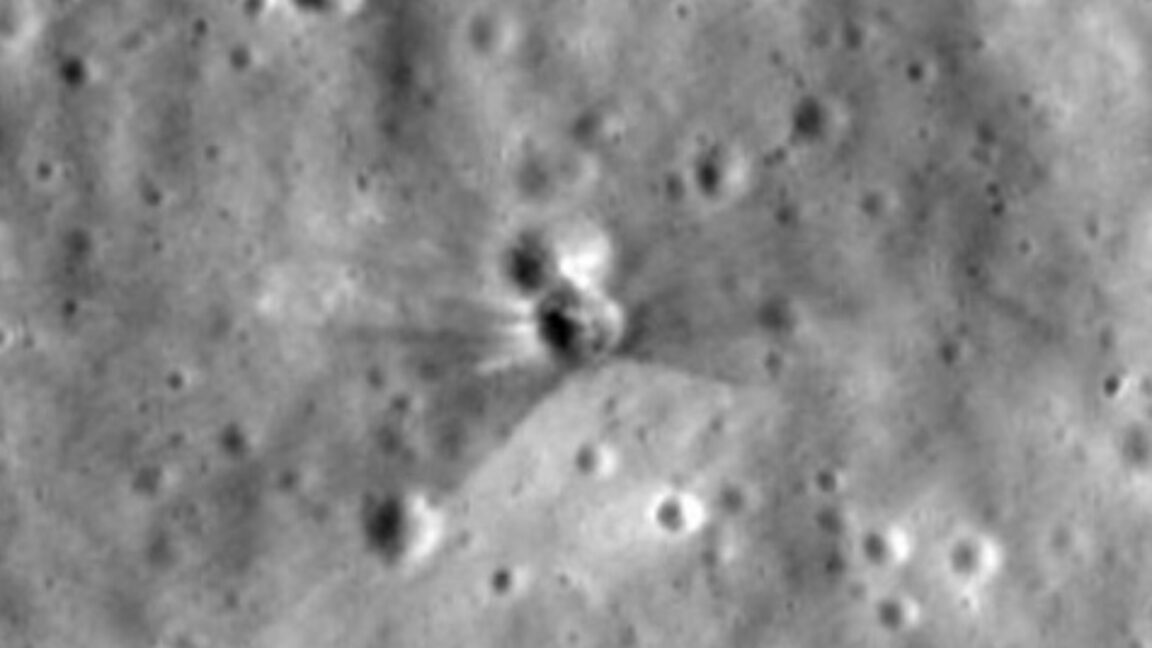
SpaceX’s new scar on the Moon. New images from NASA’s Lunar Reconnaissance Orbiter show the aftermath from the impact of a spent Falcon 9 rocket body on the Moon. NASA released the images this week, showing a fresh impact scar near Einstein Crater, located on the western limb of the Moon as seen from Earth. LRO’s narrow-angle camera captured a view of the Falcon 9 upper stage’s impact site at multiple angles, revealing a new crater approximately 60 feet in diameter and less than 10 feet deep. The rocket was left flying in deep space after launching a commercial Moon lander in 2025.
A learning opportunity… The rare, but not unprecedented, collision between an abandoned rocket and the Moon offered a chance for some unexpected research. The impact excavated pristine materials from below the lunar surface that have escaped weathering from the solar wind, galactic cosmic rays, and micrometeorites. It also provided an opportunity for asteroid trackers on Earth to refine their methods for impact predictions. It turns out their predictions of the Falcon 9’s impact site was accurate to about 0.6 miles, according to NASA.
Hardware rich… Engineers have reams of data from all 13 test flights of Starship and its giant booster rocket, known as the Super Heavy. But there’s no match for inspecting hardware after returning from space. SpaceX routinely recovers and reuses Falcon 9 booster stages with near-flawless performance. The handful of minor failures with the Falcon 9 have centered on the rocket’s single-use upper stage. So, getting Starship back in one piece is a boon. Engineers are particularly interested in inspecting the ship’s heat shield as they home in on a design for full and rapid reusability.
China will soon launch an ambitious Moon mission. As soon as this Sunday, a Long March 5 rocket will launch from a coastal seaport in China, carrying the Chang’e 7 lunar exploration mission, Ars reports. This is the latest and most sophisticated mission in China’s successful lunar exploration program, which dates back nearly two decades. The mission will pack a punch: It contains a lunar orbiter with high-resolution cameras and other sophisticated tools, a lunar lander, a lunar rover, and a mini-hopper of a probe. Although the lander’s mass has not been disclosed publicly, it is several times larger than the NASA-backed probes that have recently landed on the Moon, such as Firefly’s Blue Ghost.
Location, location, location… But what is most notable about Chang’e 7 is where the probe is going. It will land near one of the most compelling regions of the Moon, Shackleton Crater, very nearly at the south pole. Much of the lunar surface is pretty barren, but the south pole, and Shackleton Crater in particular, offers some of the most coveted real estate there. This is because the high rims of the crater create permanently shadowed regions known as “cold traps,” where it’s thought that water (in the form of ice, of course) and other useful materials may have accumulated over billions of years. In all of NASA’s and China’s plans for long-term settlement on the Moon, relatively few square miles at the south pole of the Moon matter more.
New boss at ULA. United Launch Alliance has promoted Chief Operating Officer Mark Peller to president and CEO, succeeding Tory Bruno, who left ULA in December to develop and manage national security programs at Blue Origin, Aviation Week and Space Technology reports. Peller joined ULA at the company’s formation in 2006 and most recently led development of the Vulcan rocket, which successfully debuted in 2024 but has been grounded since early this year by a problem with its solid rocket boosters.
Taking the reins… Peller will have his work cut out for him. ULA, a 50-50 joint venture between Boeing and Lockheed Martin, lost its long-standing position as the Pentagon’s preferred launch contractor last year. That was before ULA grounded the Vulcan rocket following an anomaly with one of its strap-on solid-fueled boosters on a launch in February. The rocket overcame the malfunction and still delivered its payload to orbit, but it was the second time such an anomaly has occurred in the last three Vulcan missions. It’s not clear whether ULA will be able to resume Vulcan launches before the end of the year as engineers redesign parts of the booster’s nozzle structure. In the meantime, Boeing and Lockheed Martin last month confirmed they guaranteed a loan to ULA to help it through “financial challenges” caused by the grounding.
August 21: Falcon 9 | Starlink 10-39 | Cape Canaveral Space Force Station, Florida | 15:14 UTC
August 22: Falcon 9 | Starlink 15-20 | Vandenberg Space Force Base, California | 07:25 UTC
August 24: Long March 5 | Chang’e 7 | Wenchang Space Launch Site, China | 00:05 UTC