
Development
Meet the only known trebuchet casualty in history
August 17, 2026 Development Source: Ars Technica
Share this article



“The most similar cases I was finding were car crashes and people hit by trains,” Buckberry told Science.org’s Andrew Curry. Assuming Stirling Castle hadn’t been attacked by time-travelers, though, that raised new questions. “What is large and moving very quickly in 1304?”
Big rocks flung by trebuchets, that’s what.
A trebuchet works a bit like the world’s deadliest see-saw; at the long end of the see-saw is the sling that holds the projectile, and at the shorter end is a counterweight (a box of rocks or lead, 10 to 100 times heavier than the projectile). When the counterweight drops, its momentum raises the other end of the see-saw, tossing the sling up in a big arc. And when the sling reaches the end of its length, it stops—but the projectile keeps flying until it hits something.
A typical trebuchet of the time could launch a 90-kilogram projectile (typically a big rock) a few hundred yards. According to this handy medieval trebuchet calculator, that means the projectile would have smashed into Skeleton 150 at somewhere between 200 and 300 kilometers per hour, depending on the exact weight of the projectile and the trebuchet’s counterweight, the length of the sling, and the airspeed velocity of an unladen swallow. That’s an impact with a little over 200 kilojoules of energy.
Trebuchets and other siege engines (we will, under no circumstances, be delving into the distinctions between the different types of catapult) were meant to take out walls and other fortifications. They weren’t antipersonnel weapons; people undoubtedly got injured by flying debris or collapsing structures, but medieval engineers weren’t aiming their catapults at individuals. Skeleton 150 just got terribly unlucky.
“While the use of siege engines is well-documented, we believe this is the first evidence of trebuchet trauma in the archaeological record,” wrote Buckberry, adding, “The lack of directly comparable forensic cases remains a limitation.”
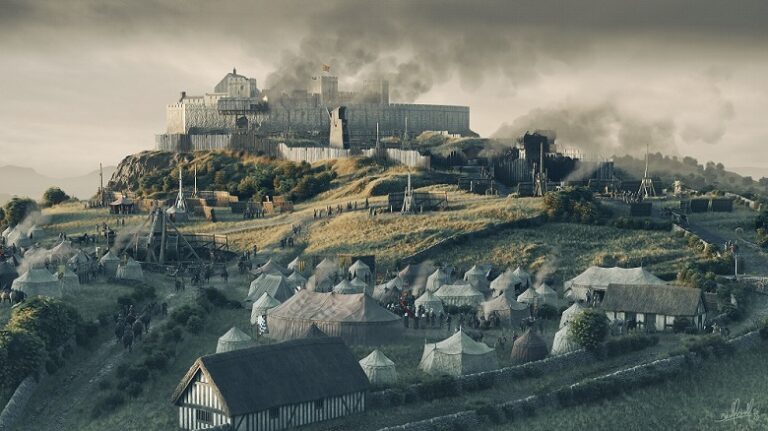
Buried not far from Sir John and the others lay skeleton 150, who Buckberry and her colleagues say was most likely a Scottish defender of the castle killed during the siege of 1304, when King Edward I of England laid siege to Stirling Castle with what Historic Environment Scotland describes as “possibly the largest array of siege engines ever assembled by the kingdom of England.”
In 1304, Skeleton 150 was probably one of the 25 men, led by Sir William Oliphant, who made up the last gasp of Scottish resistance against England and Edward I. After defeating William “They Will Never Take Our Freedom” Wallace at the Battle of Falkirk in 1298, Edward spent the next six years conquering the rest of Scotland. The country’s nobles eventually surrendered in exchange for being allowed to keep their lands (some of them may have done so with their fingers crossed). Edward’s long and bloody campaign was nearly over, except for this one castle, which inconveniently happened to perch along a strategically important road to Edinburgh. And the king was not amused.
In preparation for the siege, Edward decided to flex his newly won power over the Scots, which was undoubtedly as much a political gesture as a strategic choice. He ordered the Scottish nobles who had just surrendered to send him troops and horses for the siege, and he ordered that every church in Scotland strip the lead from their roofs and send it to the siege as well. Thirty-nine carts of lead arrived from around Scotland, mostly from St. Andrew’s, along with “all the iron and great stones of Glasgow.”
Thirteen siege engines were in place when Edward I arrived on the scene in April of 1304, and they bombarded the castle around the clock for three solid months. Somewhere during those months, Skeleton 150 met a bad end.