
Development
Rocket Report: Rocket Lab shows off its flexibility; Blue Origin's two-pad plan
August 14, 2026 Development Source: Ars Technica
Share this article



ArianeGroup decides not to halt MaiaSpace. ArianeGroup has decided against dissolving MaiaSpace after the company posted a 37.5 million euro loss for 2025, pushing its shareholders’ equity below zero, European Spaceflight reports. Shareholders’ equity fell from a positive 35.82 million euros at the end of 2024 to negative 823,375 euros. Shareholders’ equity is what remains after the company has paid all its liabilities. A negative figure means MaiaSpace owes more than it owns.
Yes, most rocket startups lose a lot of money … Under French corporate law, when shareholders’ equity falls below half of the company’s share capital, the shareholder, in this case ArianeGroup, is required to decide whether the company should be dissolved or allowed to continue operating. At a meeting on June 25, 2026, ArianeGroup officially rejected the option of dissolving MaiaSpace, allowing the company to continue preparations for the inaugural flight of Maia. ArianeGroup’s pockets are not bottomless, so this bears watching.
We like the name Horizon … Virgin Galactic plans to debut the Delta spaceship’s livery, including its name, as its next milestone before delivering the first vehicle to Spaceport America in New Mexico, where flight tests will begin. “Our first ship is now expected to enter commercial service in February 2027,” said Michael Colglazier, Virgin Galactic CEO, in a statement released on Wednesday. We advise the public to take that date with a grain of salt, but you can indeed vote to name the ship now. There are four options: Horizon, Explorer, Ascend, Apeiron.
Tank issue delayed RFA One launch. The majority owner of Rocket Factory Augsburg is still confident the company will conduct its first orbital launch attempt this year despite a setback in testing during July, Space News reports. In an August 6 earnings call, Marco Fuchs, chief executive of OHB, the German aerospace company that owns 65 percent of RFA, said engineers needed to “examine the tanks” of the rocket. “There was a problem with the tank, and this was uncertain, so the team decided to take a look into this,” he said.
RFA had been working toward an August debut launch … The company returned the rocket to the hangar and opened up the tank. He said he expected the rocket to be back on the pad soon but didn’t offer a more precise schedule. “The first test flight is still planned for later this year,” he said. “We’re hopeful that these last remaining challenges will be fulfilled in the next foreseeable days and weeks.” We’ll be watching with interest.
The front fell off … The Long March 7A rocket was developed by the China Aerospace Science and Technology Corporation and is operated by the state’s space agency. As of Monday night in China, state officials have not commented on the cause of the explosion. Later videos appeared to show the top of the rocket breaking off in flight. Based on the timing of the explosion, it occurred during the flight of the first stage of the vehicle, likely around the time of maximum dynamic pressure as the rocket accelerated through the lower atmosphere.
Neutron launch slips to 2027. Rocket Lab warned that the chances of launching its Neutron rocket for the first time before the end of the year are “narrowing” despite progress on the vehicle’s development, Space News reports. “As with any complex development program, we’ve had to tweak a few things along the way, but we’re moving now into final checkout and assembly of all of our flight hardware before integrating them at the pad,” Peter Beck, chief executive of Rocket Lab, said on the call.
Let’s be real … Ongoing work on the vehicle’s two stages, engines, and other systems, he said, “lines up with our target delivery of Neutron to the pad in Q4 2026.” Even if the stages reach the pad during the fourth quarter of this year, they still must be integrated and undergo additional testing. It is often during this final integration that problems are discovered. For this reason we can confidently say Neutron will not launch this year. Next year is plausible, but not guaranteed.
Rocketdyne returns as a standalone space company. Rocketdyne is returning as an independent company as AE Industrial Partners completes its purchase of L3Harris Technologies’ space propulsion, power, and electronics units, Space News reports. The revived Rocketdyne won’t resemble the full Aerojet Rocketdyne inherited by L3Harris three years ago. That company combined solid rocket motors, launch engines, and spacecraft systems under one roof.
RL-10 remains key asset … Missile propulsion, solid rocket motors, and hypersonic technologies remain with L3Harris’ Missile Solutions business, which the company plans to take public. The RS-25 engine used on NASA’s Space Launch System core stage was also excluded from the sale and remains wholly owned by L3Harris. Rocketdyne will concentrate on launch-vehicle engines, spacecraft propulsion, space electronics, and nuclear power systems. Its best-known product is the RL-10 upper-stage engine, which is used by United Launch Alliance’s Atlas 5 and Vulcan rockets. (submitted by Tfargo04)
There has been no confirmation from SpaceX or Louisiana officials … But earlier this year the Louisiana Legislature passed a package of incentives for aerospace companies, including liability protections and property tax breaks. If SpaceX is to fulfill its ambitions to launch thousands of Starship rockets a year to build a massive constellation of orbital data centers, among other purposes, it needs more launch sites. And there are limited expanses of undeveloped coastal locations along the Gulf of Mexico and southern Atlantic Ocean in the United States.
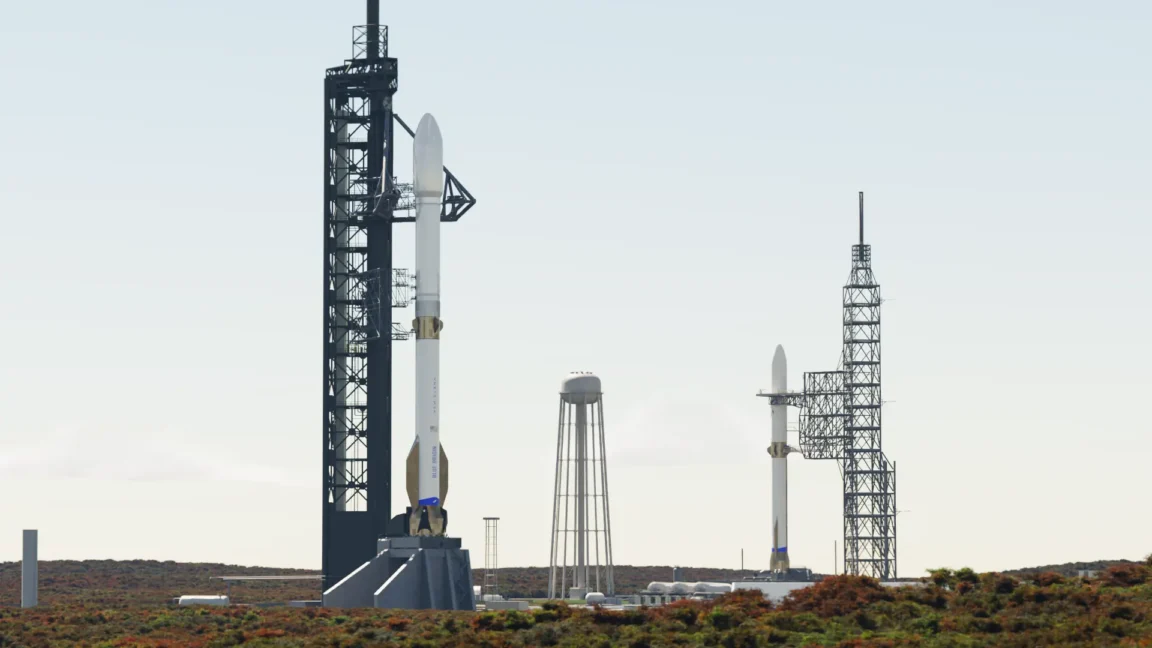
Blue Origin announces two-pad plan. In May, the explosion of New Glenn’s rocket took out Launch Complex 36A at Cape Canaveral Space Force Station in Florida. In the weeks after the anomaly, Blue Origin outlined plans to restore that pad for New Glenn operations as soon as possible. On Thursday, the company revealed that it will also move to quickly develop a larger launch pad at the nearby Launch Complex 36B.
New launch tower will resemble Starship tower … This newer pad will serve as the operational home for New Glenn 9×4 (that is nine first stage engines, four upper stage engines), while LC-36A remains the operational home for the smaller New Glenn 7×2 vehicle that blew up earlier this year. Additional infrastructure planned includes a new Vertical Integration Facility for the 9×4 vehicle and a Payload Processing Facility. Built in partnership with the US government, this facility will support both variants of New Glenn.
August 15: Falcon 9 | USSF-366 | Vandenberg Space Force Base, California | 21:52 UTC
August 16: Falcon 9 | Globalstar 2-R | Cape Canaveral Space Force Station, Fla. | 01:12 UTC
August 16: Long March 12 | Unknown payload | Wenchang Space Launch Site, China | 04:10 UTC