Development
We've flown a radiation-blocking vest to the Moon and back, and it worked
August 13, 2026 Development Source: Ars Technica
Share this article



StemRad engineers, though, figured dressing as a medieval knight doesn’t really get you all that much. The human body, Milstein explains, isn’t uniformly vulnerable to radiation. “Tissues like the bone marrow are a lot more sensitive to radiation compared to the brain,” he says. Following this idea, StemRad developed a belt for nuclear first responders, worn around the hips, which hold roughly half the body’s bone marrow, the tissue that makes blood cells. Protecting even a fraction of the bone marrow lets a person regrow it and survive a high-dose exposure.
So, StemRad, working with Lockheed Martin, expanded this idea into a female vest that, aside from the hips, also covered the breasts, stomach, colon, and reproductive organs. These are all less immediately life-threatening when irradiated, but carry a long-term cancer risk.
“It still gets people surprised,” Milstein says. “Everybody asks, what about the head? But we’re actually able to reduce the effective dose by 60 percent without protecting the head, the arms, or even the legs.” But choosing where to put shielding was just one part of the problem. Picking the material and making a design that would not hinder the astronaut’s movements was another.
“The primary factor in how effective a shielding material is is its atomic number divided by its atomic mass,” Houri says. Hydrogen, which has no neutrons, has roughly double that ratio of any other element, which is why water is often cited as a good space radiation shield. High-density polyethylene (HDPE), an ordinary plastic, packs even more hydrogen by mass than water, and, unlike water, it’s a solid, so you don’t have to worry about leaks.
The problem with a solid, rather stiff material like HDPE is that when made thick enough to offer good radiation protection, it can compromise comfort. To go around it, StemRad’s team broke it apart into hexagonal rods of varying lengths and cross-sections. “We divided up the shielding panels into thousands of hexagonal tessellated rods of HDPE,” Houri says. These rods, sandwiched between two layers of elastic fabric, made the vest extremely flexible and fluid-like. “It almost behaves the same way that water would, while still remaining solid,” Houri claims.
The rods run 9 to 60 millimeters long. Engineers calculated their length using the Bethe-Bloch formula, which describes how charged particles lose energy while moving through matter. This way, the team could predict how far a particle with a given energy would travel through their shielding before stopping.
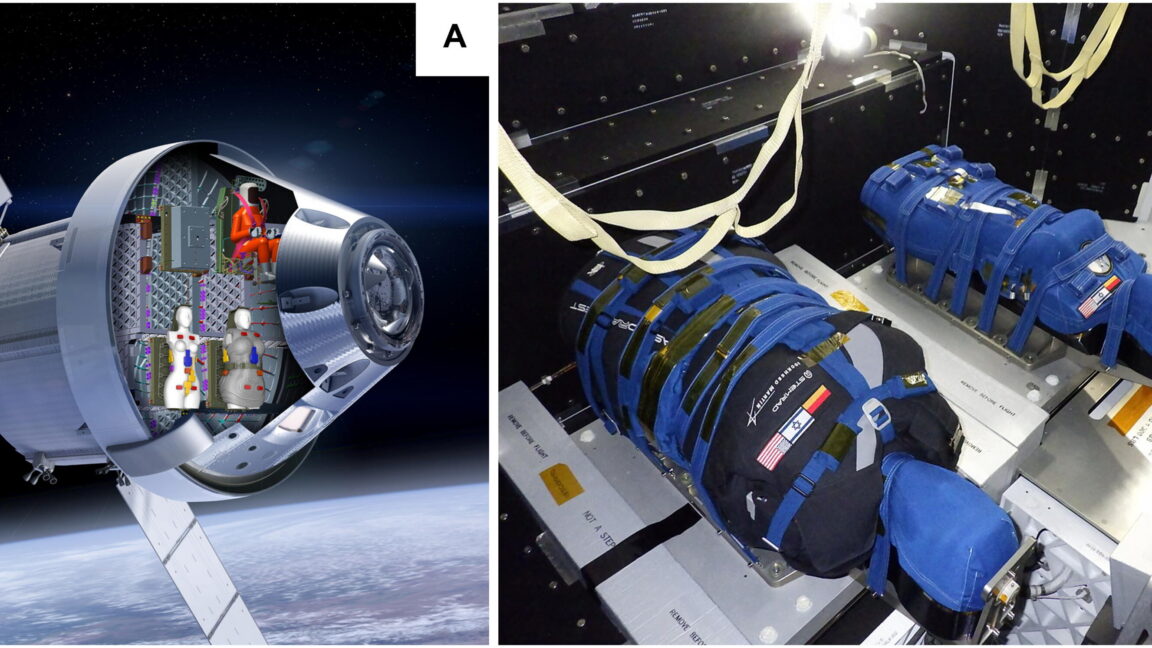
Of course, calculations, even highly precise ones, are not enough. To get hard data, StemRad sent its AstroRad vest on a round trip around the Moon.
With that confidence established, they swapped the belt’s radiation spectrum for the spectra of two historical solar storms, from August 1972 and October 1989, and let the simulated phantoms tumble freely rather than sit fixed facing forward, since a real astronaut wouldn’t stay seated for an entire event. The vest cut the effective radiation dose by around 60 percent for the 1972-style event but only about 40 percent for the 1989-like storm.
The problem is, the AstroRad vest is unlikely to be iterated in a way that could offer more protection in the future, and the protection we think it offers as it is today rests mainly on computer models.
The uncertainties baked into the computer models StemRad’s team used to simulate the vest’s performance against solar storms include a simplified two-material stand-in for Orion’s hull and a simplified Van Allen belt spectrum, which used a statistical prediction rather than a direct recording of the radiation.
Getting real, not simulated, data on the vest’s performance would mean sending it onboard an Orion spacecraft all the way to deep space and waiting for a solar storm to happen, which is hardly feasible.
But an even bigger constraint for this design, the team says, is dealing with its weight. As flown on the Artemis I, the vest weighed in at 26 kilograms, which is roughly as much as a full suit of medieval plate armor. “It will be hard [to improve protection] without adding more mass,” Milstein says. So the team wants to go in the opposite direction.
Rather than chase more protection, StemRad’s engineers’ near-term focus is preserving what the vest already does, while cutting its weight. Using the Artemis I data, they already managed to cut its weight from 26 kilograms to 16. “That reduction came without losing a large part of the protection,” Milstein claims. The goal, he says, is a lighter vest astronauts could wear not just for a storm’s peak, but for days around it.
The study on AstroRad’s test during the Artemis I mission is published in Science Advances: http://dx.doi.org/10.1126/sciadv.adz1892.