
Development
Defcon's new badge is a security key you can see inside
August 1, 2026 Development Source: Ars Technica
Share this article



Computer chips are traditionally black-box components with an opaque casing that obscures their circuitry. Even previous open source chips that made their specs and code available for users to examine were encased in impermeable plastic, creating a supply-chain problem. Users had to trust that nothing changed during the manufacturing stage of the chip, such as a backdoor component being added to it.
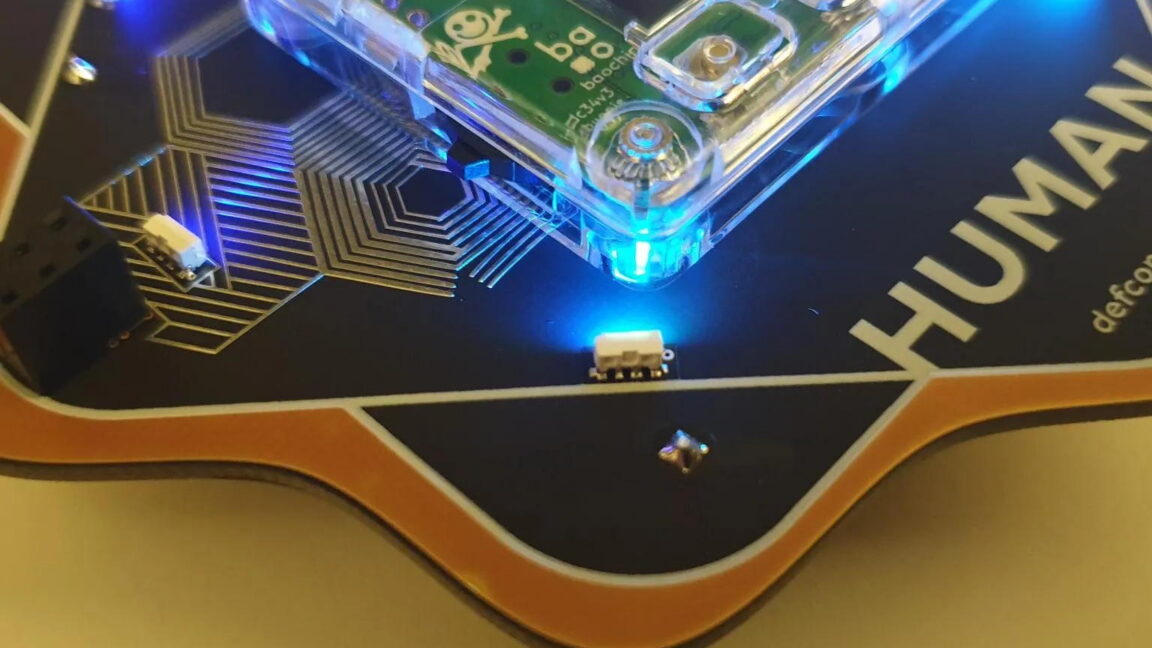
Unlike conventional chips encased in opaque plastic, the Baochip is packaged so that infrared light can be shone through the back of the silicon, allowing the chip’s internal structures to be visually inspected.
The result is a Crossbar chip that includes both Crossbar’s microprocessor and Huang’s. The Baochip is essentially the same chip but with the Crossbar microprocessor disabled, since Huang doesn’t have the rights to distribute it.
The Crossbar version of the chip uses a proprietary ARM core, whereas Huang’s version uses a RISC-V core whose implementation is open source. The RISC-V instruction set is also open and publicly documented. The two versions can use the same underlying infrastructure and peripherals while activating different CPU cores.
There are some closed-source elements on Huang’s chip. Some low-level physical-design and manufacturing elements, including those associated with TSMC’s 22-nanometer fabrication process, are proprietary. “But … if you look on the spectrum of how open you can get things, this is … very, very far beyond any [other] security-oriented chip,” Huang says.
Past Defcon badges have used commercial off-the-shelf chips rather than custom-designed open source silicon. The idea for using the Baochip was sparked by a meeting late last year when Huang spoke with Defcon founder Jeff Moss about his progress in developing his open source chip. He told Moss that he planned to release it this summer through his company, Baochip.
Moss realized the concept behind it matched perfectly with the conference theme this year—agency—which Defcon defines as the technologies we use and the choices we make that increase self-determination. And he and Huang realized it would be a great opportunity to help bootstrap the chip’s adoption. Until now, the Baochip has been distributed only in a small development release; the 27,000 Defcon badges represent its first major distribution.
Moss had one requirement for the badges. He wanted them to have a life beyond the conference and not be something that people would just throw in a drawer or a landfill after the event. He’s long been frustrated with the design and limitations of hardware security tokens and crypto wallets that, at the hardware level, can be cracked, so he thought Huang’s chip could be a more secure alternative to existing authentication tokens and wallets.
The chip also uses resistive RAM, or RRAM, a type of nonvolatile memory that Huang says is designed to make physical extraction of stored data more difficult than conventional flash memory. With flash memory, he says, “if you de-layer it down to the actual flash cells … you can just see the ones and zeros literally on these chips.”
Huang is cautious, however, about overhyping the chip’s security capabilities. He estimates that it could withstand attacks involving tens of thousands of dollars in resources, but says an adversary with millions of dollars and a sophisticated hardware-analysis lab could likely defeat it.
“I actually think it’s one of the most secure chips you can get out there, but I [also] think most chips have been oversold in terms of security,” he says.
Huang says he likes the fact that the chip will be stress-tested by Defcon attendees and knows they will likely hack them and expose flaws that will help him make them even more secure.
“I fully expect there will be zero-days [that people find in the code]. It’s actually … one of the features … of launching at Defcon,” he says of designing an open source chip capable of being examined.
Today the chip can function as a YubiKey-like security token; but in the future, he says, it could become an HSM or run other software such as Linux. The hardware uses a 350 MHz RISC-V processor with 2 megabytes of SRAM and 4 megabytes of RRAM, which he says puts it “on the edge of being able to run Linux,” and it has 4x 700MHz PicoRV32 cores for doing input-output. It already runs MicroPython and has C and Rust development kits.
Huang plans to expand the chip’s features himself, but he also expects DefCon participants to build on what he’s provided and make the chips their own.
This story originally appeared on wired.com.