
Development
Google Earth risked ruin with retracted AI tool for making fake satellite pics
August 1, 2026 Development Source: Ars Technica
Share this article



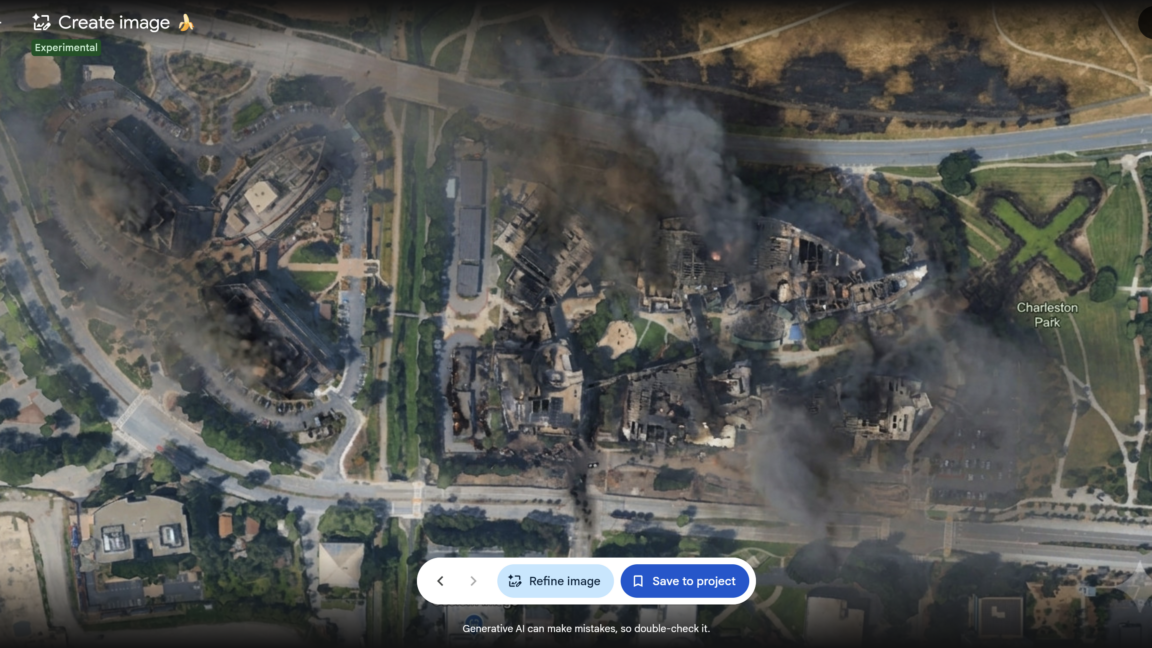
Before removing the AI feature, Google had touted its potential to allow Google Earth users to depict completed real estate projects or enable teachers and students to transform the modern-day ruins of Pompeii into a “hyper-realistic view” of what the town looked like in 78 CE under the Roman Empire. But independent researchers immediately gravitated toward the potential for misuse.
“Tonight I typed just one sentence into Google Earth and put refugees near the Mexican border,” wrote Henk van Ess, an independent investigator, in an extensive blog post detailing his concerns on July 30. “Then I planted a nuclear plant in Iran. Then I put a fatal crash on a street in Amsterdam. Google’s own satellite imagery underneath all three. What on earth is Google doing?”
Ess pointed to a previous example of AI-generated misinformation gone viral that used a Google Earth satellite photo of the US Navy’s Fifth Fleet headquarters in Manama, Bahrain. A forger had prompted Google’s Gemini AI assistant to transform a screenshot of that Google Earth image into a false image depicting the aftermath of an Iranian drone strike on the US military base.
The same process that might have taken about six steps could be done “in seconds” with the AI tool built into Google Earth, Ess said.
Before eventually removing the Google Earth feature, Google initially responded to Ess by highlighting its SynthID system that automatically embeds digital watermarks in images generated by Google’s AI tools.
“We take misinformation seriously—every image created with Nano Banana in Google Earth includes the SynthID digital watermark, so if someone is unsure about an image, they can ask the Gemini app or use Lens in Search to see if the image was AI-generated,” according to Google’s post on X on July 30. “In addition, we prevent image creation on harmful topics and are continually updating our protections.”
Previous Ars testing of Google’s SynthID system has shown that Google’s digital watermark can persist despite substantial image edits and data loss. However, Ars also encountered the issue of SynthID limiting image checks to about 10 per day.
When Ars prompted Google’s Gemini app to run a SynthID check on several AI-modified images generated within Google Earth—before Google removed the Google Earth feature—Gemini responded that it had “detected digital watermarking indicating that part or all of this image was generated or edited using Google AI tools.”
But Ess questioned why Google’s policy on preventing the creation of AI-generated images on harmful topics had not stopped him from depicting scenes such as a hospital with a bomb crater in Gaza. He also expressed skepticism about primarily relying on Google’s SynthID watermarking system and Google’s AI tools for verifying whether an image is AI-generated.
“Fakes do not travel as clean files with their credentials intact,” Ess wrote. “They travel as screen recordings, re-encodes, screenshots of screenshots, filmed off somebody’s phone in a hurry.”
Indeed, Google’s SynthID was unable to provide any image verification when Ars used a smartphone camera to take a photo of an AI-altered image made using the Google Earth feature.