
Development
Space Force-backed mission does its best impression of Top Gun in orbit
July 30, 2026 Development Source: Ars Technica
Share this article



The launch set up Puma for a series of burns to move in close to True Anomaly’s satellite. The Space Force’s criteria for success was to complete the rendezvous and photograph the target satellite in less than 84 hours. Rocket Lab reported it did the job in less than 59 hours, culminating in a head-to-head inspection and survey, with each satellite snapping pictures of the other.
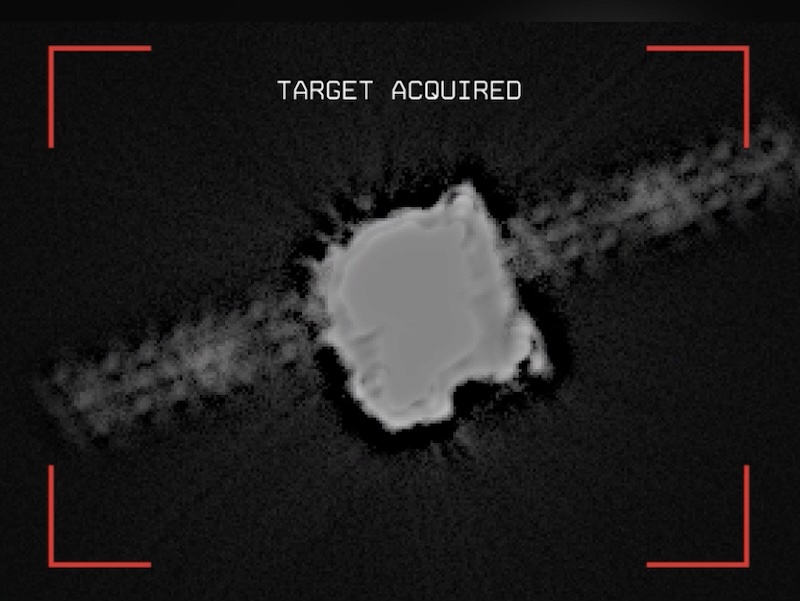
One of the images, released by Rocket Lab, shows its satellite’s view of True Anomaly’s Jackal.
“You can see that we are actively tracking them,” Rogers told Ars. “Our solar arrays are deflected, tracking the sun, and we are staring right down their boresight, which is just a really cool demonstration of our capability. We were tracking them while they were tracking us, and maintaining power-positive status.”
It’s easy to see the military utility for this type of capability. Imagine a mysterious military satellite launched by Russia or another space power. It suddenly starts approaching a multibillion-dollar US spy satellite with unknown intentions. To some degree, this is already happening in the real world. If US forces had a satellite on the shelf, they could quickly launch it directly into the same orbit as the adversary’s satellite to take a closer look, and perhaps in the future, take action.
“Jackal’s crew produced a validated mission plan in under 30 minutes from tasking,” True Anomaly said in a statement. “Jackal executed ingress and a burn sequence over 23 minutes to close on Puma. When Puma maneuvered away during the approach, Jackal downlinked what it saw, and our team replanned, revalidated, and implemented a new mission plan in rapid succession.”
As Rocket Lab’s Puma backed away, True Anomaly’s Jackal executed more burns to reengage and image its prey. Military and company officials haven’t released any photos from the most recent Victus Haze demo, and they declined to disclose exactly how close the satellites came to one another.
“Due to operational security, further details involving sensor suites for characterization, phenomenology, payloads, distances, or docking will not be shared,” a spokesperson for Space Systems Command said in response to questions from Ars.
There’s more to come on Victus Haze. The two satellites are designed to swap positions as aggressor and target throughout a series of demonstrations playing out over the next few months.
“Victus Haze was envisioned to remove the simulation and to learn in the orbital environment against a thinking adversary,” Rogers said. “We’ll keep executing and learning.”
From Rocket Lab’s perspective, Victus Haze came with an unexpected twist. The company’s engineers knew they were going to launch in pursuit of a True Anomaly satellite. That was announced in 2024 when the Space Force awarded contracts for the Victus Haze mission. But Rocket Lab didn’t know which one. True Anomaly was supposed to launch its Jackal satellite for Victus Haze on a Firefly Aerospace Alpha rocket. Instead, it launched on a rideshare mission aboard a SpaceX Falcon 9 rocket in May. At the time, nobody outside of True Anomaly or the Space Force knew this was the spacecraft for Victus Haze.
“The idea was it was supposed to be a surprise to exercise the team, and no, we didn’t know what thing we were going to go be chasing,” Rocket Lab’s Rogers said. “That was all meant to be part of this little war game.”
Most of Rocket Lab’s launches carry commercial satellites, and although the rapid call-up of Victus Haze is a uniquely military requirement, the exercise helped fine-tune the company’s procedures to improve performance on all future missions.
“The 24 hour call-up and RPO mission was very much a national security application,” Rogers said. “We have seen what I would call a responsive space mission for the commercial market. We have had some commercial customers who either lost their other ride to space, they were on a rideshare and got bumped or something, or it is a business-critical need to get on orbit. And we get a phone call very late, and they say, ‘We’ve got to get on orbit to make our business work. What can you do for me, Rocket Lab?’
“There are just not many companies in the world—in fact, probably only two at most—that you can call and can make that happen,” Rogers said. “We’ve actually done that three or four times in the past year. We’re likely to have another one this year. It’s not going to be quite the 24-hour call-up for launch. That’s not the level of intensity, but it is three months away from launch. Sign a contract, submit the regulatory requirements, and get somebody on orbit.”