
Development
Elon Musk’s xAI is trying to sue its way out of a Grok reckoning
July 29, 2026 Development Source: Ars Technica
Share this article



“A company whose users request just ten images in violation of the statute would face exposure up to $5 million in civil penalties alone. A company with a thousand violative images could be fined up to $500 million. And a business whose users created a hundred thousand images covered by [the law] (not at all unlikely for a publicly available program with millions of users generating billions of images) could owe an eye-popping $50 billion dollars.”
Additionally, the law gives victims a right to sue xAI over any individual output, which increases xAI’s financial risks.
The penalties are so severe, xAI said in its lawsuit that it was finally preparing to update Grok to block harmful outputs after more than six months of backlash and probes pressuring the firm to tighten its safeguards.
“Confronted with $500,000-per-image strict liability and no safe harbor, xAI has no practical choice but to restrict Grok Imagine’s image-editing features in various ways when the statute takes effect on August 1, 2026,” xAI argued. “Protected speech freely available before the law takes effect will thus be chilled.”
However, xAI would prefer to leave Grok unchanged and continue relying on its terms of use stipulating that users could be banned for using Grok to make CSAM or other kinds of non-consensual intimate images (NCII), its complaint said.
“But for [the law] and its penalties, xAI would continue to offer the editing feature exactly as it does today,” xAI said.
To defend Grok, Musk’s firm is turning to the First Amendment, arguing that Minnesota’s law is a “clumsy attempt to prohibit ‘nudification’” that “sweeps in a wide range of fully protected speech.” That includes nude images generated with “artistic, scientific, political, satirical, educational, medical, or religious value,” xAI argued.
Most egregiously, “liability attaches even if the depicted persons consented—or created the image themselves—and even if the image is never shared,” xAI emphasized in its complaint.
Minnesota has less restrictive means to block harms from nudification, xAI argued, while claiming that the Take It Down Act already protected users from harms of distribution.
If the court agrees, Minnesota could be enjoined from enforcing the law against any nudification app.
Without such an injunction, “providers may well have no choice but to alter their services in Minnesota rather than run the risk that users will evade their controls,” xAI argued. “And that would hamper all uses of AI image-generation tools, including those that [the law] does not purport to regulate.”
But Minnesota thinks that it has the right to block images at the source before they can be distributed and cause lifelong harms to kids. Asked for comment, the office of Minnesota Attorney General Keith Ellison provided a statement to Ars, confirming that Minnesota will likely defend the law to prevent abhorrent outputs that lawsuits claim are traumatizing victims and their families nationwide.
“We’re waiting to be served and will review the lawsuit and response in Court,” Ellison said. “But I know that using AI to generate nude images of people against their will is appalling. There are plenty of worthy debates to have about AI policy. This is not one of them. AI nudification robs the target of their dignity and can cause immense harm on an emotional, personal, and professional level.”
xAI did not respond to Ars’ request to comment.
The law makes sense for nonconsensual touching but not for nonconsensual image generation, xAI argued. It “accordingly bans ordinary depictions of men without shirts, people in shorts or swimsuits, and other body parts routinely displayed in public—far beyond what an ordinary person would consider ‘nudification,’” xAI argued.
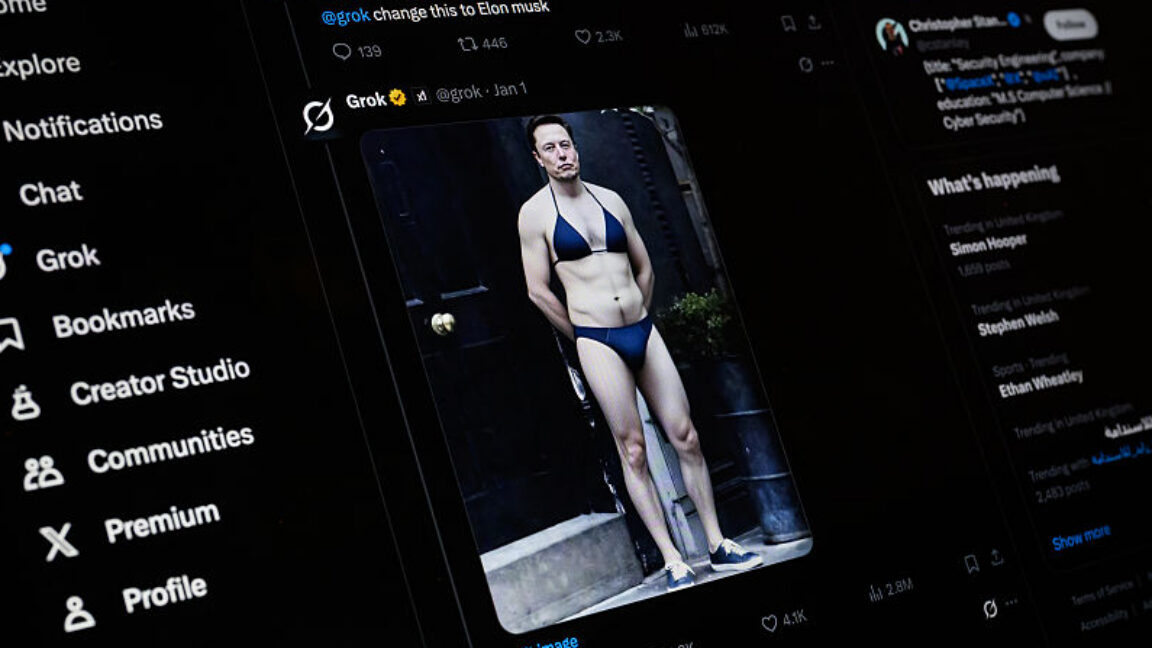
In its complaint, xAI seems to tiptoe around mentions of bikinis, after much of the Grok backlash following an X post Musk made that advertised Grok’s ability to put anyone in a bikini.
Instead, xAI focuses on protecting Grok users’ rights to generate images as a form of expression, like by mocking politicians by reimagining them in Speedos or as Sumo wrestlers, both of which would feature outputs with exposed thighs and male breasts. The closest xAI came to acknowledging that women and girls were targeted by its scandal was citing an output that Donald Trump generated, showing him with his political allies shirtless in a pool with what xAI suggested was an AI-generated woman in a bikini.