
Development
Who wins and who loses after US bans foreign robots?
July 30, 2026 Development Source: Ars Technica
Share this article



But the ban also broadly applies to foreign-made robots produced by countries nominally allied to the United States, including Japan, South Korea, and Germany.
There are a number of exemptions. For example, the new ban defines covered robots as being any mobile device—potentially in combination with a docking station—weighing more than 4.4 pounds. That would permit US consumers to continue buying small robots, such as robotic toys, although most robot vacuums weigh more.
The FCC ban also only covers new models of foreign-made robots. That means US consumers and businesses can continue purchasing existing robot models previously authorized by the FCC and continue to use previously purchased robots, but are blocked from purchasing newer, unauthorized models that come out from this point onward.
The agency made clear that its foreign-made robot ban does not apply to trains, drones, underwater vehicles, and “connected vehicles” that drive on roads, such as robotaxis. The FCC already enacted an import ban on foreign-made drone models in December 2025.
Similarly, it does not cover anything classified as devices by the Food and Drug Administration, including medical or surgical robots, external limb prostheses, and mobility assistive devices, such as wheelchairs.
The FCC ban also specifically exempts fixed or stationary robots. That means US businesses can continue purchasing and using foreign-made industrial robot arms and other specialized, non-mobile robots.
Notably, the US Department of Defense can determine that a foreign-made robot or class of such robots does not pose security risks—thereby exempting such robots from the FCC’s Covered List. The Department of Defense has been rebranded the Department of War under the Trump administration and is referenced as such in the FCC documents.
Boston Dynamics has already been making its Atlas humanoid robot, along with its four-legged Spot robot and wheeled Stretch robot, at its main facility in Waltham, Massachusetts. The US robotics company is also planning to massively scale up manufacturing of the Atlas robot under South Korea’s Hyundai Motor Company, which gained full ownership of Boston Dynamics in July 2026.
“This is one of the strongest technology-security actions in modern US history,” wrote Evan Beard, CEO of Standard Bots, in a LinkedIn post. “The message is unambiguous: robotics is a technology America must lead and own—and foreign-subsidized robots will not be allowed to unfairly dominate US robotics as they did solar.”
Similar praise came from Rush Doshi, director of the Initiative on China Strategy at the Council on Foreign Relations, who, in a social media post, described the FCC decision as “one of the most significant actions taken so far in support of the US robotics ecosystem.”
However, several robotics researchers and analysts interviewed by The Robot Report expressed skepticism about any potential boost to US competitiveness in robotics. Some even warned that the ban could prove counterproductive for US robotics efforts to develop humanoid robots.
“In the near term, the measure could slow US physical AI innovation by cutting startups and researchers off from future low-cost Chinese platforms before comparable Western alternatives exist,” said Georg Stieler, a global robotics advisor and managing director for Asia at Stieler Technology & Market Advisory, in an interview with The Robot Report.
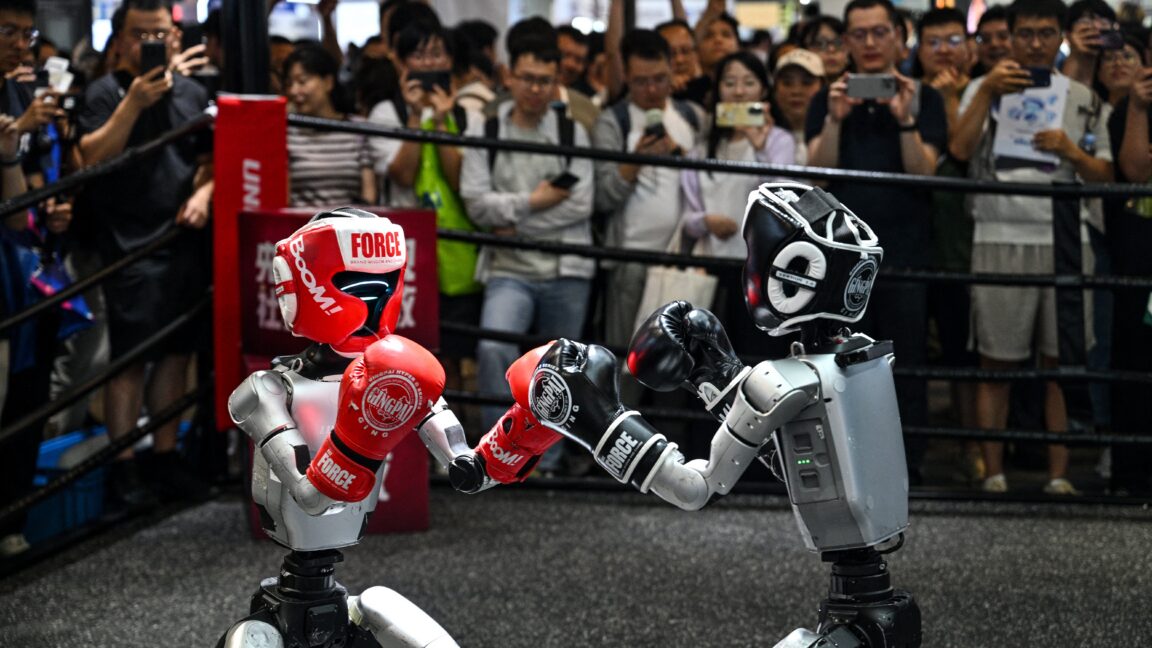
US domestic production of robots lags behind China in terms of mass manufacturing at lower cost, said Rueben Scriven, a senior analyst at Interact Analysis. “This announcement is more likely to inhibit the US humanoid robotics industry, as the presence of low-cost Chinese humanoid robots has been helping educate the US market through promotional and entertainment use cases—an effect this policy risks undermining,” Scriven told The Robot Report.
The outcome of previous FCC bans is also not necessarily encouraging. US government restrictions on drones made by Chinese companies such as DJI have failed to create a “competitive mass-market consumer-drone producer” based in the United States, Stieler pointed out. The Verge has also reported that newly created companies have popped up to sidestep the US ban on foreign drones by selling “barely disguised versions of DJI technology.”