
Development
This is the world's most advanced robotic servicing satellite—that we know about
July 24, 2026 Development Source: Ars Technica
Share this article



Northrop Grumman and its subsidiary, SpaceLogistics, have the same idea with the Mission Robotic Vehicle. There are clear military applications for this capability. Last year, the head of US Space Command, Gen. Stephen Whiting, told Congress that China was developing “on-orbit, maneuverable counterspace satellites to target our satellites using dual-use technologies.” He explicitly called out SJ-21 as an example of a mission that China could use “for potential offensive purposes against satellites we rely on to defend the homeland and project power.”
The US Space Force already has a fleet of inspector satellites roaming geosynchronous orbit to observe and report on the activities of foreign spacecraft. US military operators maneuvered one of these inspector satellites near the SJ-21 and SJ-25 satellites during the refueling operation last year.
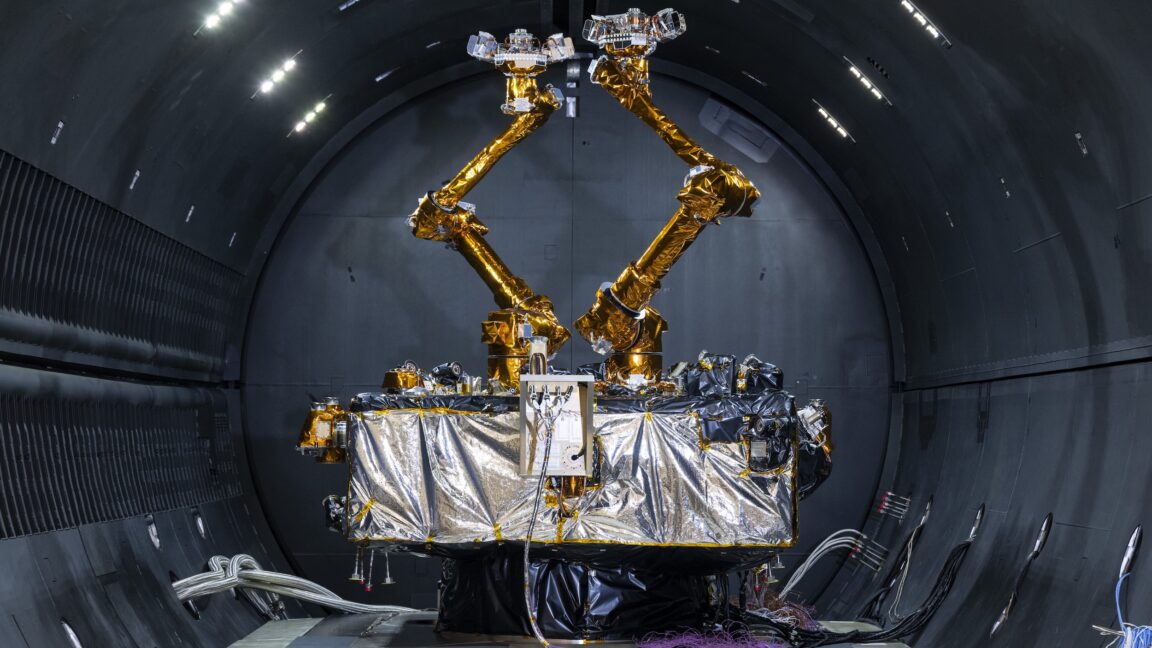
But military officials hadn’t publicly acknowledged any US-owned satellite with capabilities similar to China’s trio of Shijian satellites. That changes with Northrop Grumman’s MRV mission. The Pentagon’s Defense Advanced Research Projects Agency (DARPA) spent approximately $420 million to develop the satellite’s robotics payload, alongside hundreds of millions of dollars invested by Northrop Grumman.
The public-private partnership brought Northrop Grumman’s preexisting commercial satellite servicing program together with DARPA’s Robotic Servicing of Geosynchronous Satellites (RSGS) program. These programs originally operated independently.
DARPA partnered with the Naval Research Laboratory to develop the RSGS robotics payload. More than 20 years in the making, the robotics system was designed to meet Defense Department reliability standards, including redundant robotic arms, avionics, and mission troops. The RSGS payload also features cameras and sensors to allow the MRV to autonomously approach, inspect, capture, and upgrade client satellites that weren’t designed for visitors.
Northrop Grumman and SpaceLogistics have not identified which satellite will be the first stop for the MRV. The companies have commercial agreements with two communications satellite operators, SES and Optus, to add jetpacks to their spacecraft using the MRV. The Space Force is also expected to use the MRV to visit at least one of its satellites.
Another idea is to use the MRV to enable a new era in orbital logistics, not just servicing and life extension. The spacecraft could theoretically be part of a logistics train in geosynchronous orbit. A depot spacecraft, such as Northrop’s own ROOSTER satellite platform or Blue Origin’s Blue Ring, could launch with a cache of prepositioned spare parts, payloads, and sensors. The MRV could come pick up these payloads and take them to the satellites that need them.
The most lucrative national security market for satellite servicing is, at first, likely to be in geosynchronous orbit, home to some of the military’s most expensive multibillion-dollar satellites. The spacecraft there are one-of-a-kind or operate in small fleets. Despite the distance from Earth, this makes geosynchronous satellites vulnerable to attack. Satellites in low-Earth orbit, just a few hundred miles above the planet, are often (but not always) part of large proliferated constellations such as SpaceX’s Starlink. With a few exceptions, military and commercial satellites in LEO are less expensive and easier to replace than satellites in GEO.
But there’s a future for refueling and servicing in LEO. NASA signed a contract last year with Katalyst Space Technologies, a satellite manufacturing startup, to reboost one of its astronomy satellites in LEO. Katalyst launched the mission last month, and the spacecraft is now in pursuit of its client.
SpaceX is planning the most ambitious refueling demonstration in history with its Starship rocket. SpaceX aims to transfer cryogenic propellants between Starships in LEO, perhaps late this year or next year, in a precursor experiment for future large-scale refueling sorties to support Moon landings for NASA’s Artemis program.
These companies and more are taking distinct paths toward satellite servicing, orbital refueling, in-space depots, and what the military likes to call dynamic space operations. But the trend is unmistakable: to fully utilize the domain of space, the throwaway mentality must go.