
Development
Robot snakes searched for Venezuela earthquake survivors in collapsed buildings
July 24, 2026 Development Source: Ars Technica
Share this article



That first snake robot deployment caught the attention of Beatriz Gonzalez, a native Venezuelan living in Atlanta, when she asked the AI chatbot Grok for ways to help search and rescue operations in Venezuela following the earthquakes, according to The Tribune-Review. Grok referred her to a Carnegie Mellon University article about the 2017 operation in Mexico City.
Gonzalez called Choset’s lab. The robotics researchers were eager to help and eventually confirmed they would go while onstage preparing to demonstrate their robots during a concert celebrating America’s 250th anniversary at Pittsburgh’s Point State Park on June 27. “We were on between Third Eye Blind and Nelly the rapper,” Choset said.
That decision led to frenzied overnight packing and work to prepare the robots for the work that lay ahead. The researchers had to replace head-mounted cameras on several robots to ensure they were working properly, and they packed extra batteries for the control case that also serves as the robot’s power supply. Within 24 hours, they were flying to Miami with three snake robots in tow on their way to Venezuela.
The stopover in Miami on June 28 took slightly longer than expected because the team scrambled to find a private jet owner willing to take them to Venezuela. A few jet owners backed out because of restrictions imposed by the Venezuelan government. But Gonzalez assisted the team by using her connections, and they eventually got a flight.
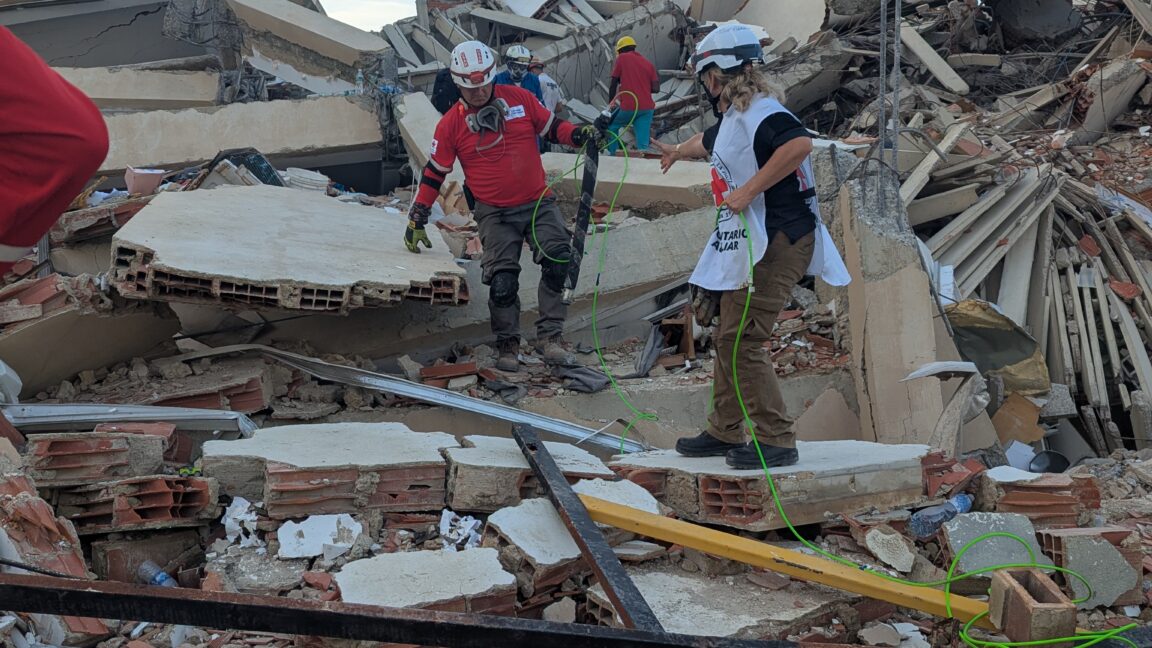
In one case, a Jordanian rescue team with a dog had concluded that a collapsed apartment building had no survivors, whereas a Colombian team’s infrared cameras seemed to indicate the possible presence of a survivor. The Carnegie Mellon team deployed a snakebot into a small hole, while a Venezuelan father hovered nearby to see if the team could find his little boy beneath the rubble.
The snake robot went in about 15 to 20 feet without finding anybody. But the man whose son was missing still expressed his thanks to the robotics researchers for trying. “The people in Venezuela were beyond gracious,” Choset told Ars.
Choset also recalled local Venezuelans continually supplying the team with hot meals, along with handing them sports drinks and even a pound cake while they were assisting with search efforts.
“They were very caring, and they’re showing this kind of love, this kind of affection for us while they’re suffering a burden that no human should ever have to suffer,” Choset said.
The snakebot team eventually had to return to the United States without finding a survivor. But nearly 6,500 people were rescued with the help of search and rescue teams from all over the world.
By coincidence, Choset ended up having a lengthy conversation with a woman whose husband, a security guard, was buried for eight days in the collapsed basement of a shopping center. He described himself as overjoyed when he later learned that the woman’s husband had been pulled out alive.
“She had two kids, and the age difference was the same as my two boys, so it hit home for me there,” Choset told Ars.
The Carnegie Mellon researchers have several ideas for how to improve the snake robot for possible future deployments. One of their priorities is to attach light-based sensors that can help perform 3D point cloud mapping of a snakebot’s environment—giving the robot operator and search and rescue teams a better sense of how to steer the robot beneath collapsed buildings.