
Development
I wanted a clock that never needed setting. Things escalated.
July 23, 2026 Development Source: Ars Technica
Share this article



The RPi image loader got me going, and I was able to log into my Pi Zero. After thinking about things for a bit, I distilled my software requirements down to a list:
Many of these items were easy and well within my typical ops wheelhouse. I fell back on good ol’ systemd timers and services for a big chunk of things—I’m actually coming to quite like systemd, God help me. The LAN NTP and apt-mirror sources already existed (I know, I know, I should be using apt-cacher-ng instead). The deployment pipeline would use Gitea actions and would be more or less exactly like one I’d already set up for another project, so I cribbed from Past Lee there. HomeKit integration looked like it was going to basically be a bolt-on thanks to HAP-python.
But I started to worry when I looked up examples of how to communicate with the clock display via I2C. My much-atrophied Python muscles were already straining and would absolutely not be able to meet this challenge. This was the point where the project stopped feeling fun and started feeling impossibly hard.
So I shoved the coding tasks off onto an LLM.
Seeking an LLM’s help when one can’t really verify the outputs can be fraught, but fortunately, I recall just enough Python to follow-flail my way through the results, with the help of the inline comments. Claude Code proved more than capable enough to tackle this project—first with Opus 4.8 and then later with the new fancy Fable model, whose world-ending powers I harnessed and used on what is probably in truth an intern-level coding project.
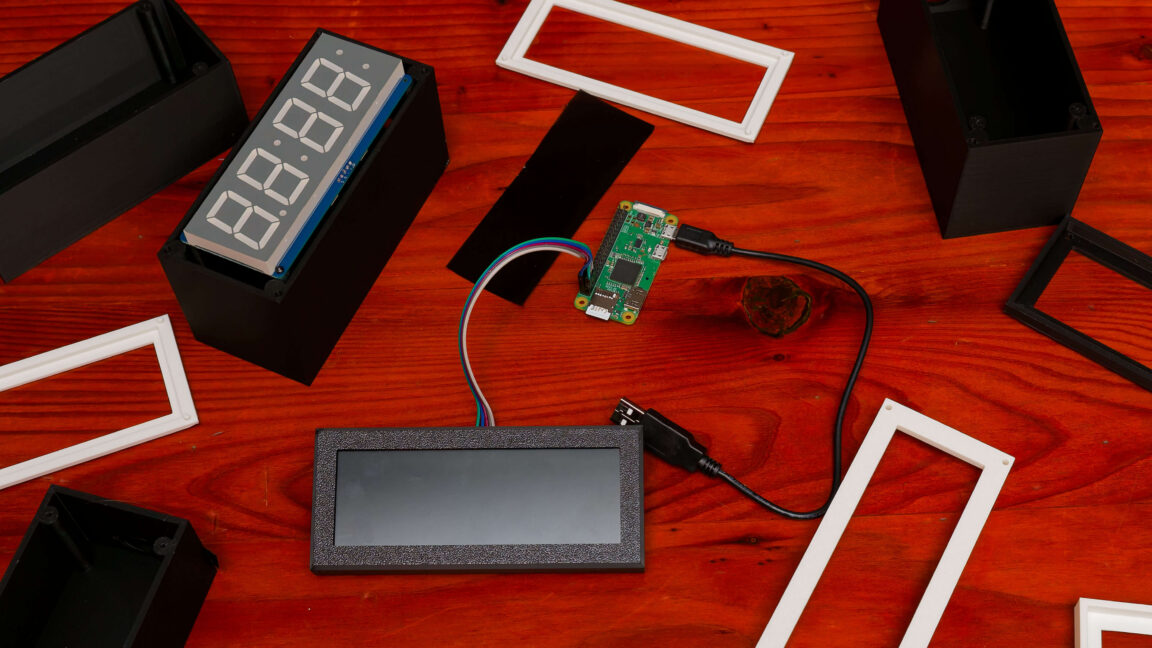
On the physical side, I did indeed find a Creative Commons-licensed 3D-printable enclosure designed around the same Adafruit display I was using, but it wasn’t quite right.
Modifying the model meant doing battle with the absurdly user-hostile nightmare that is Autodesk Fusion, so I girded my loins and dove in—and hit another wall. Parametric modeling, especially when weighted down with decades of AutoCAD’s stupid UI/UX choices, was even harder than programming.
Here’s the finished device, first in pieces and then all assembled: