
World
Trump buys time for Iran deal after frantic day of diplomacy
April 22, 2026 International Source: BBC World
Share this article



The US president's decision marked the second time in as many weeks he has backed off a threat to escalate the war, buying more time.
Trump buys time for Iran deal after frantic day of diplomacy
Copyright current_year BBC. All rights reserved. The BBC is not responsible for the content of external sites. Read about our approach to external linking.
Copyright current_year BBC. All rights reserved. The BBC is not responsible for the content of external sites.
Read about our approach to external linking.
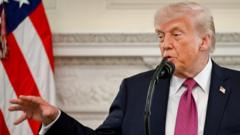
Donald Trump stands in the White House dining room with a white wall with carvings behind him and part of an American flag. He is seen from the waist up speaking, turned to his right and his gesturing. He is wearing a blue blazer and a white shirt and pink patterned tie.
Tuesday began as a frantic day of diplomacy in Washington, with Air Force Two ready to fly Vice President JD Vance to Islamabad for another round of peace talks between the US and Iran.
Several hours later, Air Force Two hadn't taken off and the negotiations were postponed. President Donald Trump announced that he would extend the ceasefire with Iran, set to expire on Wednesday evening, to allow the regime more time to create a "unified proposal" to end the war.
In between, Trump weighed his options as the world waited to see if the countries were any closer to ending the war. Trump's decision marked the second time in as many weeks that he has backed off a threat to escalate the war, buying himself more time to wind down a conflict as it approaches the two-month mark.
Vance never officially announced the Islamabad trip, leaving Washington guessing. And Iran never officially committed to attending the talks, leaving the White House in the difficult position of deciding whether or not to send Vance with no assurance that Tehran would even come to the table.
As the day wore on, signs of a postponement emerged. Special envoy Steve Witkoff and Trump's son-in-law Jared Kushner, senior members of the US negotiating team led by Vance, flew to Washington from Miami instead of heading straight to Islamabad. Soon after, Vance made his way to the White House for "policy meetings" as the president and his senior advisers debated what to do next.
In the end, Trump announced the ceasefire extension on Truth Social, his preferred means for war updates since it began in late February. The president said he made the decision at the request of Pakistan, which has mediated talks between Tehran and Washington.
"We have been asked to hold our Attack on the Country of Iran until such time as their leaders and representatives can come up with a unified proposal," Trump said.
Notably, Trump this time did not specify how long the ceasefire might last. Earlier this month, he set a two-week deadline for the first ceasefire. That came after conflicting comments in press interviews, during which he said the talks were going well but also warned that he would consider resuming the war if Iran refused to negotiate.
"There is no clear formula" for ending wars, James Jeffrey, a former US ambassador to Iraq and Turkey, told the BBC.
Trump isn't the first US president to "threaten significant military escalation," Jeffrey added, "while also putting a good deal on the table."
A digital screen displays "Welcome to Islamabad" as Pakistan prepared to host the US and Iran for the second phase of peace talks in Islamabad, which were delayed on Tuesday.
A broad sky photo with a highway below centers on an orange and blue billboard that says "Welcome to Islamabad".
Trump's open-ended statement on Tuesday was more measured than his past social media attacks on Iran. That may signal Trump's desire to end a war that has roiled the global economy and is unpopular with anti-interventionist supporters in Trump's Maga base.
"This is a pragmatic decision based on what are quite obvious fractures in the current leadership of the Iranian government," said Brian Katulis, a senior fellow at the Middle East Institute.
But Katulis said Trump's decision also created more uncertainty about how long the war will last.
"This move begs the question though for Trump about how he can deal with the economic pain that Americans are experiencing and the political pain he's experiencing from his base," Katulis said. "He hasn't answered the questions that are still driving this crisis."
With the ceasefire extension, the US and Iran now have more time to make a durable peace deal. But major questions remain.
Iran has said that the US blockade of the Strait of Hormuz is an act of war. While Trump chose not to restart the war immediately, he gave no indication he would end the blockade, which the US hoped would pressure Tehran to back down. So far that hasn't happened, leaving Trump with fewer options other than ramping up the military campaign.
Iran, meanwhile, has not signaled interest in ending its nuclear program or support for proxy groups in the Middle East -- two so-called "red lines" that Trump has demanded be included in any final peace deal.
Trump bought himself more time. But a quick resolution to the war, for now, seems as elusive as ever.
US President Donald Trump stands outside the Oval Office
Trump says US will not lift Hormuz blockade until deal made with Iran
Petrol drips out of a fuel hose at a petrol station in Saint-Etienne-de-Montluc, western France, on 15 April, 2026.
Oil prices rise after Trump says Iranian ship seized
A vessel is seen in water off the side of another ship
US intercepts and seizes Iranian-flagged cargo ship, Trump says
A composite image of Nick Marsh and a climbing green graph
Are insider traders making millions from the Iran war?
A composite image of Nick Marsh and a graphic of a rising cost bar
A thin, grey banner promoting the US Politics Unspun newsletter. On the right, there is an image of North America correspondent Anthony Zurcher, wearing a blue suit and shirt and grey tie. Behind him is a visualisation of the Capitol Building on vertical red, grey and blue stripes. The banner reads: "The newsletter that cuts through the noise.”
Follow the twists and turns of Trump's second term with North America correspondent Anthony Zurcher's weekly US Politics Unspun newsletter. Readers in the UK can sign up here. Those outside the UK can sign up here.
Follow the twists and turns of Trump's second term with North America correspondent Anthony Zurcher's weekly
The BBC has been able to obtain testimony from parents and those trying to help children deal with the distress that comes with war.
As the United States and Israel wage war with Iran, India is beginning to feel the tremors at home.
What we know so far about the US-Israeli strikes against Iran and what might come next.
Billionaire investor Justin Sun is suing the family's World Liberty crypto venture after spending $45m on its tokens.
Despite Donald Trump’s announcement of an extension of the US-Iran ceasefire, several vessels have been attacked in the Strait of Hormuz.
It follows questions from a military strategist and a scrutiny panel over the island's preparedness.
The mood in the Strait of Hormuz remains combustible despite Trump's ceasefire extension.
The airline is the latest to cut flights as the US-Israel war with Iran sends jet fuel prices soaring.