
Development
F1 in Belgium: Machine learning algorithms are ruining the sport
July 20, 2026 Development Source: Ars Technica
Share this article



Sections Forum Subscribe Search AI Biz & IT Cars Culture Gaming Health Policy Science Security Space Tech Feature Reviews AI Biz & IT Cars Culture Gaming Health Policy Science Security Space Tech Forum Subscribe Story text Size Small Standard Large Width * Standard Wide Links Standard Orange * Subscribers only Learn more Pin to story Theme HyperLight Day & Night Dark System Search Sign In Sign in dialog... Sign in I tried to be positive F1 in Belgium: Machine learning algorithms are ruining the sport Many will say Spa is the best racetrack on earth, but not for these F1 cars.
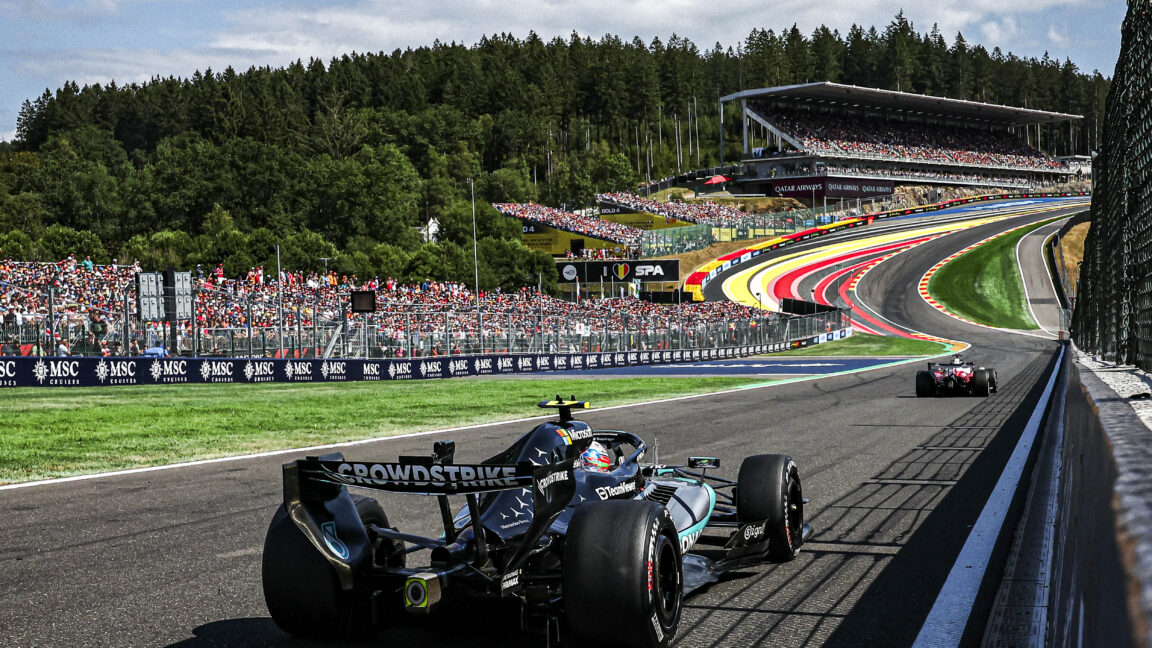
44 Kimi Antonelli approaches the famous Eau Rouge corner. Credit: Nicolas Economou/NurPhoto via Getty Images Kimi Antonelli approaches the famous Eau Rouge corner. Credit: Nicolas Economou/NurPhoto via Getty Images Text settings Story text Size Small Standard Large Width * Standard Wide Links Standard Orange * Subscribers only Learn more Minimize to nav Formula 1 returned to the Spa-Francorchamps circuit for the Belgium Grand Prix this weekend. This ribbon of tarmac in the Ardennes is one of the sport’s historic venues, featuring in the first F1 season way back in 1950. But as yesterday’s race showed, the current F1 machinery is utterly ill-suited to this dramatic venue.
As we saw at Suzuka in Japan earlier this year, a 2026 F1 battery is able to power the race car’s electric motor for only a few seconds a lap; for much of the rest of the lap, the energy-starved cars have less power going to their rear wheels than in the junior F2 feeder series.
For many, including much of the current F1 grid, Spa is considered perhaps the planet’s greatest race track. In fact, both Spa and the Belgian Grand Prix predate the F1 world championship, with its first race held in 1922. Back then, the circuit was a 9-mile loop of public roads, taking in the towns of Malmedy and Stavelot before returning to Francorchamps. In the postwar years, the layout shrank slightly to 8.7 miles (14.1 km) and was ferociously fast, with average lap speeds of up to 150 mph (240 km/h)—and ferociously dangerous, given cars with huge amounts of power and minimal concessions to safety.
The Spa we know and love today was reconfigured in 1979, cutting out about half of the original layout, though at 4.3 miles (6.9 km), it’s still the longest track on the F1 calendar. Interestingly, some of the circuit remained as public roads until 2000, when it became a dedicated race track only. Eau Rouge and Raidillon are its two most famous corners—a quick left, then right, that climbs 77 feet (24 m) of steep hill. But in the era of high downforce race cars, other corners like Pouhon have become greater tests of skill.
Not this year. As I’ve detailed more than a few times now, the current breed of F1 car is not at all suited to tracks with high-speed corners. Because the hybrid side of the new power units provides such little energy, going flat out all the time is not the fastest way to complete a lap. Corners that once required a driver’s commitment and maybe a little bravery to drive at the limit are now coasted into to allow the engine to divert some of its power to recharge the battery. Obviously, the drivers aren’t thrilled.
“For most of sector two, you run just on the engine,” said Red Bull’s Max Verstappen. “So what is that? 450 bhp, 500 bhp? Something like that, which is, I guess, more or less what a Formula 3 car has but with F1 downforce. So you can imagine, of course, that that is not very exciting to drive.”
“But honestly, I don’t want to sit here and complain again because probably someone will shoot me outside the door,” he joked.
Rumors continue to swirl about Verstappen’s future. As he is not in the top two of the driver’s championship, he could potentially activate an escape clause in his Red Bull contract, and some think a move to McLaren could be possible. A complete F1 sabbatical is another alternative, as Verstappen has made no secret of his desire to win some of the world’s other great races outside of F1, like the 24-hour endurance races at Le Mans, the Nürburgring, and, yes, Spa.
While I’d love to see Verstappen in more GT3 and possibly prototypes, I’m guessing he’ll stay in F1, and with Red Bull. “I’m mentally just adjusting to it. I’m trying to make the best out of it,” he told the media after qualifying. “Even though, of course, it’s not what I like, not what I love to do in Formula 1. But I can also sit at home and drive nothing. But that also doesn’t do anything. So I’m just trying my best.”
That qualifying session went rather well for the Dutch driver, too. His teammate, saddled with a grid penalty for changing an engine, helped punch a hole through the air for Verstappen, giving him a tow through the final sector of the track, letting Verstappen claim second on the grid. On pole? Mercedes’ Kimi Antonelli yet again, with a margin of three tenths of a second to the Red Bull.
Things did not go nearly as well for Antonelli’s teammate, George Russell. Declared this year’s champion-in-waiting before the start of the season, the British driver has been comprehensively outdriven by his teenage teammate this year. But Antonelli’s ease with the new cars and Russell’s discomfort with having to adopt a radically new driving style can’t explain the half-second gap between the pair in qualifying.
Over the weekend, the blame seemed to shift from Russell’s car to the driver, then back to the car again. There was—and is—something definitely wrong with Russell’s car, which was clearly slower than its sister car on several flat-out sections.
The self-learning AI systems that teams are now using to manage their energy deployment strategies across a lap are looking increasingly likely to blame. By their nature, they’re fairly opaque to the driver. And because the electrical energy is so limited—just 4 MJ capacity in the battery—even tiny deployments to fill in extra torque to help the V6 or from getting a bit of wheelspin is enough to throw off the energy management and leave a driver with a fraction of the power they thought they should have.
“My whole focus for the last 36 hours has been on straight-line speed. It hasn’t been focused on the set-up, tires, or anything, because we’re all trying to solve what is going on,” Russell told the media after qualifying.
Even Russell said after the race that Hamilton was blameless and shouldn’t have been penalized. Clive Mason/Getty Images Once again this season, Russell finds himself two whole race wins in arrears to his teammate in the standings. Clive Mason/Getty Images Once again this season, Russell finds himself two whole race wins in arrears to his teammate in the standings. Clive Mason/Getty Images Even Russell said after the race that Hamilton was blameless and shouldn’t have been penalized. Clive Mason/Getty Images Once again this season, Russell finds himself two whole race wins in arrears to his teammate in the standings. Clive Mason/Getty Images “Even my last lap, for some reason, I lost another tenth and a half to myself, just on the straight,” he said. “And you’re watching on your steering wheel, [you’re] losing speed when you’re full gas on the straight. You feel powerless. We don’t know what’s going on. I don’t think it’s the power unit, to be honest. My team are really, really on it now, to try and solve it.”
His team did not solve it, and his car was visibly slower than the others as they flew down the Kemmel Straight toward the right-left of Les Combes. (Incidentally, isn’t it wonderful how all of Spa’s corners have actual names and aren’t just referred to as turn 1, turn 2, etc.?) As all the drivers lifted and coasted into what was previously a heavy braking zone, Russell regenerated enough energy to attempt an overtake on Lewis Hamilton’s Ferrari. Hamilton, minding his own business, had nowhere to go, and Russell clipped him and then spun into the gravel trap. An expletive-filled radio tirade back to the Mercedes garage followed, with Russell furious that yet again he’s rewarded with a DNF due to his car.
Lewis Hamilton would have been justified in firing off a few expletives himself. Despite the turn 1 collision being clearly a racing incident, the stewards decided it was somehow Hamilton’s fault and issued the driver a 5-second penalty.
The race was won, as so many others this season, by Antonelli. Verstappen thrilled his many fans in the crowd by briefly passing Antonelli at the start, a position he couldn’t hold. Antonelli was in the lead by Les Combes, and that’s where he finished the race, notching up his sixth win of the season. Although there were a couple of memorable overtakes, the 2026 race was far from a classic; it was one more sad example of how the new ruleset’s cars just don’t work properly on sport’s most popular race tracks. I guess I picked the wrong year to plan a trip to Monza for the Italian Grand Prix in September.
44 Comments Staff Picks Jakelshark it’s run onboard, controlling the way the electrical power gets deployed or regenerated, in real time. I’ll see if I can get any of the teams to talk to me for an explainer. My loose understanding of most of the complaints is the AI lacks a lot of contextual awareness of why the driver is applying gas/brakes when they do. Like maybe there is another car, a strong crosswind, poor grip tires, etc during a particular turn. But the AI isn't programmed to take in all of these variables while it's trying to optimize braking/throttle/energy-recovery. It ends up with a dynamic brake/throttle map that the driver doesn't always understand and can be very wrong under certain conditions. July 20, 2026 at 4:27 pm s smellybeard This +1000. Expected better from Ars than an attention grabbing AI hate mongering headline. The issue with F1 is clear: energy can neither be created nor destroyed and the internal combustion engines can't process it fast enough to keep up with the electrical requirements. As a Canadian actor once said in a Scottish accent: Ye canne' change the laws of physics. July 20, 2026 at 5:11 pm Comments Forum view Loading comments... Prev story Most Read 1. Sheetz is quitting VMware, migrating 11,000 virtual machines 2. India's first privately-developed rocket reaches orbit on dramatic debut launch 3. The first trailer for Avengers: Doomsday is finally here 4. Hegseth wants a "High-T" military; doctors call it a clinical minefield 5. Beyond grep: The case for a context-rich AI coding harness Customize Ars Technica has been separating the signal from the noise for over 25 years. With our unique combination of technical savvy and wide-ranging interest in the technological arts and sciences, Ars is the trusted source in a sea of information. After all, you don’t need to know everything, only what’s important.