
Development
Rocket Report: India's Vikram-1 nears debut flight; AST to become rocket company?
July 17, 2026 Development Source: Ars Technica
Share this article



Step by step … JAXA has been developing the RV-X rocket to demonstrate technologies needed for a reusable launch vehicle. The conical fuselage stands about 7.3 meters tall and is somewhat similar in appearance to the DC-X vehicle developed by NASA in the 1990s, and SpaceX’s Starhopper. The agency says it plans to analyze the data from the flight for the development of an experimental reusable rocket in a joint project, called CALLISTO, with French and German research institutions. (submitted by tsunam)
AST SpaceMobile seeking other launch vehicles. The direct-to-cell satellite company announced its intention to offer $1 billion in convertible notes on Wednesday after the US stock market closed. Shortly after the announcement, the stock value dropped more than 10 percent as investors appeared concerned about dilution of their shares. What is interesting for our purposes is the reason offered by AST SpaceMobile for the transaction: the need for more rockets to get its large BlueBird satellites into orbit.
Company considering acquisitions … AST SpaceMobile intends to “pursue an expanding universe of growth initiatives and secure additional access to orbit for its space-based cellular broadband network, including partnerships and/or acquisitions to further vertically integrate its business and mitigate risks associated with third-party launch providers.” The decision follows the failed static-fire test of a New Glenn rocket in April, which was due to launch a BlueBird satellite to expand the company’s constellation. The company’s plan for future launches on New Glenn are necessarily on hold.
Ariane 6 is cleared to launch CubeSats. The European Space Agency has awarded a contract to launch its solar storm-monitoring CubeSat on an Ariane 6 rocket, European Spaceflight reports. Scheduled for launch in early 2027, the Henon CubeSat will be flown as a secondary passenger alongside the space agency’s PLATO telescope, which will be tasked with finding Earth-like exoplanets.
Up to 16 satellites … Before the award, a feasibility study was conducted to confirm that CubeSats could be safely accommodated as secondary payloads aboard an Ariane 6 flight. “Henon was a reference case, but we also looked at how many CubeSats could be accommodated in this launch architecture,” said Roger Walker, head of CubeSat missions at ESA. “We can fit up to four 16U CubeSats, in fact.” After the launch, Henon will use its miniaturized electric propulsion system to maneuver into a distant retrograde orbit around the Sun.
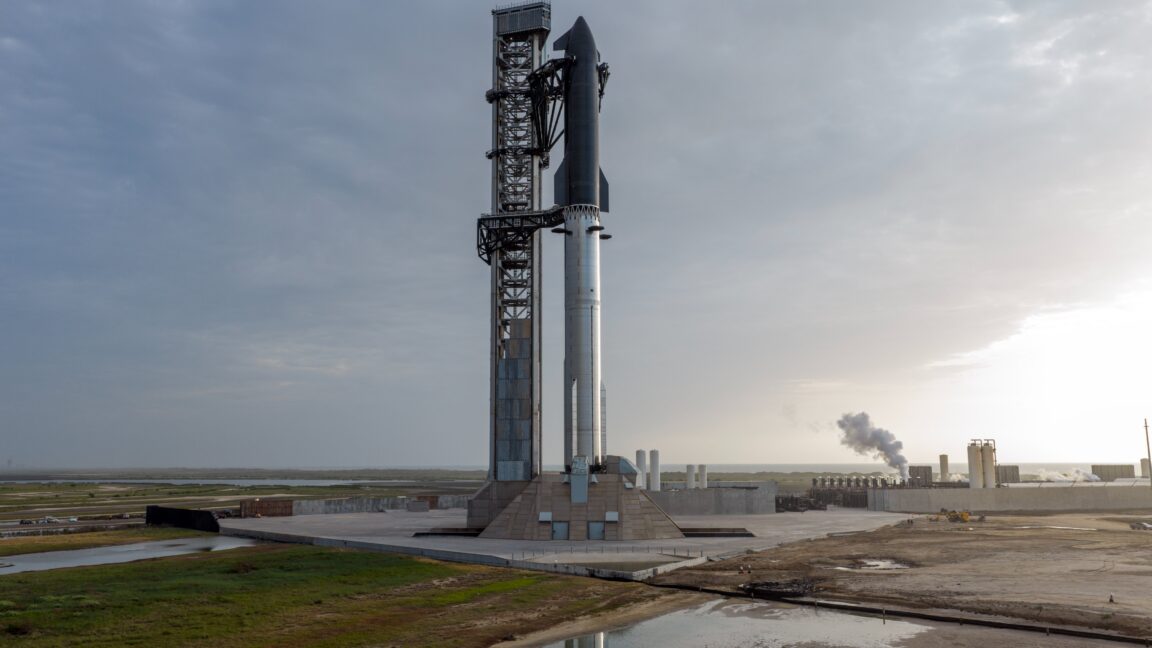
How many launches to build a data center megaconstellation? In a new feature, Ars looks into the technical challenges of building orbital data centers and assesses what it might take to build SpaceX’s proposed 1 million satellite megaconstellation. The key to all of this is not radiation or the need to cool data centers in space. The single-most important factor is cheap access to space. For the purpose of the analysis, Ars modeled three scenarios: high-performing Starship and low-satellite mass; medium-performing Starship and satellite mass; and low-performing Starship and high-mass satellites.
The numbers are pretty daunting … The optimistic scenario would require 17,500 Starship launches to deploy 1 million satellites. The most pessimistic scenario would require 77,000 total launches. Over a period of five years, by the way, for the pessimistic scenario that would be 42 Starship launches a day. As for total costs, including launches, satellites, and ground systems, under the most optimistic scenario the constellation could be deployed for $1.45 trillion. Pessimistically? Hold your breath: It’s $9.8 trillion.
NASA mission moves to Falcon Heavy. NASA’s SunRISE (Sun Radio Interferometer Space Experiment) mission will launch on a SpaceX Falcon Heavy rocket from the agency’s Kennedy Space Center in Florida, the space agency said this week. As part of the announcement, NASA did not announce a launch date for the heliophysics mission, which had originally been scheduled to launch on United Launch Alliance’s Vulcan rocket.
Six new eyes on the Sun … The mission is flying as a rideshare sponsored by the United States Space Force’s Space Systems Command. SunRISE comprises six toaster-oven-size small satellites, or SmallSats, that will operate as one giant radio dish slightly above geosynchronous orbit (about 22,000 miles, or 35,000 kilometers, in altitude) to track the rumbles of radio bursts coming from within the Sun’s atmosphere, or corona. (submitted by Tfargo04)
July 16: Starship | Flight Test 13 | Starbase, Texas | 22:45 UTC
July 18: Vikram 1 | Aagaman test flight | Satish Dhawan Space Center, India | 06:00 UTC
July 20: Falcon 9 | Starlink 17-39 | Vandenberg Space Force Base, Calif. | 14:00 UTC