
Development
2026 Toyota RAV4 plug-in: Big battery means daily drives are all-electric
July 17, 2026 Development Source: Ars Technica
Share this article



Sections Forum Subscribe Search AI Biz & IT Cars Culture Gaming Health Policy Science Security Space Tech Feature Reviews AI Biz & IT Cars Culture Gaming Health Policy Science Security Space Tech Forum Subscribe Story text Size Small Standard Large Width * Standard Wide Links Standard Orange * Subscribers only Learn more Pin to story Theme HyperLight Day & Night Dark System Search Sign In Sign in dialog... Sign in most expensive isn’t always best 2026 Toyota RAV4 plug-in: Big battery means daily drives are all-electric Toyota’s everyday small SUV should rarely require trips to the gas station.
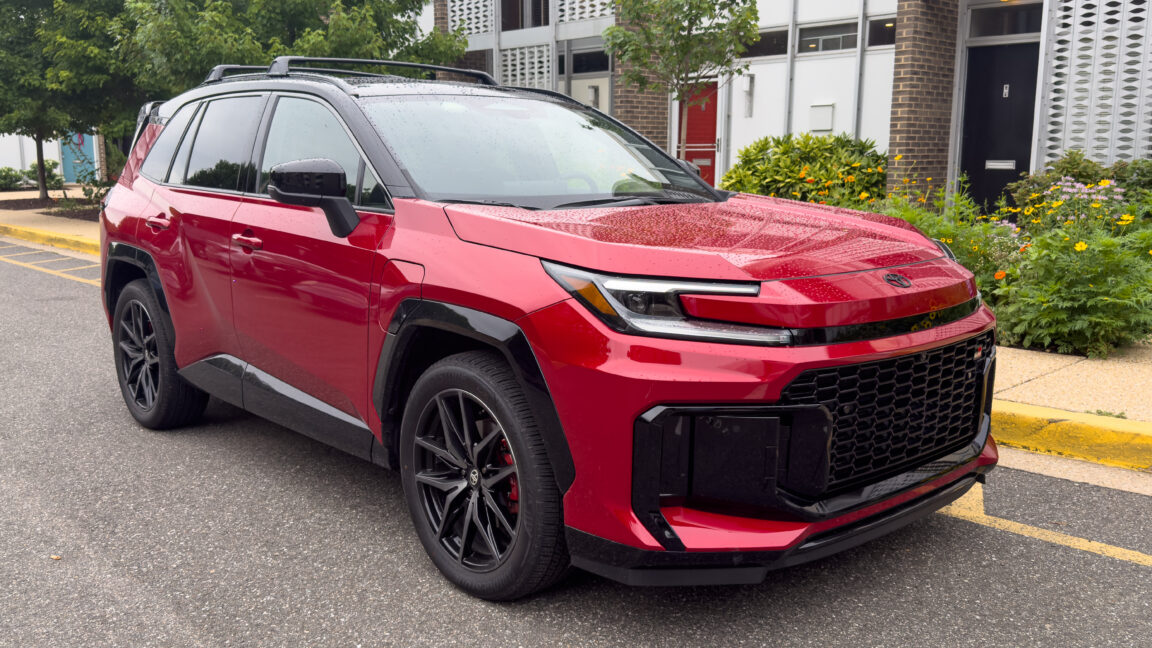
44 The front of the new RAV4 GR Sport is dominated by LED lights and big grilles and scoops. Credit: Jonathan Gitlin The front of the new RAV4 GR Sport is dominated by LED lights and big grilles and scoops. Credit: Jonathan Gitlin Text settings Story text Size Small Standard Large Width * Standard Wide Links Standard Orange * Subscribers only Learn more Minimize to nav For year after year, more Americans have bought Toyota RAV4s than anything that isn’t a pickup truck. The brand’s reputation for solid reliability has kept it ahead of SUVs from other automakers, and the nation’s embrace of SUVs and crossovers relegated the poor old Camry to near-bottom of the top 10. For the latest generation—the sixth since 1994—all RAV4s are electrified. Most will use a mix of internal combustion engine and brakes to recharge their hybrid powertrains’ traction batteries, like the millions of Priuses out there on the roads. But there’s also a plug-in hybrid EV option, with an all-new powertrain with some noticeable improvements compared to the outgoing PHEV.
Just as Toyota’s designers and engineers have tried to improve on the previous RAV4 with each successive generation, their counterparts in the powertrain department have similarly been iterating and improving the combination of electric motors and piston engine. Under the hood there’s a naturally aspirated 2.5 L four-cylinder engine that operates on the Atkinson-cycle, aided by variable valve timing on both intake and exhaust sides.
The engine, which on its own generates 186 hp (139 kW) and 172 lb-ft (233 Nm), is connected to one of two electric motors under the RAV4’s hood, as well as to Toyota’s electronically controlled variable ratio transmission.
Forget anything you know about conventional continuously variable transmissions or anything to do with cones or belts. This eCVT uses a planetary gear arrangement that sends power from the engine to one electric motor to charge the RAV4’s lithium-ion traction battery. This is a useful 22.7 kWh in capacity and is found under the entire cabin like a battery EV, rather than stealing cargo space above the rear axle like so many earlier PHEVs.
It’s a more interesting shape than the slab-sided SUVs we used to get. Jonathan Gitlin In addition to the four-cylinder engine and two electric motors, the silicon carbide inverter and other electronics are also in the engine bay. Toyota In addition to the four-cylinder engine and two electric motors, the silicon carbide inverter and other electronics are also in the engine bay. Toyota I worry this SUV devalues the GR sub-brand. Jonathan Gitlin I worry this SUV devalues the GR sub-brand. Jonathan Gitlin In addition to the four-cylinder engine and two electric motors, the silicon carbide inverter and other electronics are also in the engine bay. Toyota I worry this SUV devalues the GR sub-brand. Jonathan Gitlin Most of the time, propulsion to the front wheels comes from a second electric motor, also connected to the eCVT; this permanent-magnet synchronous traction motor has an output of 203 hp (151 kW) and 201 lb-ft (272 Nm). So most of the time, the RAV4 is a series hybrid, and while you may hear the revs flare when you accelerate hard, most of the time the power that’s being generated along with that sound is headed to the battery pack. But sometimes—highway speeds, really—it’s more efficient to work as a parallel hybrid, something the eCVT allows.
A third electric motor powers the rear axle, providing an additional 55 hp (41 kW) and 91 lb-ft (123 Nm), and together the RAV4 PHEV offers a maximum combined output of 324 hp (242 kW) and 315 lb-ft (427 Nm).
There are four different trims to choose from, and if you care about efficiency and maximizing the miles you can drive fully electric, you should go for the SE ($41,500) or the XSE ($47,200). These are rated at a combined 40 mpg (5.9 L/100 km) and up to 52 miles (84 km) on battery power alone. For those feeling outdoorsy, the Woodland ($45,300) adds some protective cladding, tow hitches, and also all-terrain tires and a raised ride height that together conspire to reduce the combined economy to 37 mpg (6.5 L/100 km) and the electric-only range to 49 miles (79 km).
And for this generation, the automaker has also introduced a GR Sport trim; at $48,500, this is the most expensive RAV4 PHEV. It’s also the one Toyota sent us to review. The powertrain is unchanged, but there are larger, lighter 20-inch wheels with performance tires and more offset. There are new springs and front dampers, the rear suspension has been reinforced, and the GR Sport rides 0.6 inches (15 mm) lower than an SE or XSE. There’s some bodywork unique to this version, too: a bigger grille, front and rear spoilers, and a diffuser at the rear. Needless to say, this is not the trim to choose if you are a hypermiler. It should return a combined 36 mpg (6.5 L/100 km), and its battery range is the shortest, at 48 miles (77 km).
Yes, that does say almost 59 mpg doesn’t it? Jonathan Gitlin In addition to Eco mode, there’s an eco setting for the adaptive cruise control that accelerates more gently. Jonathan Gitlin In addition to Eco mode, there’s an eco setting for the adaptive cruise control that accelerates more gently. Jonathan Gitlin Yes, that does say almost 59 mpg doesn’t it? Jonathan Gitlin In addition to Eco mode, there’s an eco setting for the adaptive cruise control that accelerates more gently. Jonathan Gitlin Sport mode keeps the engine on for you. Jonathan Gitlin Sport mode keeps the engine on for you. Jonathan Gitlin Are any of us truly normal? Jonathan Gitlin Are any of us truly normal? Jonathan Gitlin Sport mode keeps the engine on for you. Jonathan Gitlin Are any of us truly normal? Jonathan Gitlin But even 48 miles is more than most people drive most days. So as long as you plug it in regularly—and according to data, owners do —then the RAV4 PHEV will spend most of its time driving around in silence, leaving the gas in its tank where it was left. Completely recharging the battery pack takes 3.5 hours with the onboard 7 kW level 2 charger, or between 9–12 hours if you only have access to a 120 V socket.
Here could be another reason to opt for the cheaper trims: The XSE and Woodland both feature an 11 kW onboard charger that cuts level 2 charge times to 2.5 hours, and they can even DC fast-charge via a CCS port. Although the battery is still a fraction of the capacity you’d find in a BEV, don’t expect fast charging miracles—35 minutes from 10–80 percent, Toyota says, assuming optimum conditions. I’ll let the comments hash out exactly what scenario it makes more sense to fast-charge a PHEV than just fill it with gas, since I can’t really think of one right now.
But the main reason to save a few dollars and not buy the most expensive RAV4 plug-in is that, despite the GR Sport badges here and there, this just doesn’t feel at all sporty to drive. The low center of gravity from the centrally mounted battery means there’s little roll. And I found very little lateral support from the sports seats despite their wider bolsters, which discouraged me from probing much about its limit of grip even within the confines of what we consider sensible driving on public roads. Perhaps that’s why the dash indicated 54 mpg (4.3 L/100 km) by the end of my week?
The pedals and seats are racier than other RAV4s. Toyota The bolstered seats look like they would be supportive but failed. Toyota The bolstered seats look like they would be supportive but failed. Toyota We’re a long way from the terrible Toyota infotainment systems of a few years ago. Jonathan Gitlin We’re a long way from the terrible Toyota infotainment systems of a few years ago. Jonathan Gitlin The bolstered seats look like they would be supportive but failed. Toyota We’re a long way from the terrible Toyota infotainment systems of a few years ago. Jonathan Gitlin The sports seats might not have held me in place the way a racing bucket might, but after a four-hour stint behind the wheel, it began to feel as if there was as little padding, at least as far as my right glute was concerned.
While I’m complaining, it seems the “don’t remember the AC should be on” thing I complained about when reviewing the C-HR recently is now a default Toyota behavior. Again, there’s probably a good reason the car doesn’t default to whatever the last climate setting was. But when there’s a heat dome on top of climate change and the car is parked outside, I very much do not want to wait interminable seconds for an infotainment system to initialize as I melt before I am able to access those settings to start the cold air blowing.
I suspect that this very sweaty problem could be avoided by using Toyota’s smartphone app to remotely chill the RAV4 plug-in’s interior, but it’s invariably impossible to test connected features with press fleet vehicles, so it’s something I’ll have to ask the automaker about. Alternatively, Ars owners who aren’t abstaining from connected car services can let me know.
Because in most other regards, I found much to like about this newest plug-in RAV4. Toyota’s latest infotainment UI is legible and easy to use, with wireless Android Auto and Apple CarPlay as standard. And even if I don’t want to take one down a touge , I did find it pleasant to putter around the city in, and it cruised well on the highway. The onboard suite of advanced driver assists are standard whichever trim you choose. But if I wanted a GR-badged Toyota, I’d stick to the GR Supra or the GR Corolla or the GR86. This RAV4 plug-in is a dish best served less spicy.
44 Comments Staff Picks U UnsafeCode We love our 26 RAV4 XSE Plugin so far. Our AC definitely comes on every time we start with the HVAC set to Auto. There’s a setting for it. It has no problems cooling quickly in 97-100F weather even in ECO AC mode. We have been running errands entirely in EV mode getting a little over 4mi/kwh on average. We run the ICE every few weeks and on a recent round trip in hybrid mode at 70-75mph, we averaged 41mpg. It does take 87 octane for whoever was wondering. With a Level 2 charger at 40A we can charge it back up from a 15mi drive in under 30 minutes. I’ll eventually test charging it at 48A but we haven’t needed the increased speed so far. We bought it over an EV because we take a trip once or twice a year that’s around 750mi each way and driving through Atlanta is already stressful enough without trying to find a place to charge. (And at some point we plan on taking longer vacations. ) July 16, 2026 at 9:10 pm Comments Forum view Loading comments... Prev story Next story Most Read 1. Sheetz is quitting VMware, migrating 11,000 virtual machines 2. Hundreds rally at Bethesda HQ to protest Xbox layoffs, and Ars was there 3. How hard is it to build orbital data centers, actually? 4. Engineer identifies and explains every '90s computer seen in Jurassic Park 5. Move over, GPS: Navigation satellites in low-Earth orbit are making a comeback Customize Ars Technica has been separating the signal from the noise for over 25 years. With our unique combination of technical savvy and wide-ranging interest in the technological arts and sciences, Ars is the trusted source in a sea of information. After all, you don’t need to know everything, only what’s important.