
Development
A "disaster waiting to happen"? Industry officials worry about Crew Dragon availability.
July 13, 2026 Development Source: Ars Technica
Share this article



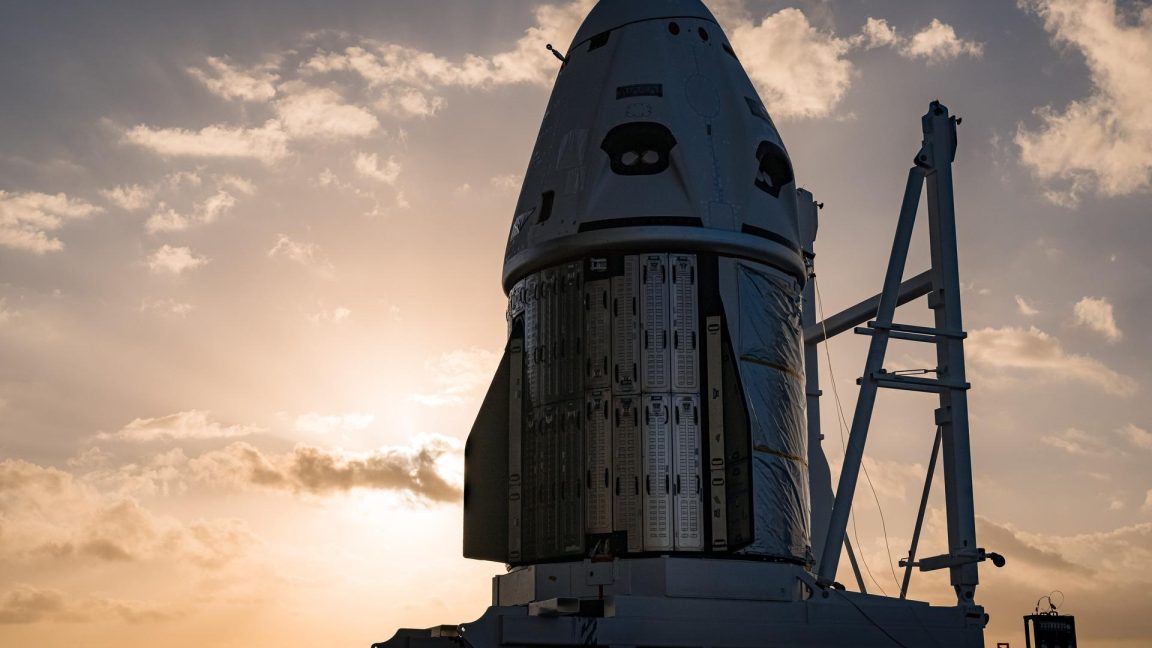
Crew Dragon would seem to be the obvious answer for commercial space stations in the 2030s, but there are some questions. The first of these is availability. SpaceX President Gwynne Shotwell has said the company will fly Crew Dragon and the Falcon 9 rocket for a finite number of years, possibly for less than a decade as the company transitions its launches to Starship. Could humans launch on Starship? Eventually, but this seems unlikely before the mid-2030s, and docking the large Starships to smaller space stations would be challenging.
NASA, obviously, will want Crew Dragon to fly longer, and this will have some influence. But gradually pretty much all of SpaceX’s launch activity, beginning with Starlink satellites but eventually other commercial satellites, will migrate to Starship. This would leave SpaceX in the position of keeping a Falcon 9 production line open just to support Crew Dragon, which would certainly increase the price. Although Crew Dragon pricing is a closely held secret, multiple sources say costs have already risen in recent years for the crewed launch vehicle.
After speaking to officials at several private space station companies, it is clear these concerns are front of mind. The bulk of expenses in operating a space station will come not from the facility itself, but safely transporting crew and cargo to the facilities. The providers do not have certainty that Crew Dragon will be available for the long haul, and they also have pricing concerns due to Falcon 9 availability, as well as lack of competition.
“It’s a disaster waiting to happen,” one industry source told Ars about Crew Dragon availability in the 2030s.
Beyond that, NASA and private space station companies may need to look to an emerging company across the pond.
Last week, a Europe-based firm, The Exploration Company, hosted an office-opening celebration in Webster, Texas. At the facility, located just a couple of miles from Johnson Space Center, founder Hélène Huby said her company was considering making Houston the base of its operations to develop a crewed spacecraft.
The Exploration Company has already won funding from the European Space Agency to develop a cargo vehicle, called Nyx, to carry supplies to the International Space Station. An initial mission may happen in late 2028 or 2029. And Huby has made no secret of her desire to build a crew vehicle.
“It’s very clear that in the United States there is a big need for an additional crew vehicle, and nobody exactly knows if Dragon will continue to serve,” she said. “And even if Dragon continues to serve, which I wish it will because it’s an amazing vehicle, then it’s good to have a bit more competition. And also the path for Boeing is kind of uncertain right now.”
Huby is seeking to attract funding both from the European Space Agency and NASA for the development of a crew vehicle, and then to leverage that money to raise additional private capital for a crew vehicle. The company has already taken preliminary steps toward this, which she estimates will require about eight years and $4 billion.
If this sounds far-fetched, perhaps it should not. Huby has shown considerable skill in working with European space officials to emerge as a leading contender to build a crew vehicle at a time when leaders there have made their desire for one clear.
Additionally, at the office-opening party this week, there were representatives from both Axiom Space and Voyager on hand. Both companies have already signed deals for cargo services. If they like what they see with Nyx, it would not be too difficult to envision them signing up for crewed missions.