
World
Israeli soldiers punished over vandalism of Jesus statue in Lebanon
April 21, 2026 International Source: BBC World
Share this article



Two soldiers will be removed from combat duty and receive 30 days of military detention, Israel's military says.
Israeli soldiers punished over vandalism of Jesus statue in Lebanon
Copyright current_year BBC. All rights reserved. The BBC is not responsible for the content of external sites. Read about our approach to external linking.
Copyright current_year BBC. All rights reserved. The BBC is not responsible for the content of external sites.
Read about our approach to external linking.
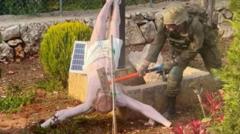
An image of the incident had prompted outrage after it was widely shared online
An Israeli soldier uses an implement to hit the face of an upturned statue of Jesus Christ in southern Lebanon. Photo: April 2026
The Israeli soldier who hit a statue of Jesus with a sledgehammer in Lebanon and the soldier who photographed the incident will receive 30 days of military detention, the Israel Defense Forces (IDF) has said.
The IDF also said the two soldiers - who have not been named - would be "removed from combat duty" following an inquiry.
Another six soldiers who were at the scene and failed to intervene or report the incident will be dealt with separately, it added.
The incident in the village of Debel in southern Lebanon prompted widespread condemnation after an image of it was widely shared online this week. Israel's Prime Minister Benjamin Netanyahu said he was "stunned and saddened" by what happened.
In its statement on Tuesday, the IDF said an inquiry into the incident had "determined that the soldiers' conduct completely deviated from IDF orders and values" and expressed "deep regret over the incident".
It also said IDF troops had replaced the damaged statue "in full co-ordination with the local community" a short while ago.
It stressed that its operations in Lebanon were directed "solely" against the Iran-backed group Hezbollah "and other terrorist groups, and not against Lebanese civilians".
Hugo Bachega speaking in front of buildings reduced to rubble in southern Lebanon
'Nothing to go back to' - BBC reports from Lebanon's 'Yellow Line'
Two men on motorcycles ride among traffic, as people make victory signs and fly yellow Hezbollah flags, in Nabatieh, Lebanon (17/04/26)
Ceasefire with Israel brings respite to Lebanon, but obstacles to peace remain
Two people ride on a moped, while one holds a Hezbollah flag and holds two fingers in the air, on a street in Beirut in front of a huge pile of rubble where a building once stood, taken on Friday.
What we know about the Israel-Lebanon ceasefire
Locals had said the statue was on a crucifix outside a family home on the edge of Debel, one of the few villages where residents have remained during Israel's war with Hezbollah.
The head of Debel's congregation, Father Fadi Flaifel, told the BBC after the incident: "We totally reject the desecration of the cross, our sacred symbol, and all religious symbols.
"It goes against the declaration of human rights, and it doesn't reflect civility."
He claimed similar incidents had happened before.
Among those to condemn the incident was the US Ambassador to Israel Mike Huckabee - the representative of Israel's most important ally - who called on Monday for "swift, severe, and public consequences" following the "outrageous act".
Netanyahu had expressed regret for the incident "and for any hurt this has caused to believers in Lebanon and around the world".
The IDF said its troops had replaced the statue on Tuesday
A statue of Jesus on a cross erected in front of a fence atop a low stone wall
Thousands of Israeli troops continue to occupy a wide area of southern Lebanon after a US-brokered ceasefire came into force between Israel and Lebanon on Friday.
The ceasefire has paused six weeks of fighting between the IDF and the Shia Muslim armed group Hezbollah, although both sides have accused each other of violations.
Hezbollah began firing rockets at Israel in support of Iran two days after Israel and the US launched a war on Tehran on 28 February.
Israel began a military campaign in Lebanon on 2 March in which more than a million people have been displaced and more than 2,290 have been killed, including 177 children and 100 healthcare workers, Lebanese authorities say.
Israeli officials say that 13 Israeli soldiers and two civilians have been killed by Hezbollah attacks in the same period.
A 14-year-old boy was among those shot dead, according to the mayor of al-Mughayyir.
Conflict spread across the Middle East after the US and Israel launched strikes on Iran on 28 February.
The US president's comments come amid uncertainty over whether Iran will attend peace talks in Pakistan this week.
One of the late pope's last wishes was for his vehicle to be used for children in Gaza, but a charity is still waiting for an entry permit.
The Israeli military says it views with "great severity" the actions of the soldier, as the US ambassador demands "swift" consequences.
The Proclaimers will also appear at the festival's final event at Boughton House.
British Jews have described to BBC Panorama how they are experiencing a rise in antisemitism.
President Macron blames the attack on Hezbollah. The Iran-backed armed group denies "any connection" to the incident.