
Development
A Jupiter-size planet that escaped its star's death
July 11, 2026 Development Source: Ars Technica
Share this article



WD 1856 b, though, apparently did not migrate outward. It got closer.
The discovery immediately has the science community buzzing. “It sent theoretical astrophysicists into a feeding frenzy,” O’Connor said. “When you find something that’s totally bizarre, totally in the wrong place, totally unexpected from any previous way of thinking about things—that’s the Universe inviting us to get creative.” First, though, scientists needed more data to get creative with, so O’Connor’s team booked time on the James Webb Space Telescope to take a closer look at what was going on in the WD 1856 system.
The JWST observations were done on April 27, 2023, and captured a single transit that lasted just eight minutes. The viewing angle and the unusual size mismatch between the star and its planet posed an immediate technical problem. Standard exoplanet transmission spectroscopy assumes a smaller planet is entirely silhouetted against the face of a much larger star, which was not the case here.
To get around it, the team developed new equations to express the transmission spectrum as the time-varying area of the planet overlapping the star’s disk. Then, they modified POSEIDON, software for reconstructing exoplanets’ atmospheres based on JWST data to account for the grazing transit geometry (the software had been developed by Ryan MacDonald, the lead author of the study). When the scientists were done crunching numbers, WD 1856 b’s atmosphere proved somewhat surprising.
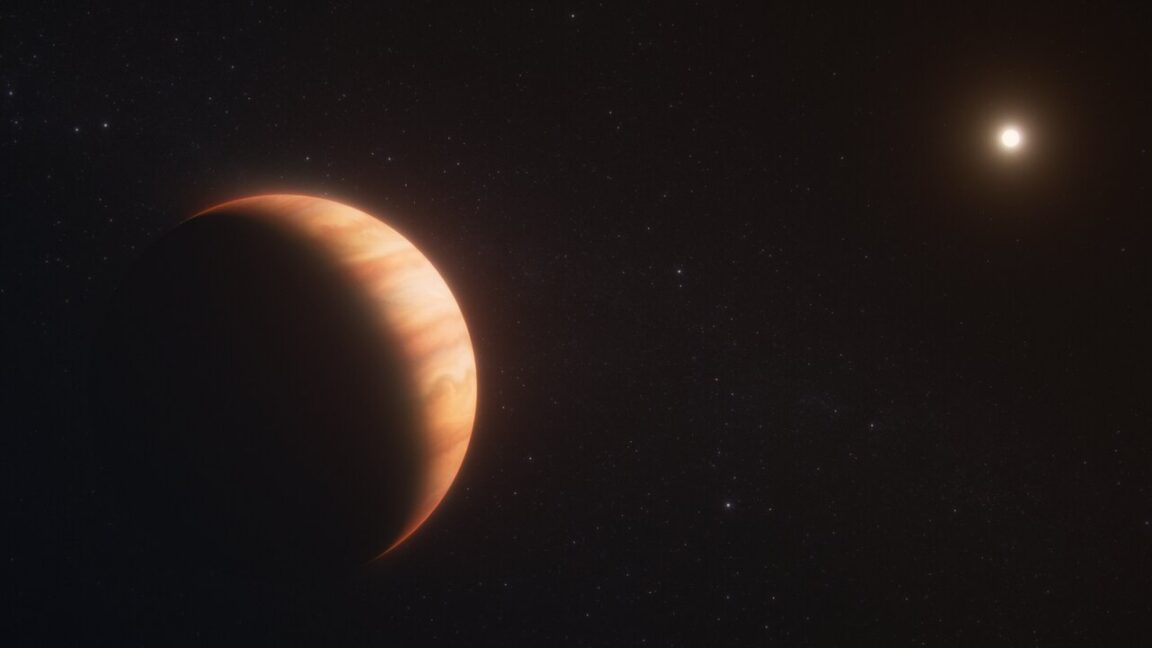
It turned out the planet is shrouded in aerosol hazes, and its atmosphere contains methane. It is also far hotter than the team expected. WD 1856 b apparently emits roughly 25 times more energy into space than it receives from its cooling host star. Even though its star, according to O’Connor, has been dead for about 6 billion years, the planet is glowing.
This extraordinary temperature, O’Connor argues, tells us a lot about WD 1856 b’s history.
Running the planet’s current temperature backward through their cooling models, the team found that the reheating event most likely occurred 3 billion to 5.5 billion years after the end of the red giant phase—far too late for the common-envelope scenario. “We interpret the planet’s temperature as residual heat from its migration process,” O’Connor said. “And we think the timing is such that it can only have been through gravitational interactions with the companion stars.”
But this explanation comes with a caveat.
The cooling models used in the calculation were built for objects with Jupiter-like atmospheric compositions, where methane accounts for roughly 0.3 percent of the atmosphere. On WD 1856 b, the methane content stands at roughly 7 percent. Because methane is a very potent greenhouse gas, this discrepancy might have skewed the models’ predictions. O’Connor says building new models of objects with atmospheric compositions closer to those of WD 1856 b might be necessary to ensure we have the evolution of the survivor planet right. “That’s going to take a pretty dedicated effort,” he said. Efforts like this, though, might soon pay off.
WD 1856 is only about 75 light-years from Earth—it’s practically our galactic neighbor. O’Connor takes the proximity as a hint that there might be more planets that outlived their stars out there. “Having one so close to us is a suggestion that there might be a lot more of these waiting to be found,” he said. Before embarking on the wide search for planetary survivors, though, the team wants to examine the WD 1856 system in more detail.
“We’ve already taken additional James Webb Telescope observations of this system. Those happened long after we submitted this paper. Our team has only really just started,” O’Connor said.
Nature, 2026. DOI: 10.1038/s41586-026-10514-7