Development
An orbiting disco ball gave Einstein’s theory its most precise test yet
July 10, 2026 Development Source: Ars Technica
Share this article



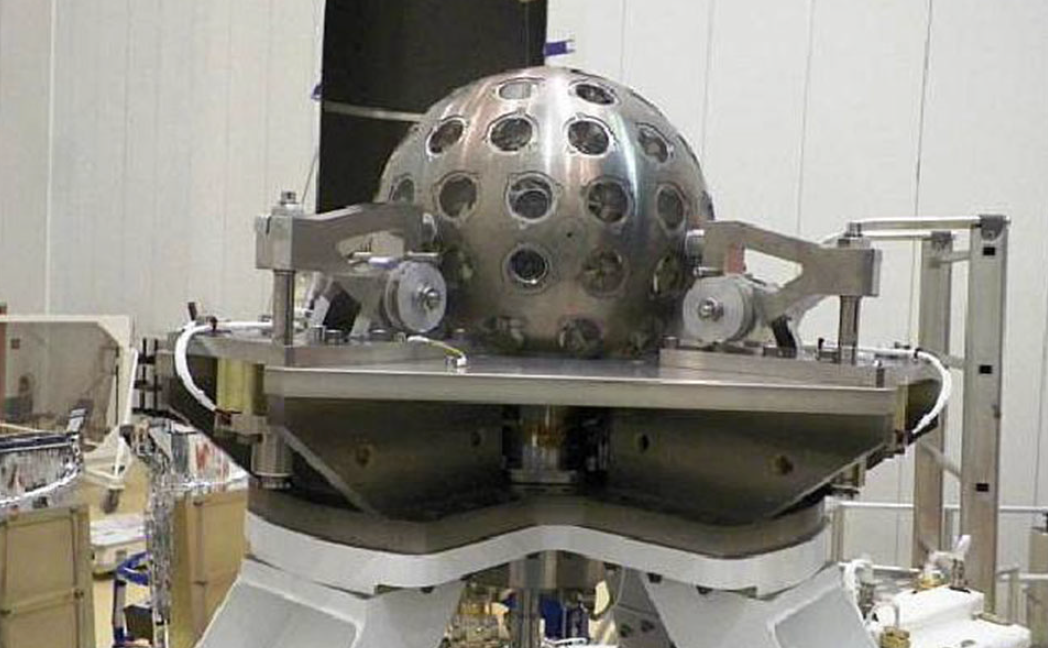
“The idea is that we want to measure gravitation,” Ciufolini said. “We have non-gravitational effects like photons impinging on the satellite and pushing it. So, the mass must be very large and the cross-section of the satellite very small, so the acceleration induced by photons is very, very small.” In theoretical physics, satellites of this kind are called test particles, meaning an object whose motion is governed almost entirely by the gravitational field. LARES-2 was placed in orbit at an altitude of roughly 12,265 kilometers by a Vega-C rocket in July 2022.
Once the LARES-2 was in position, the researchers started shooting it with ground-based lasers.
The retroreflectors on LARES-2 are designed to reflect a beam of light exactly in the direction this beam came from. When Ciufolini and his colleagues fired short laser pulses at the satellite, they could pinpoint its position down to roughly 1 millimeter based on the light that came back. About 200,000 such observations, spanning July 2022 to June 2025, formed the dataset the team used to measure Earth’s frame dragging.
But even such precise positioning was not enough to achieve the accuracy the team wanted.
The problem with measuring frame dragging using Earth-orbiting satellites is that the Earth is not a perfect sphere. Its equatorial bulge produces classical Newtonian forces on satellite orbits that are orders of magnitude larger than the frame dragging signal. The solution Ciufolini proposed decades ago while working with physicist John Archibald Wheeler was to use two satellites in supplementary orbits, meaning with orbital inclinations that sum to 180 degrees.
“Suppose we have a satellite orbiting around a perfectly spherically symmetric object—the orbit of this satellite would act like a gyroscope,” Ciufolini said. Under ideal conditions, the orbital plane and its orientation in space would remain fixed, and the only thing altering this orientation should be frame dragging.
“But the Earth is not spherically symmetric,” Ciufolini said. “It is oblate, and this oblateness produces a change in the orientation of the orbital plane.” With two satellites at supplementary inclinations, the Newtonian perturbations are equal and opposite in the two orbital planes and cancel each other out. The Lense-Thirring effect, which pushes both orbital planes in the same direction, adds algebraically—the noise vanishes and the relativistic signal survives.
That’s why LARES-2 was working in synchrony with its older and larger cousin called LAGEOS, a NASA satellite designed exclusively for high-precision laser-ranging, launched in 1976. The orbital inclinations LAGEOS and LARES-2 summed up to 180.01 degrees, which the team considered close enough.
But the Earth’s irregular shape was not the only challenge.
This final measured value came in incredibly close to Einstein’s general relativity predictions, carrying a tiny margin of error of just one to two parts per thousand based on their statistical models.
The measurement confirmed general relativity once more, but Ciufolini thinks its true value lies in what it rules out. General relativity is incompatible with quantum mechanics, despite our best efforts to reconcile the two, and does not explain dark energy. The Chern-Simons theory, one of the leading alternatives that emerged from quantum gravity frameworks, modifies Einstein’s equations and introduces mathematical corrections expected to make them work at ultra-small scales where quantum mechanics and gravity must coexist.
While it does not fully reconcile Einstein’s physics with quantum mechanics and does not offer a universally accepted solution to the dark energy issue, many physicists think Chern-Simons brings us one step closer to the complete Theory of Everything. The problem, though, is that it predicts a different magnitude for frame dragging. “By measuring frame dragging very precisely, we have been able to put limits on what is predicted by Chern-Simons theory,” Ciufolini said. His measurement does not rule it out, but severely narrows its scope, eliminating a large range of its potential variations.
But there are other implications of Ciufolini’s study that are more down to Earth—quite literally. By pinpointing and filtering out the gravitational distortion of the K1 tide from the satellites’ tracking data, the experiment also yielded a much more precise measurement of the tide’s actual strength, a bonus finding that could provide new insights for earth science. “My Chinese colleagues tell me that if we improve the knowledge of tides, we can indirectly improve the study of earthquakes,” Ciufolini said. And he expects the experiment to keep on giving.
“These laser-ranged satellites have a peculiar characteristic: They last for hundreds of years,” Ciufolini said. “The more you wait, the more data you accumulate, and the better the results of frame dragging measurements will be. So, we can wait maybe 100 years, and they’ll become even more useful for theoretical physics.”
Nature, 2026. DOI: 10.1038/s41586-026-10715-0