
World
Trump says US will not lift Hormuz blockade until deal made with Iran
April 21, 2026 International Source: BBC World
Share this article



The US president's comments come amid uncertainty over whether Iran will attend peace talks in Pakistan this week.
Donald Trump: US will not lift Hormuz blockade until deal made with Iran
Can Iran and the US find middle ground to make a deal?
Copyright current_year BBC. All rights reserved. The BBC is not responsible for the content of external sites. Read about our approach to external linking.
Copyright current_year BBC. All rights reserved. The BBC is not responsible for the content of external sites.
Read about our approach to external linking.
US President Donald Trump stands outside the Oval Office
Trump says US will not lift Hormuz blockade until deal made with Iran
Watch: Can Iran and the US find middle ground to make a deal?
Lyse Doucet in a dark blue coat and headscarf
The US will not lift its blockade on Iranian ports until a deal has been reached with Tehran, US President Donald Trump has said, amid continuing uncertainty over whether fresh talks to end the war will take place.
The blockade, which began a week ago, is "absolutely destroying Iran", Trump wrote on his social media platform Truth Social, adding his country was winning the conflict "by a lot".
His comments come with the temporary US-Iran ceasefire set to end on Wednesday, but with no certainty over whether a second round of peace talks will go ahead in Pakistan.
There is tightened security in Pakistan's capital in anticipation of a meeting. But US Vice President JD Vance - set to lead the US delegation - has not yet left Washington, while Iran says it has not decided whether to attend.
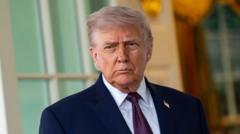
Donald Trump has a stern expression and wears a suit with gold behind
Why and how is US blockading Iranian ports in Strait of Hormuz?
A man with a grey beard and hair looks into the camera. He is wearing a black shirt and behind him is the Iranian flag.
Tehran will never cede control of Strait of Hormuz, senior Iranian politician tells BBC
Split screen image showing correspondent Frank Gardner on the right and a vessel on the left
US blockade of Iranian ports explained in two minutes
Since the blockade began, US forces have directed 27 vessels to turn around or return to an Iranian port, according to US Central Command (Centcom).
The US also intercepted and seized an Iranian-flagged cargo ship for the first time in the conflict, after it tried to get through the blockade on Sunday.
also intercepted and seized an Iranian-flagged cargo ship
for the first time in the conflict, after it tried to get through the blockade on Sunday.
Videos shared by Centcom were said to show the ship being warned before troops repelled onto the vessel.
Tehran deemed it an "act of piracy" and a violation of the fragile ceasefire between the two countries.
Iran has maintained its own blockade on the Strait of Hormuz, a key shipping route, for nearly two months - causing global energy prices to soar.
Iran has maintained its own blockade on the Strait of Hormuz,
, for nearly two months - causing global energy prices to soar.
It was briefly re-opened on Saturday but quickly closed again, following reports of vessels in or near the strait, including a tanker, being targeted by Tehran.
briefly re-opened on Saturday but quickly closed again
, following reports of vessels in or near the strait, including a tanker, being targeted by Tehran.
Trump said Iran had "decided to fire bullets" and called it a "total violation" to the ceasefire agreement.
Iran said it would keep the route shut until the US stopped the blockade of its ports.
There are indications a second round of peace talks between the US and Iran will go ahead, despite Tehran refusing to confirm whether it will send a delegation.
Following the first round of talks earlier this month US Vice-President J D Vance said the US "could not get to a situation where the Iranians were willing to accept our terms", and Iran's foreign ministry urged Washington to refrain from "excessive demands and unlawful requests".
The potential second round comes at a crucial moment. Sources told the BBC on Monday afternoon that the US delegation would be leaving "soon" but did not specify a time, while officials told the New York Times that they would depart on Tuesday.
Later on Monday, an Iranian foreign ministry spokesperson said that, "so far", Tehran had "no plans" to attend.
Vance is expected to be joined by special envoy Steve Witkoff and Trump's son-in-law and adviser, Jared Kushner, as in the previous round of talks.
It is not clear who - if anyone - from Iran's side will be showing up.
However, in Islamabad, there are signs of preparation for the talks.
Guests at the city's Serena Hotel, where the previous round was held, have been told to leave in preparation for meetings, while police announced the closure of key roads due to the arrival of foreign delegations.
A senior government official told Reuters news agency that Pakistan was confident it could get Iran to attend the talks.
Road blocks have been set up leading to the hotel expected to host the talks
Two people crossing a road which has been blocked off with concrete barriers
Speaking to Radio 4's PM programme, the BBC's Chief International Correspondent Lyse Doucet, who is in Tehran, said that although the situation was unpredictable, there was a better chance the talks would happen.
"There is one rule in diplomacy [which] is, you don't want to be the one blamed for something breaking down.
"If JD Vance is going to be in Islamabad, it will be really hard for the Iranians to not show up.
"And I think the telephone lines are burning with the Pakistanis trying to ensure that both sides get there, because the venue is ready, the security is in place, they are just waiting for teams to arrive."
Displaced people cross a bridge linking southern Lebanon to the rest of the country. The bridge in Qasmiyeh has been badly damaged by an Israeli air strike. Photo: 17 April 2026
A moment of risk and opportunity: How two ceasefires could boost US-Iran talks
Lyse Doucet in a blue coat and headscarf, she is stood with a dark Tehran skyline behind her
Lyse Doucet in Iran: Destruction shows huge civilian cost of the war
Lyse Doucet in a blue headscarf with a dark Tehran skyline behind her
French President Emmanuel Macron and UK Prime Minister Sir Keir Starmer walk in a courtyard, they both wear dark blue suits and ties.
UK and France to lead defensive mission in Strait of Hormuz
The US has intercepted an Iranian ship entering the Gulf as part of its naval blockade, US President Donald Trump has said.
Tehran vows retaliation soon for what it calls an "act of armed piracy", which comes as the US prepares for a second round of talks.
Lyse Doucet speaks to Ebrahim Azizi, who says Iran "will decide the right of passage" through the crucial shipping route.
Prosecutors say the singer, real name David Anthony Burke, could face life in prison due to the nature of the case, if convicted.
BBC's Shaimaa Khalil reports from Los Angeles as singer David Burke pleads not guilty to the murder of 14-year-old Celeste Rivas Hernandez.
Lori Chavez-Deremer's tenure leading the department was overshadowed by allegations of wrongdoing.
Energy markets have seen wild swings since the US and Israel attacked Iran on 28 February.
"Look at that, wow!" - A couple in Temecula woke up to find a balloon boarded with 13 people behind their home on Saturday.