
Development
ULA's last six Atlas Vs can't launch anything besides Boeing's Starliner
July 7, 2026 Development Source: Ars Technica
Share this article



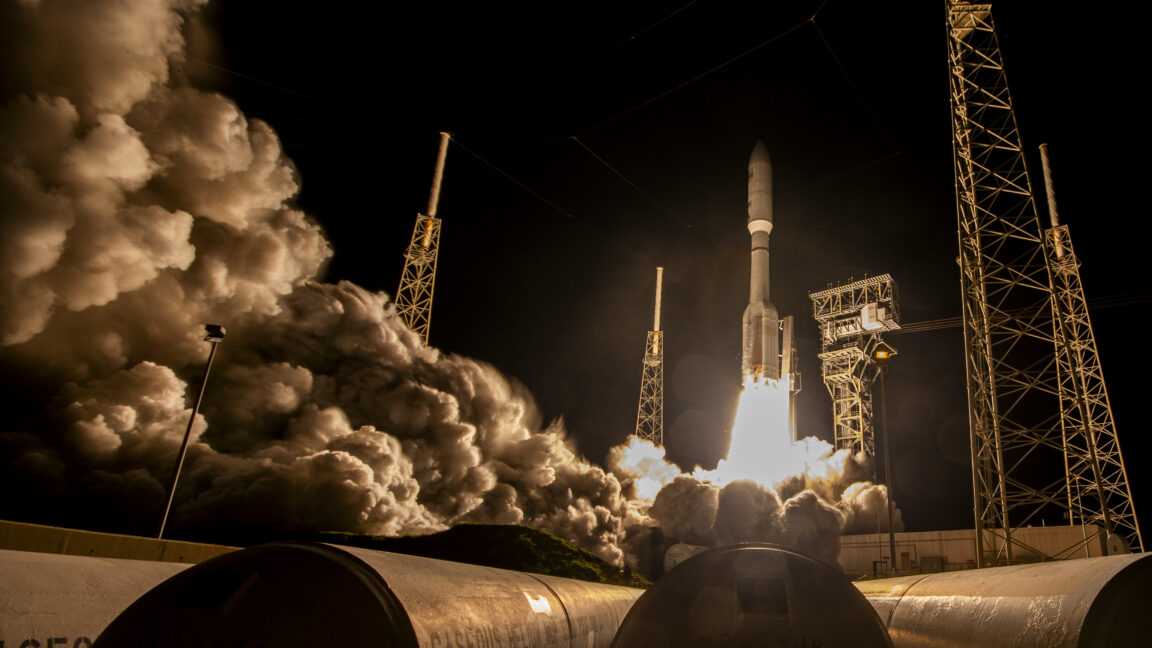
The Starliner spacecraft flies in an exposed configuration during launch, meaning the launch last week was the last time an Atlas V will fly with a payload fairing. Even if Boeing gave up some of the Atlas Vs under its contractual control, ULA would not be able to easily retrofit any of the leftover Atlas Vs for other missions.
A ULA spokesperson confirmed to Ars that the payload fairing now in production for the company’s newer Vulcan rocket—the replacement for the Atlas V—is “not interchangeable” with the out-of-production Atlas fairing. The Atlas V rockets earmarked for Starliner missions will fly with dual-engine upper stages, a configuration optimized for low-Earth orbit missions, not for high-energy orbits or deep space missions.
Additionally, Thursday morning’s mission was the last to use the Atlas V’s most powerful configuration with five strap-on solid rocket boosters. The Atlas V was designed to fly with anywhere from zero to five strap-on boosters to augment the thrust from the rocket’s Russian-built RD-180 main engine. ULA has enough Atlas V boosters in storage to affix two strap-on motors to each of the six Starliner flights in its backlog. This limits the overall lift capability for the remaining Atlas Vs.
ULA’s next launch will be the return to flight of its newer Vulcan rocket, which has been grounded since February due to problems with its own solid-fueled boosters, similar but distinct from the booster design used on the Atlas V. The recent explosion of Blue Origin’s New Glenn rocket on its launch pad in Florida also clouds ULA’s return-to-flight plans for Vulcan. The initial focus of Blue Origin’s investigation is on the engine compartment of the New Glenn. The New Glenn and Vulcan rockets share the same main engine: Blue Origin’s methane-fueled BE-4.
In 2022, Amazon secured contracts to launch most of the remaining Amazon Leo megaconstellation on ULA’s Vulcan, Europe’s Ariane 6, and Blue Origin’s New Glenn rockets. Amazon has since booked 13 rides on the Falcon 9 rockets from SpaceX, whose Starlink broadband network is a competitor of Amazon Leo.
The Vulcan rocket is supposed to be the workhorse for Amazon Leo. The tech and retail giant has reserved 38 launches on Vulcan rockets and funded the construction of a dedicated new rocket assembly hangar at Cape Canaveral to support the ramp-up of Vulcan’s launch cadence.
“Atlas V has played a critical role in the early deployment phase for Amazon Leo, launching 224 satellites with a 100 percent success rate across all eight [operational] missions, and we’re excited to build on that foundation with ULA as we transition to Vulcan,” said Melissa Wuerl, Amazon Leo director of launch systems.
It’s anyone’s guess when Amazon will launch satellites on Vulcan after the rocket’s recent solid rocket booster woes. Blue Origin’s New Glenn rocket—also owned by Amazon founder Jeff Bezos—is out of service after a catastrophic explosion on the launch pad at Cape Canaveral in late May. Europe’s Ariane 6 is the only one in Amazon’s stable of big, new rockets that has successfully delivered Amazon Leo satellites to orbit. Until Vulcan or New Glenn return to flight, the Ariane 6 and SpaceX’s Falcon 9 will be the only rockets available for Amazon to launch a growing backlog of satellites produced at the company’s factory near Seattle and shipped to Cape Canaveral for launch processing.
“With hundreds of flight-ready satellites standing by at the Cape and a new, dedicated vertical integration facility ready to support Leo Vulcan 1 and subsequent missions, we have a clear path to increase launch and deployment cadence, helping us quickly expand network coverage following an initial service rollout later this year,” Wuerl said in a statement.
In all, Amazon has purchased more than 100 launches for the Amazon Leo constellation. Fifteen of these launches are now complete, having deployed 398 satellites since October 2023, including the two demo satellites that are not part of Amazon’s operational fleet. The first-generation Amazon Leo constellation will eventually number 3,232 satellites.
The 396 production satellites now in orbit are “enough to support continuous service across initial latitudes,” Chris Weber, vice president for business and product for Amazon Leo, wrote on X. “Still lots of work ahead—including raising all these new satellites to their assigned altitude—but we’ve completed enough launches for initial service this year, and future missions just add coverage and capacity.”
These initial services will at first be continuously available only to users at mid-latitudes. The Amazon Leo birds currently in space move between 51.9 degrees north and south latitude, where the highest concentrations of satellites are at any one time. The constellation will grow to provide connectivity for customers anywhere between 56 degrees north and south before eventually expanding to global coverage.