
Development
The missing 500 million: Cosmic bombardment melted Earth's first crust
July 5, 2026 Development Source: Ars Technica
Share this article



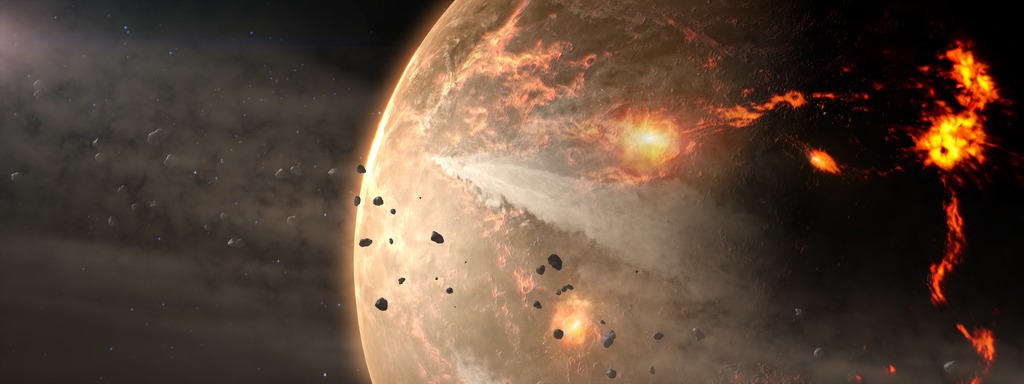
The issue with both these ideas, though, was that Earth, based on most models, appeared too cold for all this to happen. “People have tried to understand Earth’s heat budget through time, and nobody could make it fit,” Johnson said. “Nobody could make it fit because we did not consider the energy coming from outside of Earth.” This energy, he argues, came from asteroid and meteorite impacts that were far more frequent back when the solar system was young. Adding these impacts to the early Earth’s heat budget, though, proved rather challenging because Earth has a peculiar way of healing its scars.
The reason we don’t really know what was happening on Earth four billion years ago is that plate tectonics effectively recycles the surface of the planet back into the mantle. “One place where we do know what was going on back then is the Moon,” Johnson said. “We have sent people there. We have collected sample from there. We have immense amounts of high-quality data from the Moon.” Because the Moon does not have plate tectonics, its crust is a single, solid, continuous shell. And this shell, Johnson’s team noted, is peppered with impact craters.
Calibrated against dated lunar samples, crater counts on the Moon let Johnson’s team estimate how frequently large bodies were hitting our closest celestial neighbor shortly after the Earth had formed. “Scaling that flux up to Earth’s larger size and stronger gravity makes it clear the planet must have been hit by thousands of impactors that were greater than 10 kilometers in diameter,” Johnson said. When his team determined the most probable frequency of impacts and the size of impactors, they could calculate how much energy this immense bombardment delivered to Earth and, consequently, how much heat it produced.
Most prior modeling of early Earth’s heat budget focused on internal sources like heat left over from accretion and core formation plus the ongoing decay of radioactive isotopes—we thought these were absolutely dominant. Johnson’s space bombardment model showed they were not.
The simulations that captured the localized effects of individual large impacts also produced wholesale recycling of crust back into the mantle, with material dripping down to depths of at least 600 kilometers. Johnson thinks this recycling explains why so little Hadean crust survived to the present. It also explains, he argues, the near-total absence of shock-deformed Hadean zircons in the geological record. The researchers suggest that with so much melt present at shallow depths, it would have absorbed and scattered shock waves before they left lasting deformation in surviving crystals.
The impact flux didn’t stay high forever; it declined more or less exponentially. Between 3.9 and 3.5 billion years ago, it had dropped enough that internal heat sources took over as the dominant influence on the crust. As impact heating faded, the upper mantle cooled, and the once-thin basaltic crust thickened.
The team’s modeling suggests crustal thickness reached around 30 kilometers by the early Archean, the era that came after the Hadean. This thicker, cooler, more rigid crust was also finally able to support plate tectonics, and it’s around this same time that the first continental rocks show up in the geological record. “As soon as you can create thick crust and you can create a mantle lithosphere underneath, you can start building continents,” Johnson said.
The team admits much of the argument rests on physics-based modeling rather than rock samples. In the absence of geological evidence, though, Johnson thinks reliance on modeling is justified. “We need to start taking seriously the outputs of these models rather than just say, well, we can’t find any rocks, so let’s give up,” he said. But ancient rocks, as hard to find as they are, may also pop up in near future—the Earth is extremely good at covering the tracks of its history, but it’s not perfect.
“In Nuvvuagittuq Greenstone Belt in Canada, a team of North American researchers has recently dated a dark, mafic rock as 4.2 billion years old,” Johnson said. “I also know another group has found a rock which is possibly even older. Hopefully you will be able to read about it in the next couple of months.”
Science, 2026. DOI: 10.1126/science.aeb5402