
Development
Artificial cell manages a few rounds of cell division
July 2, 2026 Development Source: Ars Technica
Share this article



One limitation of the SpudCell is that it has no way to ensure that, when the cells divide, each offspring receives copies of all seven of these molecules. Instead, the system simply makes a bunch of copies to increase the probability that some of them will end up in each of the offspring. It doesn’t entirely work; after five generations of divisions, the majority of the SpudCells are missing at least one of the seven molecules of its genome.
The system for copying parts of the genome into RNA for protein production comes from a virus called T7. This has become a workhouse of molecular biology—you can order up T7 RNA polymerase online and have it shipped to you on ice. In this case, the gene encoding T7 RNA polymerase was added to the SpudCell genome, and it was made by those artificial cells.
The last element needed here is the translation of RNAs into proteins. And here, the researchers simply purified the translation machinery and supplied it to the SpudCells. They relied on a system developed by a team at the University of Tokyo, which added a tag to every protein required for translation and purified them using the tags. The Minnesota team simply purified these proteins and fed them into the system.
But the complex of proteins needed to make more proteins is far too large to go through a small pore. So the researchers encased these proteins and other large materials in a different membrane and then fed those to the SpudCells. To get the two membranes—one from the SpudCell, one from its food—to interact, the researchers added a tag to the pore protein that they had already been using. They then added something that would interact with that tag to the food membrane. This allowed the two to interact long enough to fuse, spilling the food into the interior of the SpudCell and adding additional membrane material to it.
This “feeding” process allows the SpudCells to continue making new proteins even after they would have exhausted their initial supply of raw materials. The added membrane material also increased the SpudCell’s size, literally causing it to grow.
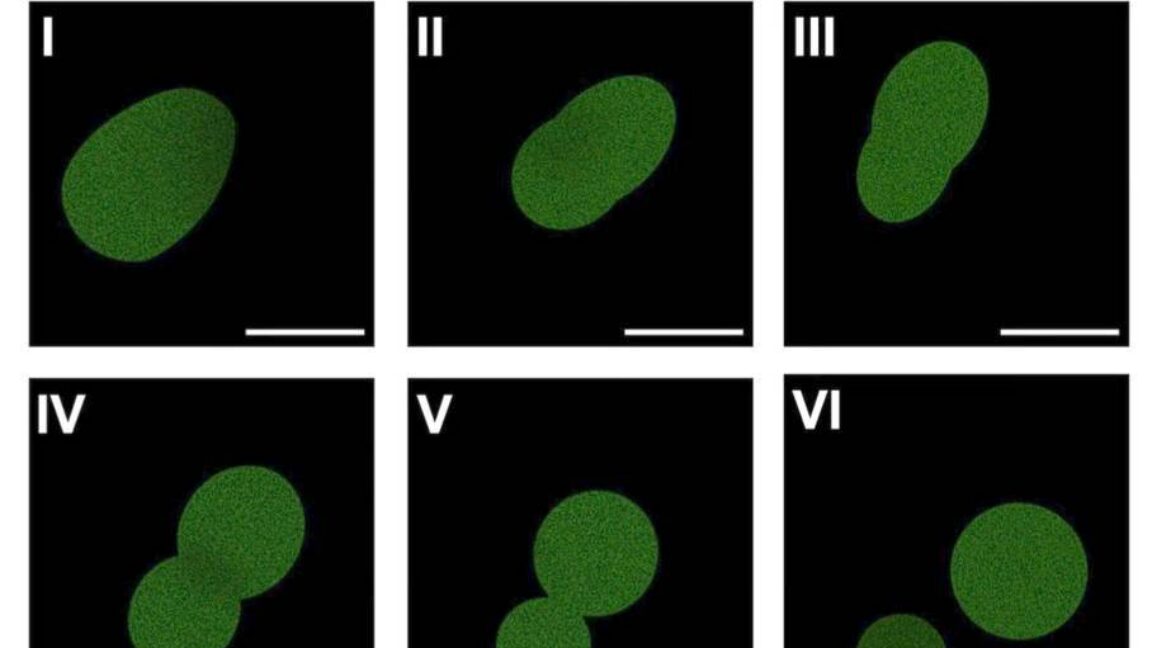
Normally, cell growth eventually results in cell division, splitting the membranes and their context between two new cells. But the SpudCells had no mechanism for achieving this. Initially, the researchers simply passed them through a wire grid and applied physical force to cause the membranes to split. But they eventually developed a system that could cause the pore proteins to clump by adding certain chemicals to the solution. That altered the membrane’s shape and eventually led to parts of it budding off. While this is a far more random process, it approximates cell division.
So in a limited, carefully engineered sense, these “cells” could feed, grow, and divide, driven by proteins encoded by their own genome. As noted above, though, that genome was only distributed into the next generation of cells at random, and pieces of it were progressively lost over each generation. As a result, no SpudCells were taken past five generations in this work.
Those five generations were enough to show that natural selection could operate on SpudCells. The researchers found they could alter their genome to tweak the levels of the pore protein made by the SpudCells. Since that is essential for their feeding, higher levels led to more rapid growth, especially in conditions where they were supplied less of the food. After five generations, the frequency of these rapid feeders in the population had increased, showing that selection operated even under these highly artificial conditions.
It’s important to recognize that these conditions are very engineered and artificial. This is not a direct equivalent of the earliest cells, as it relies on a number of specialized, highly evolved proteins to work, along with conditions specially crafted by the humans running the show.
But it still could be useful as an analog. We don’t know whether life went through a critical stage similar to this, but the work can lead us to ask questions that help us think about it. For example, we might use SpudCells to start looking at simplified systems that could ensure that genetic material is evenly distributed among the offspring of cell division. Or what selection could lead to pore proteins that didn’t simply allow anything to pass into or out of a cell? Or any number of potentially informative questions.
There’s a truism that all models are wrong, but some are useful. And that seems to be the case here. We know this is not a good model of a primitive cell in the sense that it doesn’t reflect what the earliest cells on Earth looked like. But it still could be useful for asking questions about them.
The researchers have published a webpage with more technical details of their system if you want to learn more.