Development
June research roundup: 6 cool science stories we almost missed
July 1, 2026 Development Source: Ars Technica
Share this article



A paper published last month in the journal Fluids might hold the answer. The authors fired the Trionda ball through a wind tunnel and analyzed the aerodynamics. (It’s a common experimental approach used to study baseball aerodynamics, too.) They found that the ball traveled faster once it hit a certain velocity regardless of where it was struck. They attribute this to the so-called “drag crisis,” i.e., the point where the air flow around the ball shifts from a smooth laminar flow to a turbulent flow. The resulting disruption in drag makes the ball move faster, so it doesn’t slow down as goalkeepers have been conditioned to expect. Hitting the ball on the seam reduces drag, and the effect is less likely to occur at higher altitudes.
Japan Journal of Physical Education, Health and Sport Sciences, 2026. DOI: 10.5432/jjpehss.07-25031 (About DOIs).
Fluids, 2026. DOI: 10.3390/fluids11050128.
Credit: Vesuvius Challenge Credit: Vesuvius Challenge
The latest breakthrough: One of the scrolls, PHerc. 1667, has now been “virtually unrolled” and read in full, with the technical details and a full column-by-column transcription appearing in a preprint on the arXiv. The text is a philosophical treatise on ethics and human moral progress, and the final column revealed the name Aristocreon, a nephew and disciple of the Stoic philosopher Chrysippus. So the team believes the scroll likely dates to the 2nd century BCE. There are gaps in the text where the papyrus surface has been lost, but it’s still an impressive achievement. The team was also able to use higher resolution imaging to reveal ink on another scroll, PHerc. Paris 4, and to recover the title and author of a third scroll, PHerc. 139.
arXiv, 2026. DOI: 10.48550/arXiv.2606.29085.
Wang’s team made its boron buckyball by zapping a boron target with a high-powered laser, producing a plume of boron atoms that cooled and formed different kinds of nanoclusters. They then weighed each cluster to determine the number of atoms, and used photonelectron spectroscopy to determine the shapes of the clusters. They were surprised to find an 80-atom cluster that was both highly stable and highly symmetrical. The result isn’t entirely consistent with current theory, which predicts a boron buckyball shouldn’t be stable, but Wang et al. have done an exhaustive search of various configurations for 80 boron atoms and still think a buckyball is the most likely candidate.
Chemical Science, 2026. DOI: 10.1039/D6SC02674E.
Credit: Ajay Narendra et al. 2026 Credit: Ajay Narendra et al. 2026
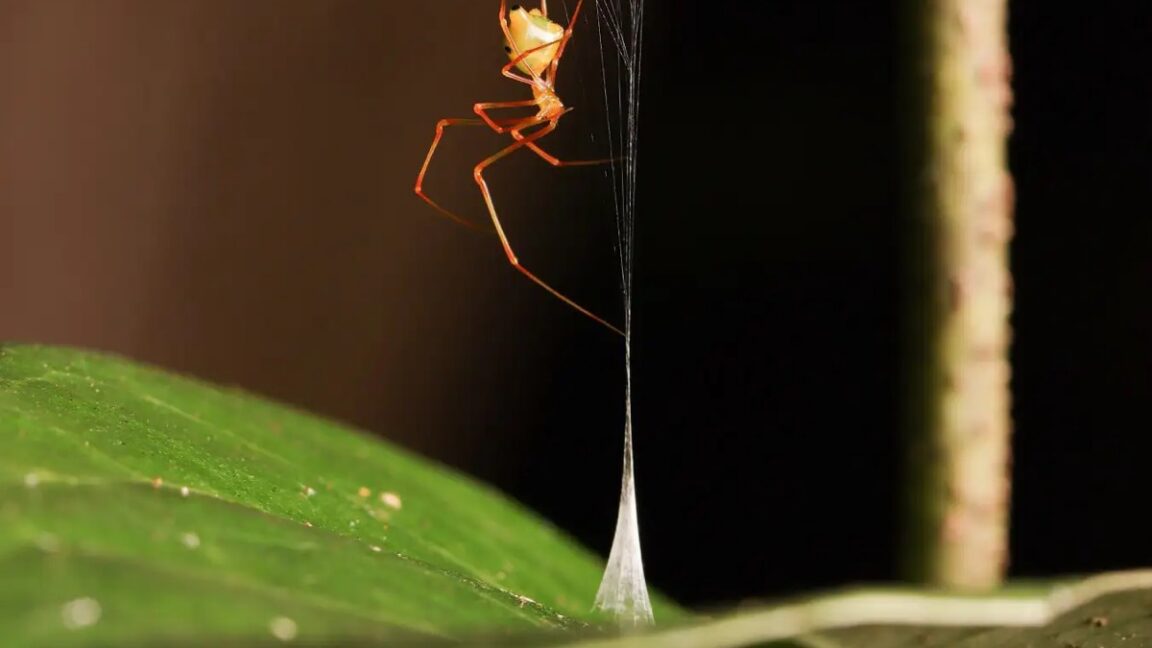
When an ant locks onto the trap with their mandibles, it gets stuck, and its struggles release the trap’s anchor point, launching the ant up to the main web. It took high-speed cameras set at 5,000 to 7,000 frames per second to capture that moment. Anderson et al. hypothesize that this is the spider’s strategy to avoid hunting on the ground, which carries a risk of counterattack from an ant colony.
Current Biology, 2026. 10.1016/j.cub.2026.04.066.
Nature Communications, 2026. DOI: 10.1038/s41467-026-72566-7.
Credit: Sandro Botticelli/Public domain Credit: Sandro Botticelli/Public domain