
Development
NASA's X-59 "frankenjet" tests supersonic flight without the sonic boom
June 29, 2026 Development Source: Ars Technica
Share this article



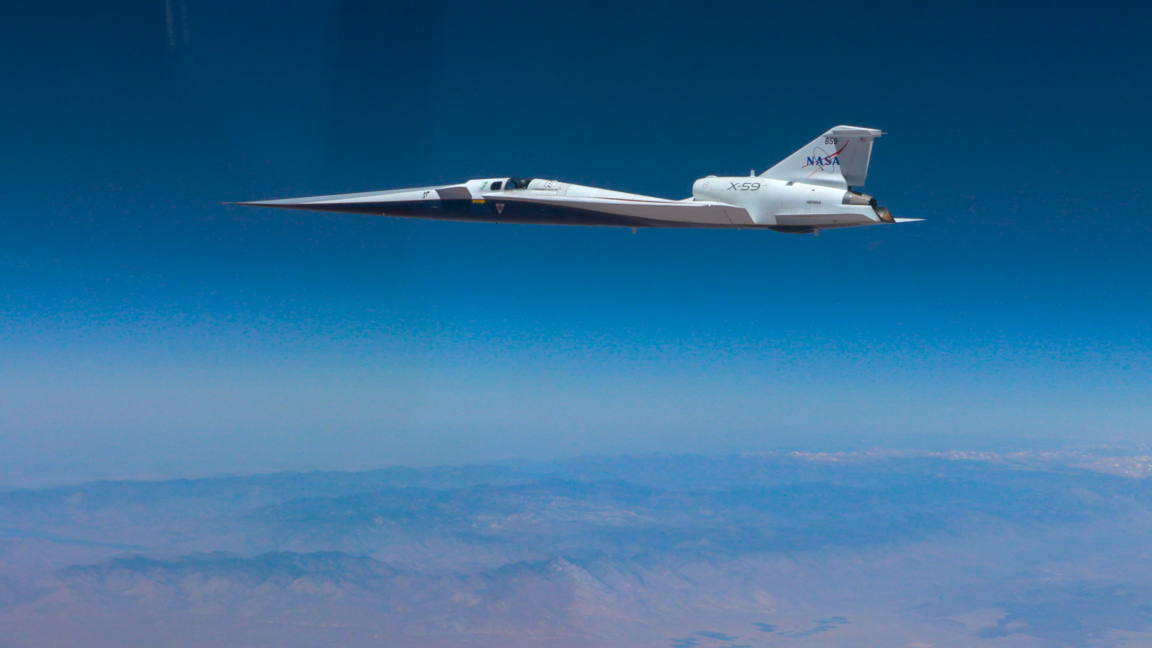
One trade-off of the X-59’s long, tapered nose is that there is no forward window for the pilot. As a NASA presentation notes, the last notable crewed aircraft that flew in the United States without forward-facing windows was Charles Lindbergh’s Spirit of St. Louis monoplane that made the first nonstop transatlantic flight in 1927.
Instead, the X-59 pilot relies on an eXternal Vision System (XVS) developed by NASA Langley Research Center, which uses two high-resolution cameras on the top and bottom of the aircraft to display a forward view to the pilot through a 4K monitor. The same monitor provides additional flight data through augmented reality features to assist with takeoffs and landings.
The X-59 also has actual side windows that allow a pilot to check for runway edges when taxiing on the ground, taking off, and landing.
Like many experimental aircraft, the X-59 is a “frankenjet” because it uses “off-the-shelf” components from many different aircraft, Less said. For example, the aircraft’s landing gear comes from an F-16 Fighting Falcon jet. The throttle that controls the aircraft’s engine power originated from an F-18 Super Hornet fighter jet that operates from aircraft carriers, whereas the stick comes from an F-117 Nighthawk stealth attack aircraft.
The X-59’s long nose and overall shape make the aircraft “a little bit sensitive in pitch” when the nose is moving up or down, Less said. That showed up as a potential issue early on during the simulator runs, so NASA and Lockheed Martin tried to ensure that the autopilot systems could provide backup in case the aircraft didn’t handle well in flight.
The initial test flights showed that the aircraft handled better than expected despite the pitch sensitivity. “If you start aggressively trying to control a very precise pitch attitude, you get into a little bit of an oscillation, but you can easily get out of that,” Less explained.
The most notable in-flight anomaly so far appeared during the X-59’s second flight on March 20, which happened to be the very first flight for Less. About four or five minutes after takeoff, a warning light appeared on the cockpit display that suggested the aircraft was experiencing an uncontrolled loss of air that might trigger a fire.
The aircraft’s pressurization system automatically shut down due to a potential bleed leak, which also cut off airflow inside the cockpit. Fortunately, Less had not flown very high yet and was able to quickly return to base for a safe landing. The post-flight investigation showed that the warning light had been a false alarm—the result of the indicator’s instrumentation being incorrectly installed.
“It may seem like we spent a lot of time and effort training, but it pays off when you get out there and something’s not going quite right and we know how to respond,” Less said. “We think we’re prepared for every contingency.”
The X-59 has performed smoothly for the most part despite the few anomalies. On June 5, 2026, it went supersonic for the first time, with Less as the pilot. The 81-minute flight saw the aircraft reach a top speed of Mach 1.1—about 713 mph—at an altitude of 43,400 feet.
However, the experience of going supersonic as a pilot is significantly less exciting and more anticlimactic than what Hollywood films often show, Less said.
“What surprises most people is when you go supersonic, you really don’t know other than your gauges telling you that you’ve gone supersonic,” Less told Ars. “I was showing my wife and my daughter some video of the moment that we went supersonic, and I said, ‘I’m sorry, it’s kind of boring.’”
NASA followed up on that milestone with a second supersonic flight test on June 12 that achieved a top speed of Mach 1.4—approximately 924 miles per hour—and reached an altitude of 55,000 feet. Those represent the speed and operational altitude that the X-59 will aim for in future flight tests intended to evaluate the sonic thump.
The ultimate test of the X-59 design’s success would come in the third phase of the program, when NASA plans to fly the aircraft above communities all across the United States. The agency wants to perform X-59 flight tests over communities that are broadly representative of the United States when factoring in demographics, building construction, climate, geography, and a host of other characteristics.
The ground microphone arrays will once again be deployed, but NASA also plans to recruit community members who can share their feedback on the sounds they hear each day during the flight tests. Each community may experience frequent flight tests for about a month, during which they may hear quieter and louder sonic thumps ranging from 70 PldB to 90 PldB, Coen said.
“Each day, we’ll fly over the community and [fly] the X-59 a little bit differently, so each flight will produce either a quiet sound or a louder sound,” Coen said. Many people may not even hear anything on the lower end, but the louder sonic thumps could approach “something that is quite annoying,” he said.
For the first community test, the X-59 will take off from NASA Armstrong Flight Research Center at Edwards Air Force Base in California’s Mojave Desert before conducting supersonic test runs over an unspecified neighboring community that does not typically hear sonic booms from other test aircraft.
But follow-on tests elsewhere in the United States will require an airfield capable of supporting the X-59’s runway requirement of 10,000 feet. Although NASA has not yet finalized its list of communities designated for the flight tests, dozens of major airports have the runway lengths capable of accommodating the X-59.