
Development
Feedbacks upon feedbacks: Rock weathering and the climate
June 26, 2026 Development Source: Ars Technica
Share this article



Organic carbon in rocks ranges from visible debris from fossil leaves and wood to molecular remains of plankton, algae, and microbes. In past global warming events, like the Toarcian, so much organic matter was buried at sea that the resulting shales are black with organic carbon. Later, after plate tectonics raises such sediments to the land surface, they can be eroded, and the organic carbon within them can be weathered into CO2.
To measure how much organic carbon was weathered on land during the Toarcian, Stow and colleagues turned to isotopes of the element rhenium extracted from rocks deposited on the seabed at the time. Rhenium works as a tracer of organic carbon oxidation because it binds chemically with organic matter in seabed sediments.
When organic carbon is weathered on eroding land, it’s released to the atmosphere as CO2 gas. But the rhenium that was bound to the organic carbon gets washed through rivers into the ocean, where it is incorporated into new seabed sediments. There, it acts as a tracer of the organic carbon that was oxidized from the older sediments.
The intensity of organic carbon oxidation changes the ratio of the isotope rhenium 187 to rhenium 185. This makes the ratio of these two isotopes in sediments a measure of the organic carbon weathering at the time.
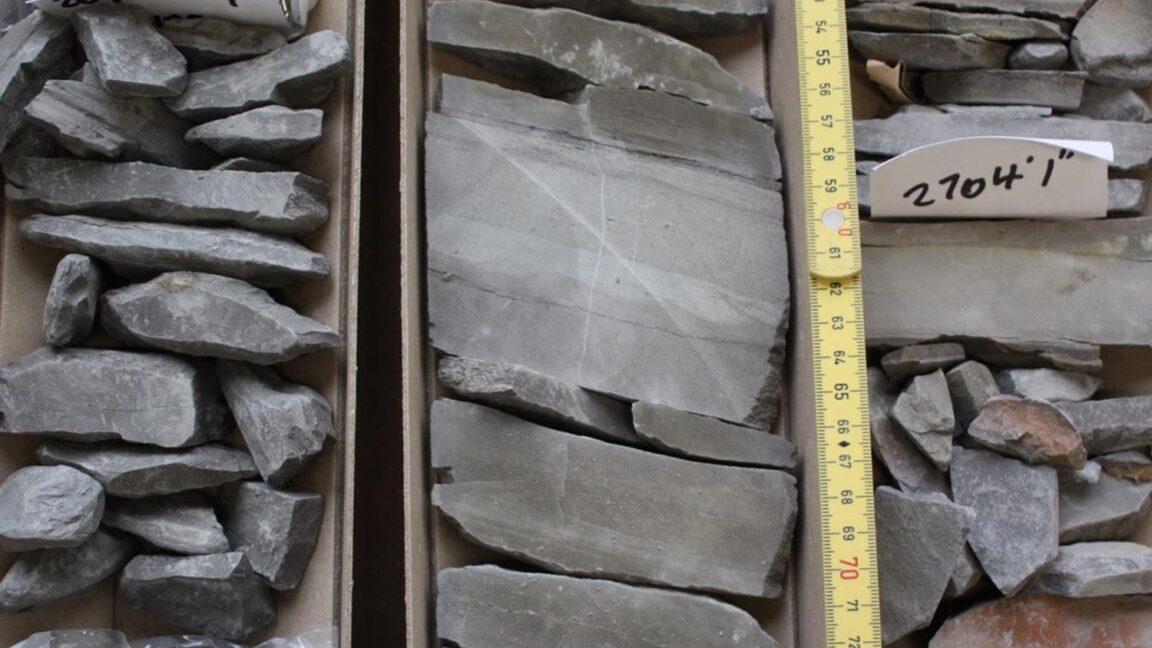
The team used a 1,300-meter rock core of sediments deposited from the late Triassic to the early Jurassic. It was drilled in the 1960s in Wales and is now stored by the British Geological Survey.
The concentrations of rhenium in the rock are as low as one billionth of a gram per gram of rock, requiring exquisitely sensitive techniques to measure it. Recent improvements in the sensitivity of mass spectrometers have been “a bit of a game changer” in allowing studies like this, Hilton said.
The team chipped shale samples from different points along the drill core, with each sampling location representing a different point in time during the warming event. They digested the rock samples in a succession of different acids to break down the minerals and the organic matter, and after several further preparation steps, the rhenium isotopes were measured using “Inductively Coupled Plasma Mass Spectrometry” (ICP-MS).
“Lo and behold, we end up finding that we can explain this apparent discrepancy,” said Hilton. In other words, weathering of organic carbon amplified the warming initiated by volcanic CO2, so the planet warmed more than it would have if only the volcanic CO2 had been emitted.
Complex questions remain about how much organic carbon weathering eats into our carbon budget, and over what timescales.
For one thing, it will depend on where organic-rich sediments are eroding around the globe and how those locations are affected by changes to temperature and rainfall. “We have more extreme storms driving more debris flows, more landslides, and more erosion,” said Rugenstein. “Does that tend to enhance organic carbon oxidation, or does it actually dampen it because you end up shuttling all this organic carbon… to the [continental] shelf where it just gets buried?”
Grant also points to the complications. “We really have to understand the more complicated organic carbon system to be able to fully balance out CO2 mass balance, to be able to understand how that both operated in the past and how it’s operating now,” she said.
Rugenstein points to the huge scale of other human changes to the environment as a further source of uncertainty. “We have moved so much sediment around as humans and changed sedimentation patterns that it’s just difficult to know,” Rugenstein said. ”Have we accelerated or decelerated organic carbon burial that could counteract this kind of positive feedback?”
Rugenstein also points to CO2 emissions from permafrost and soils as a larger and more immediate concern for humans. “That’s going to be a bigger positive feedback than this geologic organic carbon will be—this [organic carbon weathering] could be sustained for longer, but at much lower rates,” said Rugenstein.
But even with all the uncertainty, the new results shed more light on how our planet works.
“It can just give us a greater understanding of how the Earth works mechanistically,” said Grant.
Nature Communications, 2026. DOI: 10.1038/s41467-026-71533-6