
Development
Early land animals skipped the tadpole phase
June 23, 2026 Development Source: Ars Technica
Share this article



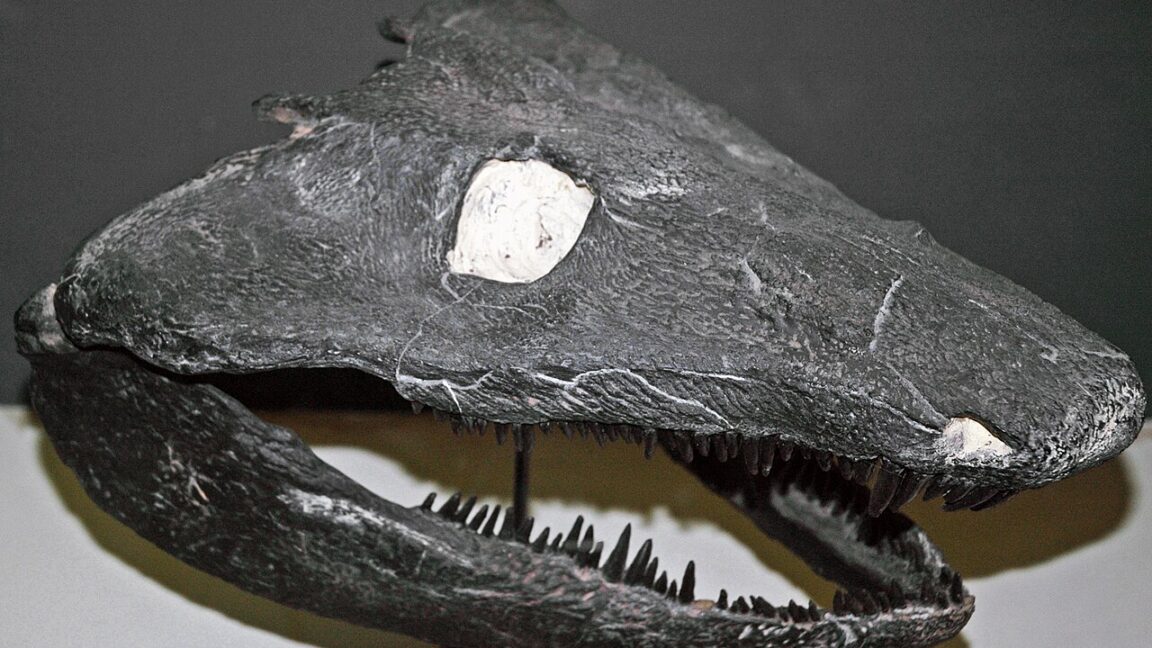
One of the most important specimens in the study was an embolomere fossil designated FMNH PR 1082, which has been sitting in the collections at the Field Museum for decades. “I think it’s been there for about 50 or 60 years. It was originally found by a collector,” Mann said. The fossil was initially classified as a different tetrapod species due to its very small size. But armed with modern imaging techniques like electron microscopy, Pardo and Mann realized the fossil was in fact a very young embolomere that died before it could even consume its first meal. “We were able to identify features that linked it to embolomers like the shape of the vertebrae, the radial spines on the tail, and the nice little fangs,” Mann said.
The team also realized that this young embolomere looked like a miniature adult. What’s more, the individual had an abdominal yolk, a portion of the egg’s yolk sac that an embryo internalizes into its body cavity just before hatching to use as an energy reserve. (According to the researchers, this internal yolk mass suggests the ancestral tetrapod egg was relatively large and nutrient-dense, like the ones laid by reptiles and birds, as opposed to the small eggs laid by amphibians and fish.) Despite having hatched recently, the specimen lacked the external gills that tadpoles should have, and there were signs of ossification in its bones—it was a youngling, but it was no tadpole.
The lack of a tadpole phase so early in life suggested there was no metamorphosis in this animal’s life cycle, which led Pardo and Mann to hypothesize the development of early tetrapods was direct, as it is in the reptiles or mammals that appeared much later.
Then they started looking at other fossils to make sure the FMNH PR 1082 was not some kind of outlier. It turned out it wasn’t.
Without the tadpole phase and metamorphosis, though, the transition from water to land was probably way tougher than we thought.
“We have lots of assumptions in our field that are based on relatively limited data,” Pardo said. One of those assumptions was that a distinct aquatic larval stage made the water-to-land transition easier for early tetrapods. While direct development, without undergoing a radical metamorphosis early in the animal’s lifecycle, might appear to be a simpler solution, it likely made the lives of young embolomers considerably harder.
The first challenge they faced was being tied to the same environment throughout their entire lifespan. Unlike amphibian tadpoles, they lived in the same ecological niche as larger juveniles and three-meter-long adults and had to compete with them for resources. Then there was the problem of supporting their body mass on land. The team noted in the paper that juvenile embolomers had weak, poorly developed limbs at hatching, which probably left them unable to move long distances across land. They were likely stuck wherever they hatched.
“It certainly makes it harder to not have a tadpole stage,” Pardo said.
He suggested that this is evidence that amphibian metamorphosis is not an ancient evolutionary stepping stone that enabled the first animals to expand out of water and conquer the land, which was then preserved in modern frogs or toads. Instead, it might be an evolutionary innovation that amphibians developed much later in response to challenges coming with the water-to-land transition.
“It may be something unique to amphibians that emerged as an adaptation to their specific way of living on land,” Pardo said. “Instead of being primitive, it may actually be something new, something novel and exciting. We’ve never thought about it this way.”
Science, 2026. DOI: 10.1126/science.aeb7635