
Development
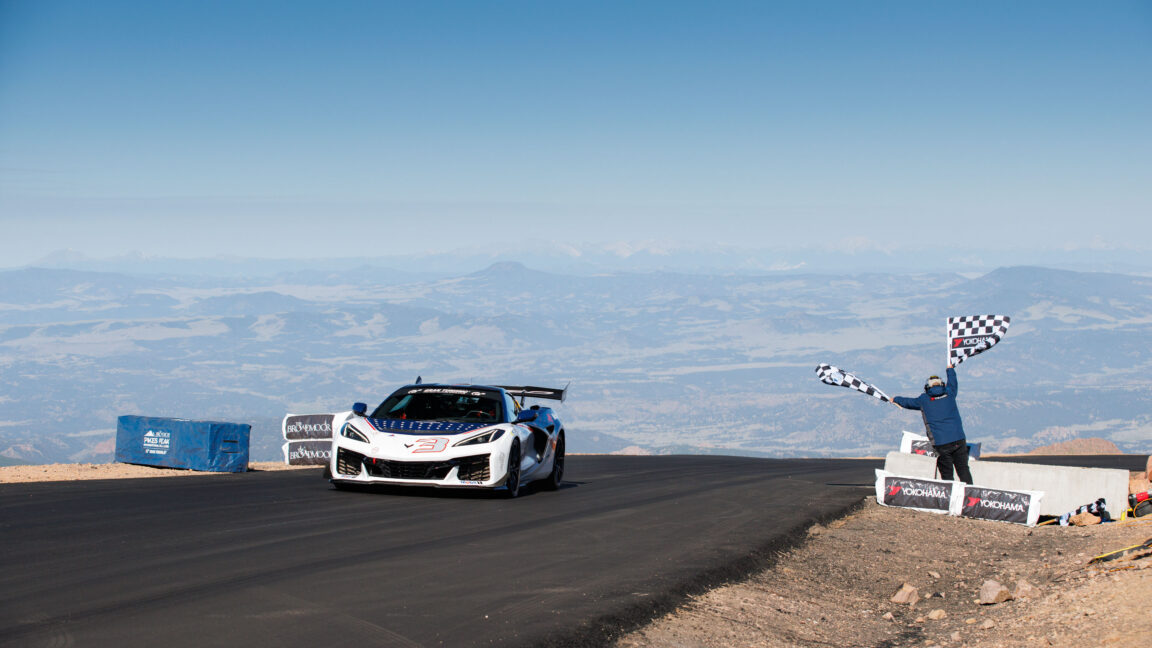
1,250 hp hybrid Corvette shatters the Pikes Peak production record
June 22, 2026 Development Source: Ars Technica
Share this article



But there’s no way to simulate all the variables of real life, particularly the weather. “The mountain is an ever-changing beast,” Burns told me. “Luckily, this year it’s been fairly great.”
Dumas was after overall honors, but ahead of the race, Burns told me that the competition this year was fierce: “I would love to say where we’re going to be. I think we’re very competitive within our class, and we’ll see how we do on the overall.”
Things weren’t necessarily looking great in the lead-up to Sunday. The Ford was out-qualified by some V8-powered competition: the open-wheel Sendycar V1, driven by Robin Shute, and the Nova Proto NP01 ATM Bardahl, driven by Simone Faggioli. All three feature different approaches to generating speed and grip, but only the Mustang relied on electric power.
But that’s before you factor in the altitude. “The engine is down a couple-hundred horsepower, still making in the 700 hp range at the top,” Stefan Frick told me. He’s an energy performance engineer on the team responsible for the ZR1X. “The turbochargers definitely help with that as well.”
Frick confirmed that no software tweaks to the car are needed to enable that performance at altitude. It’s running a stock tune, with Hildebrand choosing the “Race 1” traction setting to minimize wheelspin.
That car started its life as a development mule before being refitted for Pikes Peak duty with the mandatory roll cage and fuel cell, which Chevrolet’s engineers opted to mount in the trunk.
“We drilled the holes in and put safety equipment in it,” GM Executive Chief Engineer Tony Roma told me. “It’s every bit a representative car.”
While GM’s engineers prepped the car in the months leading up to the event, Hildebrand spent some time digitally training. “I’ve had a lot of time in racing simulators over the years,” he said, including plenty of serious machines provided by various race teams.
His team’s 911 Turbo S mixes all-wheel drive with rear-wheel steering to add some extra agility, but the electric front axle on the Corvette gives it a particular advantage in a few areas, including traction control.
“It makes it all easier to function with the hybrid, especially taking away power,” said Matt Foley, crew chief on the 000. Traditional traction control either cuts power to the engine, slowing all four wheels, or applies the brakes to the spinning wheels, which wears them out more quickly. “With the hybrid, you can literally just pull power out of the front,” he said.
But in the Corvette, its primary purpose is to provide instant, quick response in every corner, from the bottom to the top, something that particularly impressed Hildebrand in the extremely low-speed hairpins.
“Whatever car you’re in, no matter how much horsepower it has, you’re always waiting for it to get up in the power band and start building momentum off the corners,” Hildebrand told me. “This thing is just like ‘POP!’ It just pulls the car up into the second-gear RPM band, and it’s off to the races.”