Development
The UK will scan asylum-seekers’ faces for age checks—despite knowing the tech is flawed
June 20, 2026 Development Source: Ars Technica
Share this article



The investigation also found that the Home Office, which oversees UK immigration and policing, disbanded a scientific committee designed to advise it on broader age estimation methods while it was exploring the introduction of AI. “We were keen to highlight the inadequacies of facial age estimation, but this opportunity was not presented to us, and then the committee was shut down,” says Tim Cole, an emeritus professor of medical statistics at University College London’s Institute of Child Health and former committee member. Cole describes the face scans as “hideously inaccurate.”
In addition to the internal report and the scientific committee members’ concerns, years of test results from the US National Institute of Standards and Technology have shown that FAE systems’ accuracy often depends on the race of the person being analyzed and the quality of the photos taken of them.
“We have rigorous processes in place to verify an individual’s age and are working to modernize these through the testing of fast and effective facial age estimation technology,” a Home Office spokesperson says in response to the findings. The spokesperson adds that the committee was disbanded due to requiring “different fields of expertise.”
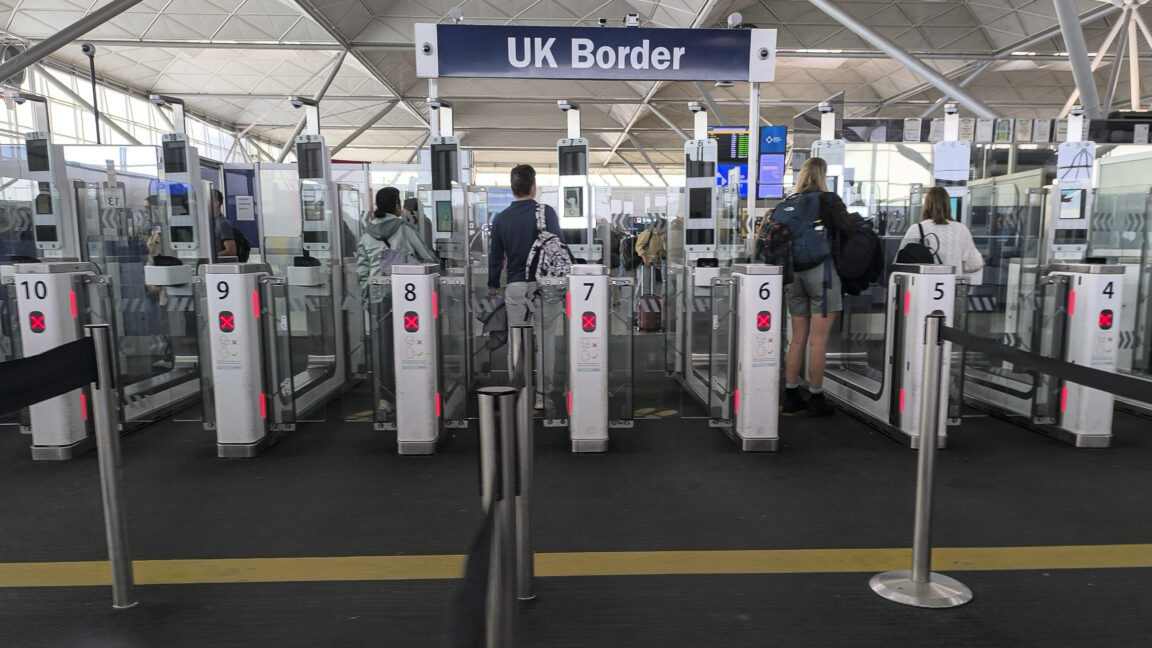
While the Home Office says face scanning is designed to be an “additional” tool for border officers and won’t “replace or overrule human judgment,” it did not answer questions about how it plans to use the technology in real-world environments. “In cases of uncertainty,” the spokesperson says, “individuals will always be treated as children until a further assessment is conducted.”
Over the past five years, AI face scans have emerged as a key component of controversial online age verification programs, as lawmakers have mandated social media platforms, porn websites, and some retailers check their users’ ages. It has also been trialed at some bars and shops in the UK. Face age estimation works by analyzing the features of someone’s face—with the underlying systems trained on millions of age-labeled faces—to produce an estimated age. In controlled laboratory tests, the best algorithms can predict a person’s age to within around 2.5 years.
However, the results can vary wildly depending on the algorithm, a person’s gender, demographic details, and other factors. Poor-quality images, such as those with bad lighting, can drastically reduce the performance of the systems. (A case in point: People have tricked some systems using images of characters from video games.) The Home Office appears to have been aware of potential problems with the technology and still pushed ahead with its program.
The leaked Home Office report produced in April 2025, which was completed before the government purchased face-scanning technology, details the testing of seven FAE algorithms against more than 2.5 million images. However, the internal report says that the unnamed “best performing algorithm” had “substantial deviations” when tested on images of Sub-Saharan Africans. On average, that system also tended to predict that a 17-year-old would be over 18, and it performed worse on females.
Tens of thousands of people make asylum claims in the UK each year, with many arriving in the country after dangerous, physically demanding journeys in small boats crossing the English Channel. Currently, border staff who doubt the age of someone claiming to be under 18 can assess their physical appearance, answers to interview questions, and general demeanor, to make an initial decision about their age. These initial age estimations are made upon the “first encounter,” the Home Office says in guidance. Since 2010, 40 percent of people who have faced age assessments have been classed as adults, according to official statistics.
The leaked Home Office report says that its findings are based primarily on testing that uses high-quality images taken of documented people, and that may mean that the algorithms’ accuracy rates would be even worse in practice. The Home Office has indicated that FAE technology would help immigration officers who are making age assessments while working at the point of first encounter.
According to the internal report, the few photos included in the testing data that were taken at initial encounters were “routinely worse” than follow-up photos of the same people. The photo quality was apparently so bad that the report was unable to determine if that or the physical condition of asylum seekers at arrival had more of an impact on the algorithms’ age estimation results. NIST’s own testing has found that for many age estimation algorithms, lower-quality photos typically lead to larger errors. The internal report concluded that more needed to be done to study the impacts of stress that asylum seekers endure before arriving at their destination.
“Children seeking asylum have often suffered unimaginable trauma,” says Martha Dark, the co-executive director of rights group Foxglove. “They should not be the test subjects for experimental tech that has baked-in inaccuracy and racist bias.” Foxglove, along with 61 other organizations, sent an open letter to the UK government on Thursday asking for the Home Office to scrap its plans to use the tool.
It is unclear if the flawed system mentioned in the report was purchased by the UK government, but in May this year it spent more than $400,000 on face-scanning technology from German company Cognitec. (The company was one of the seven algorithms tested, but it is unclear which.) A WIRED and Lighthouse Reports analysis of public data about Cognitec’s face age estimation systems found that Cognitec’s system misclassified twice as many 16-year-olds as being 18 or older when the system was tested on a dataset of lower-quality photos taken at border crossings compared to higher-quality visa photos. Lighthouse Reports conducted a full audit of the data from the NIST face estimation scores, which showed demographic differences in performance, including that 16-year-olds from West Africa were more likely to be classified as 18 or older than Eastern European 16-year-olds.
A spokesperson for Cognitec says they could not comment on their work with the Home Office; however, they point out that “demographic differences” in performance apply to all face scanning algorithms. “The reasons for bias are extremely complex and often related to image quality issues,” the spokesperson says.
“The bias of Cognitec algorithms is low compared to other algorithms of similar overall accuracy, and be assured that we are diligently and continuously working on reducing bias by developing specific testing methodologies, designing loss functions in our network training, and by diversifying the training and testing data,” the spokesperson says.
WIRED, Lighthouse Reports, and the Independent asked the Home Office detailed questions about how already stretched border officers will interact with facial age estimates, whether staff will be provided with specific training that addresses the weaknesses in the systems, and if there will be specific standards required around where and when photographs to be used in the system will be taken. We also asked the Home Office about any steps it is taking to reduce the facial and gender disparities it identified in the technology.
The Home Office did not directly address these questions but said the UK’s National Physical Laboratory has been commissioned to carry out an “independent review” of testing the systems and looking at results of its trials. It has also publicly discussed using a “threshold” age—such as configuring the system to identify if people are under 20—to reduce margins of area. It is unclear if this approach will be taken or what any thresholds may be.
Meanwhile, experts worry that any use of facial age estimation technology at borders will be “dehumanizing” for the people it impacts and could become normalized for staff. “Over time there’s a real risk that this will become entrenched,” says Anna Bacciarelli, a senior researcher at Human Rights Watch. “There’s so much risk in every component of this system that it’s really just not worth pursuing to be able to say that you’re using AI to tackle migration.”
This story originally appeared at wired.com.