
Development
Sooner than expected? Useful quantum error correction promised for 2028.
June 18, 2026 Development Source: Ars Technica
Share this article



On Monday, Amazon and QuEra claimed they will get there in two years. “By 2028, we will bring Libra, a Megaquop-scale device, capable of executing one million quantum operations over hundreds of logical qubits, to our customers, enabling first scientific applications in quantum chemistry, high-energy physics, and materials simulation that are beyond the reach of classical and Noisy Intermediate-Scale Quantum (NISQ) computers today,” Amazon’s statement said.
Those customers currently have access to a number of different quantum computing technologies via its Braket cloud service. Libra is hardware that will be provided by QuEra, a startup based in the Boston area that is pursuing neutral atom quantum computing by sharing staff and a long-term intellectual property agreement with research groups at Harvard University and the Massachusetts Institute of Technology.
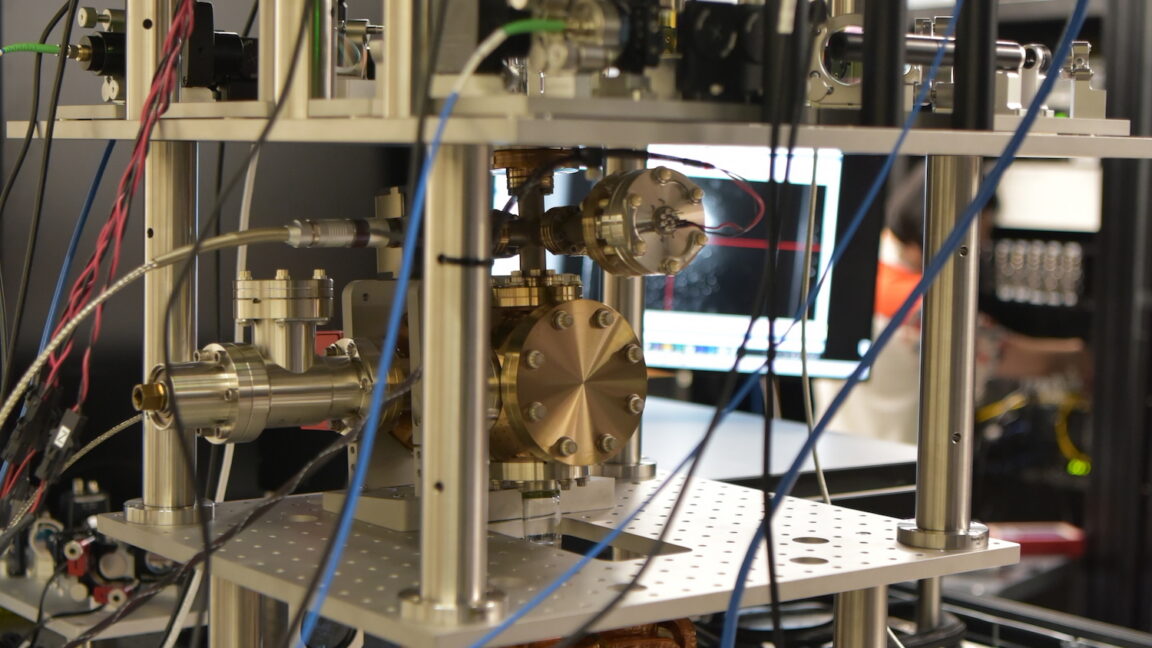
Neutral atom quantum computing is based on our ability to use lasers to cool individual atoms and trap them in a grid of overlapping light beams, with the qubit being stored in the spin of the nucleus. Separate laser systems can also move atoms around, providing any-to-any connectivity, which enables considerable flexibility for algorithmic and error-correction purposes. The technology currently falls into the “easy to make lots of them” category of hardware qubits—QuEra’s academic partners have demonstrated a 3,000 qubit grid.
However, the operation of these systems tends to heat the atoms, and moving them around is slow, so they get lost at a problematic frequency. While the people behind QuEra have demonstrated some impressive error correction, there was still considerable work to do. Understanding how the company plans to get from its current demonstrations to a high-quality system will be essential for evaluating how likely we are to start seeing error-corrected computation before the decade wraps up.
This makes the timing of Amazon’s announcement very frustrating, because QuEra intends to lay out a detailed roadmap to its Libra system next week. We’ve been promised a full briefing ahead of that, but for now, all we can say is that the two companies involved aren’t prone to hype, and probably wouldn’t be announcing this if they didn’t have very good reasons to expect things to work out.
Helios also comes with a software stack that abstracts its user’s intentions from the actual qubit hardware. Instead, users program “virtual qubits,” and a real-time control system chooses the actual hardware qubits to use. This is likely how the system will enable algorithms with error-corrected logical qubits, with the user allowing the system to handle the details of doing the actual error correction.
But the most striking news is the error rates. During single-qubit gate operations, the error rate is 0.00003, meaning you can do a lot of these operations and be confident that an error was pretty unlikely. Even the worst error rate, for two-qubit gates, is 0.0008. As a result of this and the 98 qubits Helios hosts, the machine as a whole is essentially impossible to simulate using classical computers. By the time the system would do eight rounds of operations, it would take the largest supercomputer about 10,000,000 years to simulate its behavior.
The issue of what traditional computers can do and how long it will take them has become a central issue in the biggest question the field faces: Can we get real-world quantum computers to do the key thing that theory says they should be able to, namely, do things that classical computers effectively can’t? This started out with big claims about what was termed “quantum supremacy,” some of which didn’t hold up very well once computer scientists took a careful look at the problem.
Since then, however, there’s been a bit of a shift to focus on quantum advantage, which I tend to think of as quantum computers doing things that are just wildly impractical on classical hardware. IBM has set up a quantum advantage tracker, and there’s a general consensus that we’re right on the cusp of seeing some clear examples.
But everyone involved in the discussion recognizes that each claim of quantum advantage acts a bit like a challenge to computer scientists to optimize existing classical algorithms. This seems to be exactly what’s going on, based on a claim by a group of computer scientists at a company called Q-CTRL. In May, the group put up a manuscript on the arXiv showing that they could use an IBM quantum processor to simulate a Fermi-Hubbard model in a way that was 3,000 times faster than an optimized algorithm running on a cluster of 32 CPUs.
People at another software company (Multiverse Computing) saw that as a challenge. In collaboration with some academics, they noticed a tradeoff in the algorithm used in the quantum advantage demonstration. Basically, to limit the complexity, the Q-CTRL team limited the number of symmetries they considered. But the Multiverse team saw that including all the symmetries possible in the system reduced the number that had to be considered independently. That trade-off favored shorter execution times on classical systems.
The Multiverse team also used the output of simulations to determine when to use a simplified approach to one calculation and optimized the algorithm to run on BPUs. The net result was that they cut the quantum advantage from a factor of 3,000 down to 36. Plus, they ran the simulation for one additional time step beyond what had been done on the quantum system.
The result is exactly the reason IBM set up its tracker: People there recognized that any claims of quantum advantage would only be accepted after an ongoing conversation between quantum computing scientists and more traditional algorithm makers. The awkward result of this is that even if a valid claim of quantum advantage is submitted (or already sits in the tracker), it may be several years before it’s widely recognized for what it is.
At that point, if Amazon and QuEra are right, we’ll already have error-corrected quantum computing hardware.