
Development
20 years of Intel Macs: Why Apple switched, and why it switched again
June 15, 2026 Development Source: Ars Technica
Share this article



By early 2002, Marklar had attracted more attention within Apple, and then-CEO Steve Jobs briefly flirted with the idea of allowing Mac OS X to run on Sony’s Vaio laptops. By that August, a dozen or so engineers had been added to the project as it grew from “proof-of-concept” to “contingency plan.”
That’s because Apple was having problems with PowerPC chips. Jobs promised that the desktop version of the G5 would climb in clock speed from 2 GHz to 3 GHz within a year, a promise that never came to pass. And Apple was never able to squeeze the hot, power-hungry processor into a laptop—iBooks and PowerBooks were stuck with revised versions of the G4. Future CEO Tim Cook called a G5-based laptop “the mother of all thermal challenges.”
Jobs had been fuming about PowerPC chips for a while; Walter Isaacson’s Jobs biography describes a heated call between Jobs and Motorola CEO Chris Galvin in 1997, in which Jobs declared that PowerPC chips “sucked.” And he may have harbored other bad feelings; Geoffrey Cain’s Steve Jobs in Exile says that Apple’s PowerPC switch doomed further development of the Motorola m68k chips that NeXT’s computers relied on, helping to kill NeXT’s already-struggling hardware business.
And IBM, for its part, didn’t want to devote its resources to developing a bunch of chips that would be used exclusively in the low-volume Mac lineup (in 2003, Apple shipped roughly 3 million Macs; the company no longer reports unit sales in its earnings reports, but analysts peg that number at just under 26 million Macs in 2025).
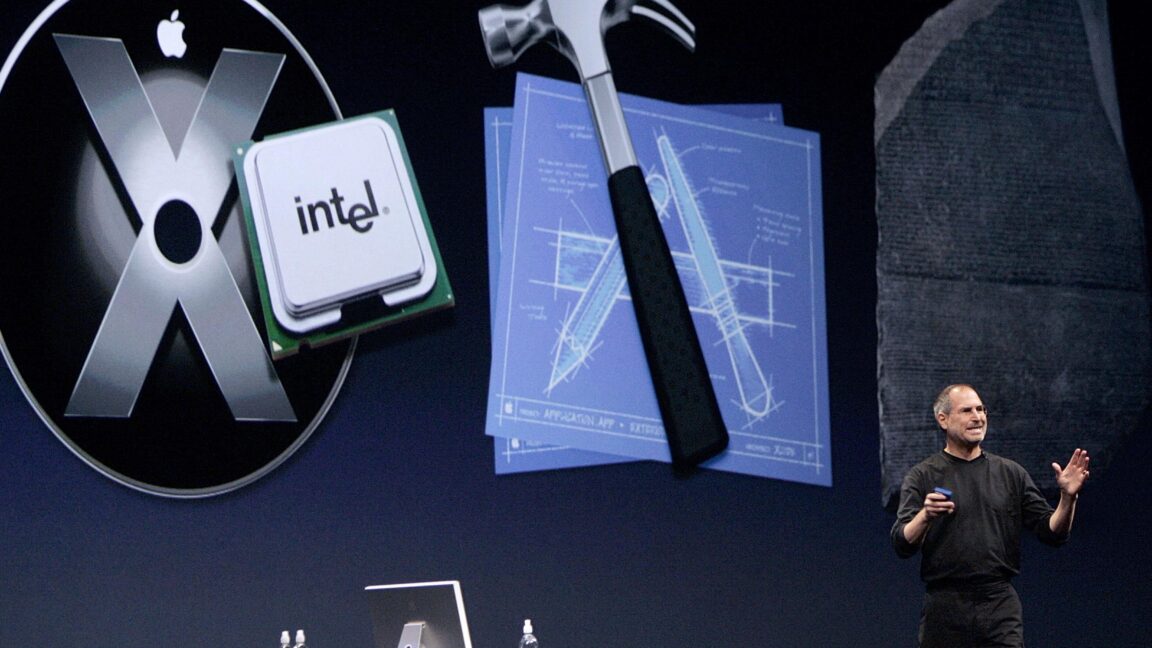
“And so today for the first time, I can confirm the rumors that every release of Mac OS X has been compiled for both PowerPC and Intel,” announced Jobs. “This has been going on for the last five years. Just in case.”
The “first” Intel Mac was a Developer Transition Kit (DTK) made available to software developers after WWDC 2005. It was essentially a Pentium 4-based PC inside a Power Mac G5 case, and it was available strictly as a loan to developers who could pay $499 per year for a developer account and another $999 for the kit. Few, if any, of these DTK kits survived; Apple required developers to return the systems by the end of 2006 and offered to trade them for a real retail Intel Mac to seal the deal.
The WWDC keynote laid out the timeline, in addition to the tools Apple would use to help developers and users navigate the transition. The next version of Mac OS X, version 10.5 Leopard, would be compatible with both PowerPC and Intel Macs. A compatibility layer called Rosetta would run most PowerPC apps tolerably well while developers worked on Intel-native versions, which could be distributed as universal binaries that supported both CPU architectures. This transition worked well enough that Apple essentially handled the Intel-to-Apple-Silicon switch the exact same way.
Apple would also take advantage of the fact that its computers would use the same hardware as other PCs. Right from the start, Apple officially supported running Windows directly on Intel Macs via Boot Camp; a Mac OS X app would handle partitioning the Mac’s disk and downloading Windows drivers for the Mac you were using, and a Windows-side app supported rebooting back into Mac OS (and eventually provided some other nice-to-haves like read-only access to HFS+ formatted volumes).
By January of 2006, Apple started shipping the first Intel Macs, starting with a new iMac and a renamed MacBook Pro to replace the outgoing PowerBook series. These first systems were externally almost indistinguishable from the PowerPC models they replaced, another strategy Apple recycled for the first Apple Silicon Macs—the implied message was “maybe these machines were different on the inside, but they’re still the Macs you know and love.”
During the WWDC 2005 presentation, Jobs predicted that the Intel transition would be mostly complete by the end of 2007. Unlike the 3GHz G5 prediction, this one actually wasn’t optimistic enough: Apple completed its switch from PowerPC to Intel chips with the announcement of a new Mac Pro and Intel-based Xserve in August of 2006.
“As we look ahead, we can envision some amazing products we want to build for you, and we don’t know how to build them with the future PowerPC roadmap,” said Jobs while explaining the rationale for the switch. (It’s funny to think of now, but some of the Mac’s staunchest loyalists did react to the switch with disproportionate dismay.)
For the first few years of the Intel era, updates came fast and often. The first wave of Intel Macs briefly reverted to 32-bit chips, a retreat from the 64-bit architecture of the G5; this was fixed the next year with a switch to 64-bit Intel Core 2 Duo processors. A flashy new aluminum-and-glass iMac overhaul came in 2007, defining an aesthetic that is still recognizable in today’s Apple products. By the early 2010s, Intel’s rapidly improving integrated GPUs enabled the Mac’s first high-resolution “Retina” displays.
But the tastiest fruit of the early Apple-Intel partnership, a machine that wouldn’t have been possible with PowerPC chips, was the MacBook Air. For that first model, Intel had even made a special version of its Core 2 Duo CPU with 60 percent smaller packaging, something that helped Apple cram an entire laptop into something that could fit in a manila envelope.
That first Air was a bit too ahead of its time; its 4,200 RPM spinning hard drive in particular helped bog it down, and the things it was missing felt like bigger compromises in 2008 than they would have just a few years later. But fast solid-state storage soon became a standard feature, and within just a few years, the MacBook Air was what virtually all laptops looked like. This was something Intel both enabled and encouraged.
Those models shipped with a now-abandoned piece of technology called the Touch Bar, a narrow strip of touchscreen above the keyboard that attempted to replace the function row with other buttons and sliders that could change dynamically based on what the user was doing.
To make the Touch Bar work, those Macs included a chip called the Apple T1. The T1 wasn’t much—it was essentially a repurposed Apple Watch processor that existed to drive the Touch Bar display and provide Macs with a Secure Enclave that could be used for Touch ID and Apple Pay. But it was a sign that Intel’s chips were no longer serving all of Apple’s needs. As in the PowerPC days, Apple was envisioning products that its chip supplier couldn’t help it build.
The first Apple Silicon Macs and the Apple M1 chip were announced in November of that year, and from then on, Intel Macs were living on borrowed time. The Apple Silicon transition took quite a bit longer than the PowerPC-to-Intel switch had, but the company finally completed the transition in mid-2023.
Apple promised that Intel Macs would be supported for “years to come,” and it did make good on that promise, though later Intel Macs received fewer operating system updates than earlier ones. From 2020’s macOS 11 Big Sur to last year’s macOS 26 Tahoe, Apple released a total of six macOS releases that supported both architectures, though Tahoe’s support list included just a bare handful of Intel models. Those Macs will get security and Safari updates until the fall of 2028. And then the Intel Mac era will be fully in the rearview.
What’s striking about the Intel Mac era is that Apple switched to and away from Intel chips for basically the same reason: It was looking for a more compelling processor roadmap and the best possible performance-per-Watt for its chips. When Intel was executing well—and during the decade between the mid-00s and mid-2010s, Intel was executing exceptionally well—Apple wanted in. It was only after years of watching Intel struggle that Apple wanted out.
The big difference? When Apple stopped shipping PowerPC chips, consumer-focused PowerPC chips essentially disappeared. But Intel is still making and shipping processors, meaning that we (and Apple) can still see what could have been if the switch had never happened.
Some of Intel’s updates this decade have been pretty good. The current Core Ultra Series 3 chips, in particular, are its most competitive in years, based on their CPU performance, graphics performance, and power efficiency. But I’d take Apple’s steady, consistent drumbeat of generation-over-generation improvement any day over Intel’s herky-jerky rollercoaster of refreshes, rebadges, and architectural overhauls.
Ditching Intel was a big risk for Apple, but so far, it’s been the right decision.