
Development
Rocket Report: Nova moving through test campaign; SpaceX IPO launches Friday
June 12, 2026 Development Source: Ars Technica
Share this article



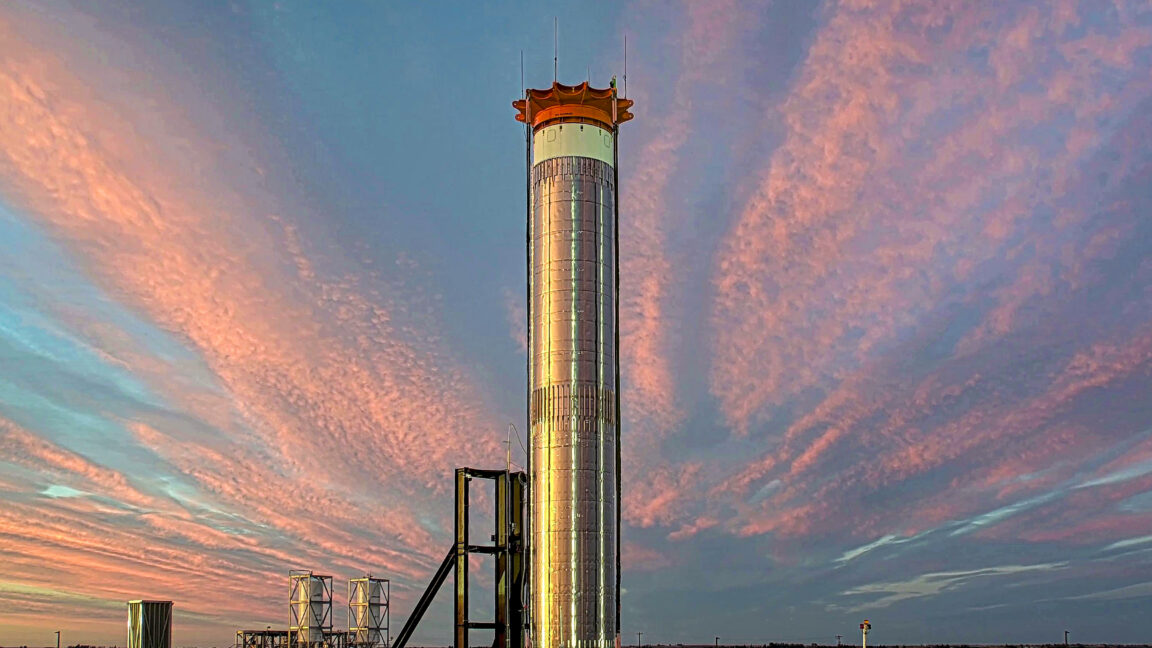
Engine installation soon … The Nova vehicle features a 27.1-meter reusable first stage that will use return-to-launch-site or droneship landing capabilities for recovery. The engines have undergone hours of vertical hot-fire testing in the twin cell firing stand at the Moses Lake site. The vehicle will receive its engines in the coming months and then undergo further testing and verification before its eventual departure to Cape Canaveral for final vehicle integration and launch. (submitted by stefan_lec)
Offshore is where the new action is at? Concerns that America’s launch infrastructure may not keep pace with rising demand are reviving interest in an unconventional workaround: sea-based rocket launch, Space News reports. Long viewed as a technically difficult niche with a history of commercial failure, companies and defense officials are giving offshore launch a second look as they search for ways to expand launch capacity in the US.
Seeking resiliency … A May report commissioned by the Commercial Space Federation warns that expanding satellite constellations could strain US launch infrastructure and force policymakers to consider “non-traditional” launch sites, including inland and sea-based spaceports. National security concerns are also at play as officials warn that space launch sites could become targets in an armed conflict. Mobile offshore launch systems potentially offer a more distributed and difficult-to-target alternative.
We take the Falcon 9 rocket for granted … It now launches so often—a few times a week—that its flights are a complete non-event. But in reality, the Falcon 9 rocket is the bedrock of SpaceX’s success today. And whatever one might think of the company’s impending IPO—whether it’s a financial boondoggle or a long-awaited opportunity for investors to own a piece of SpaceX—its valuation is largely due to the Falcon 9 vehicle. It is only due to the reuse of this rocket, and its deployment of the Starlink constellation, that SpaceX’s ambitious plans for Starlink and orbital data centers are credible.
More powerful Ariane 6 variant on tap. Arianespace has announced that the first Ariane 64 rocket equipped with its upgraded P160C solid-fuel boosters will launch on June 17. The rocket will carry 36 satellites to low-Earth orbit for Amazon, European Spaceflight reports. Since its introduction in July 2024, a total of seven Ariane 6 flights have been launched from the Guiana Space Centre’s ELA-4 launch site.
A 12 percent increase … The first five used the rocket’s two-booster configuration, while the two most recent flights used the more powerful four-booster configuration. All seven, however, used the P120C, the current generation of the rocket’s solid-fuel strap-on booster. In December 2025, the European Space Agency announced that it had fully qualified the upgraded P160C booster, which includes an additional 14 metric tons of solid propellant. The more powerful boosters allow the Ariane 6 rocket to carry four additional Amazon Leo satellites than previous launches.
See you next summer? … NASA chose an experienced, all-male crew with military backgrounds. The individuals were revealed inside a darkened Teague Auditorium where hundreds of friends, family members, and NASA employees cheered enthusiastically: NASA astronaut Randy Bresnik, commander; ESA astronaut Luca Parmitano, pilot; NASA astronaut Andre Douglas, mission specialist; and NASA astronaut Frank Rubio, mission specialist. NASA Administrator Jared Isaacman said Artemis III could launch as early as summer 2027, but much work remains before then.
But will New Glenn be ready? The Artemis III mission involves a lot of moving parts, the most significant of which is arguably a Blue Origin demonstration lander launching on a New Glenn rocket. Ars spoke with the Artemis program manager, Jeremy Parsons, to gather more information about this specific element of the mission. The nominal plan is to launch the test lander (essentially a crew module of the Blue Moon Mk2 vehicle) on New Glenn.
Dual path going forward … But of course, two weeks ago, the New Glenn rocket exploded on its launch pad in Florida, causing significant infrastructure damage there. Parsons said NASA is going to work closely with Blue Origin with the intent, for now, of launching on New Glenn. “It’s going to be a dual path,” Parsons said. “They’re really getting in and clearing out SLC-36 right now, and a lot of the key hardware is in really good shape. That being said, we’re going to be working with them hand in hand every single day, and we are bringing every assessment to bear. Like, if I needed to fly on another vehicle, what would that look like?” Vulcan and Falcon Heavy are options.
Amazon gets deadline reprieve. The Federal Communications Commission has waived a requirement for Amazon to launch half of its satellite broadband constellation by the end of July, a key regulatory reprieve that buys the tech giant time to get more of its spacecraft into orbit, Ars reports. It has been apparent for some time that Amazon would not meet the FCC’s requirement to launch half of its satellites—1,616 spacecraft—by the end of next month. Amazon filed an application in January requesting the FCC extend the deadline to July 2028 or waive it altogether. The commission decided on the latter option, removing any time limit for the 50 percent deployment milestone, but keeping the July 2029 deadline in place for the entire constellation.
Wanted: A road to space … Building satellites isn’t the biggest problem for Amazon Leo; it’s launching them. The company has stacks of satellites—each a little more than a half-ton in mass—awaiting rides to space on Blue Origin’s New Glenn rocket and United Launch Alliance’s Vulcan launch vehicle. Both rockets are grounded after recent anomalies. Amazon has booked launches on other rockets, but none have the lift capacity to put as many satellites into orbit as Vulcan and New Glenn, each of which can deliver more than 40 Amazon Leo platforms to space in one go. United Launch Alliance’s soon-to-retire Atlas V rocket has done most of the heavy lifting for Amazon Leo to date, but just one more Atlas V is available to Amazon. It will launch in the coming weeks from Cape Canaveral, Florida, with 29 satellites.
June 12: H3 | H3-30 test flight | Tanegashima Space Center, Japan | 00:53 UTC
June 13: Falcon 9 | Starlink 10-54 | Cape Canaveral Space Force Station, Florida | 12:27 UTC
June 15: Kinetica 1 | Unknown Payload | Jiuquan Satellite Launch Center, China | 03:40 UTC