
Development
F1 teams spend millions on their simulators—what makes them different?
June 11, 2026 Development Source: Ars Technica
Share this article



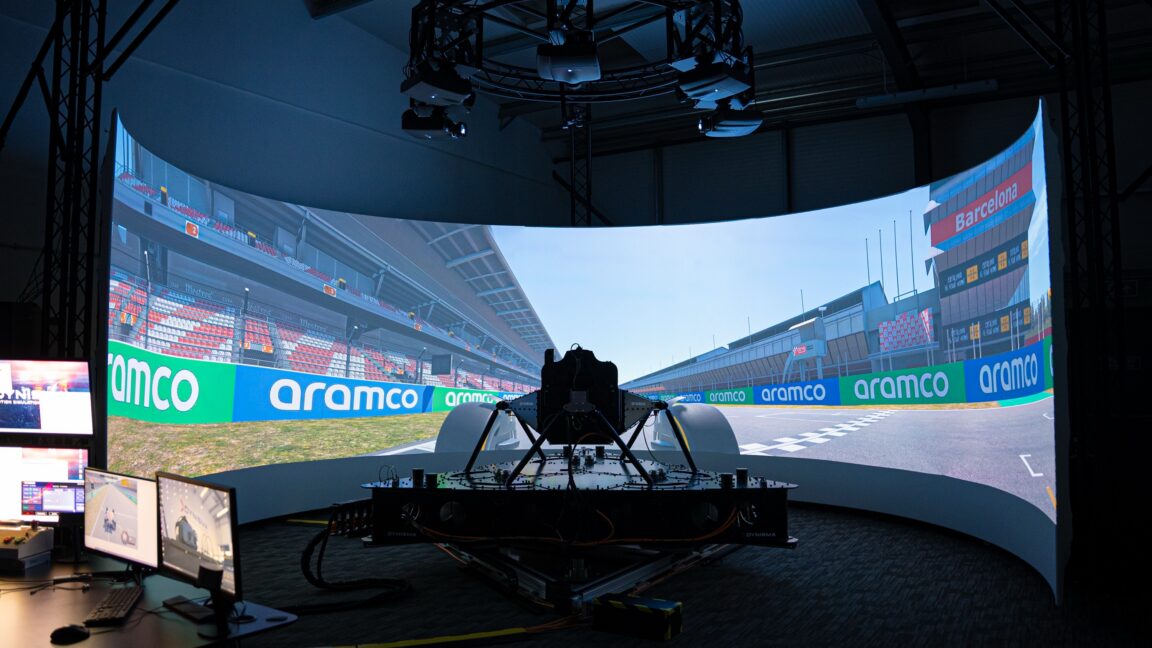
Warne started Dynisma after working for both McLaren and then Ferrari, after realizing that an ultra-low-latency simulator was possible. “I was able to prove, just with pen and paper, and then with simulation, that we ought to be able to get this kind of delay down, around 3 milliseconds,” Warne said. The first prototype, built when Dynisma was still a one-person operation, used hobbyist-grade electronics and motors to prove the concept. “Rather than using the industrial computers and [programmable logic controllers] and control systems we use today, the first system was developed using an Arduino and Raspberry Pi and a whole bunch of other consumer electronics,” Warne said.
High bandwidth is another must, and it’s an area where we see a big difference from flight simulators. “They move very, very slowly, and they’re interested in doing sustained bank angles, whereas we’re doing a very different problem,” Warne explained. “It’s all about being in a vehicle that’s stuck to the roads, and all of the vibrations that come from every bump that you get in the road, also from engines, etc, tires vibrating, all of these sorts of higher-frequency vibrations get transmitted in a car up through into the driver’s seat,” he said.
Pagenaud has seen racing simulators evolve alongside his career, which includes an Indy 500 win as well as championships in both IndyCar and the American Le Mans Series. “My first experience on the simulator I think was probably 2008 with Wirth Research… when we had the De Ferran Motorsport program and it was already pretty good, but it definitely is not at the level it’s at now,” Pagenaud said. “The evolution since my first time on the simulator is tremendous. The visuals, of course; the movement of the platform is another thing. I would say the hardware has massively improved, and the latency is something we fight for with computer power every day, but the latency is really everything to give the driver the right feedback,” Pagenaud said.
But what is it that a sim driver actually does for their team? “The biggest thing right now, especially in F1, is trying to understand the energy spent into the tire and not overheating the tires. So it is a big part of our job right now, trying to figure out what can we do to make the tires last longer, work better with the race car, give us more grip,” he said.
“The goal is to make the car better and help the race drivers perform better on race weekend, which is the job for every sim driver,” Pagenaud said. “The younger ones, obviously they’re also trying to prove themselves. So their job’s a bit different to mine. They need to perform. They need to always be super fast. I need to be consistent. I need to give the engineers a very subjective feedback on, ‘was this better or was this worse for real life?’ So I’m always trying to project myself into real life.”
As the two Cadillac race cars of Sergio Perez and Valtteri Bottas got ready for the first practice session of last weekend’s Monaco Grand Prix, Pagenaud was also getting to work in the sim at GM’s motorsports HQ outside Charlotte, North Carolina, plugged in to the same comms network as the engineers at the track and the Charlotte control center. (The Cadillac F1 team’s new Dynisma sim will be installed at the team’s new base in Indianapolis.)