
Development
Rocket Report: Starship V3 test-fired; ESA's tentative step toward crew launch
April 17, 2026 Development Source: Ars Technica
Share this article



Riding with the competition... This was the fourth time Northrop Grumman has turned to SpaceX to launch a cargo mission to the ISS. Northrop Grumman and SpaceX are NASA’s two primary resupply contractors for the space station program, each with their own rockets and cargo ships. But Northrop’s Antares rocket is out of service after losing access to Russian rocket engines in the aftermath of Russia’s invasion of Ukraine. Until a new booster is ready with US-made engines, Cygnus cargo ships will launch on SpaceX Falcon 9s. Officially, the next Cygnus mission is supposed to launch on the new Antares 330 rocket with US-made engines from Firefly Aerospace. We’ll see if that plan holds as Northrop and Firefly continue developing the new Antares booster stage. (submitted by EllPeaTea)
ESA plans for a launch abort demonstrator. The European Space Agency has opened its call for proposals to develop a Crew Launch Abort Demonstrator, a project first announced last November, European Spaceflight reports. With the call now open, the agency has published additional information about the project, including a budget of 1 million euros ($1.2 million) for this initial phase of the demonstrator’s development. ESA officially opened the call for proposals April 10 for the “system level definition phase” for the launch abort program. This is a first step, focusing on modeling a launch abort sequence with an Ariane 6 rocket, with a particular emphasis on pad abort scenarios. This phase is expected to last no longer than 12 months.
All talk?… There appears to be a connection between the Crew Launch Abort Demonstrator project and ESA’s Low-Earth Orbit Cargo Return Service, which seeks to support development of a European cargo transportation system that could undergo initial tests at the International Space Station. One of ESA’s requirements for the cargo vehicle is that it be capable of adaptation into a crew vehicle. ESA has flirted with the idea of an independent human spaceflight capability before, but none of the concepts have ever reached the launch pad. The agency has historically relied on the United States and Russia to send its astronauts into space and will probably need to look abroad for the foreseeable future. (submitted by EllPeaTea)
More swaps coming?… The Vulcan rocket is many months from returning to flight for the US military. One industry source told Ars that the Space Force may not fly another mission on Vulcan before the end of the year. Space Systems Command has moved four launches of new GPS navigation satellites from ULA to SpaceX in the past two years as Vulcan encountered delays. Col. Eric Zarybnisky, head of Space Systems Command’s Space Access office, said the military is “working through a significant number” of potential additional rocket swaps from Vulcan to another launch vehicle, likely SpaceX’s Falcon 9 or Falcon Heavy.
ESA’s first Mars rover finally has a ride. NASA confirmed Thursday that SpaceX will launch the European Space Agency’s Rosalind Franklin Mars rover, perhaps as soon as late 2028, on a Falcon Heavy rocket from Kennedy Space Center, Florida, Ars reports. So why is NASA deciding which rocket will launch a flagship European Mars mission? It’s a long story involving the search for extraterrestrial life, crippling political hatchets, and of all things, Russia’s invasion of Ukraine. Ars explores the mission’s tortured history, a nearly quarter-century of broken promises, technical setbacks, and geopolitical drama.
Taking aim on Mars… The announcement is also notable because it is the first time SpaceX has won a launch contract for a mission to Mars. The red planet is the apple of Elon Musk’s eye, with utopian concepts for a settlement on Mars to go along with SpaceX’s more tangible work on a massive rocket to actually fly there. This new rocket, named Starship, is still a ways away from being able to reach Mars. Therefore, it’s likely SpaceX’s Falcon Heavy, no slouch itself, will make the company’s first Mars run on behalf of NASA and the European Space Agency.
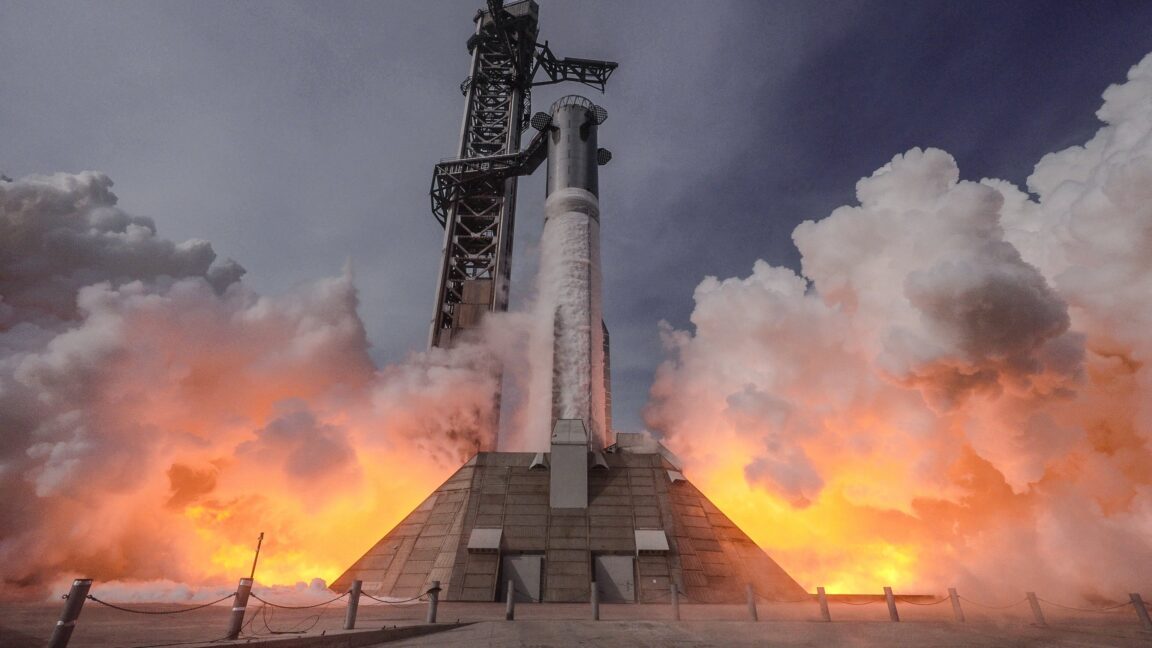
Next-gen Starship tested at Starbase. The new, juiced-up version of SpaceX’s Starship mega-rocket cleared a big hurdle this week on the path to its first-ever launch, Space.com reports. That liftoff, targeted for early or mid-May, will be the 12th overall for Starship but the first for the vehicle’s “Version 3,” which is bigger and more powerful than its predecessors. The first Starship V3 vehicle fired its six Raptor engines Tuesday while anchored on a test stand in South Texas. The static fire test follows a series of cryogenic proof tests earlier this year.
And then, Super Heavy… One day later, SpaceX fired up 33 engines on the Super Heavy booster that will send Starship V3 skyward. This short-duration test occurred directly on SpaceX’s launch pad at Starbase, Texas. The same booster was test-fired with 10 of its engines last month, but Wednesday’s static fire was the first time all 33 engines were ignited on the new Super Heavy. The upgrades debuting with Starship V3 include higher-thrust Raptor engines. Therefore, it can be said the Super Heavy booster lit Wednesday became the most powerful rocket booster ever fired. But the real fun will come with the launch, and it can’t come soon enough. It has been six months since the last Starship test flight. Starship V3 is needed to begin demonstrating in-orbit refueling, an enabling capability for turning Starship into a human-rated Moon lander for NASA’s Artemis program. (submitted by EllPeaTea)
Still some work to do… “Establishing a New Glenn launch site to provide efficient access to high-inclination orbits for our customers is a priority, and SLC-14 represents a viable option,” Blue Origin said in a statement. The selection of Blue Origin for Vandenberg moves the effort to the next phase, with several crucial milestones still remaining before any heavy or super-heavy rockets blast off from SLC-14. The selection will lead to talks between Blue and the Space Force to hash out terms and conditions of a real property use agreement for the land. Teams must also complete safety and environmental assessments.
Meanwhile, at Cape Canaveral. Blue Origin crews are prepping to launch the company’s third New Glenn rocket the morning of Sunday, April 19, Florida Today reports. The Jeff Bezos-founded space company announced the two-hour launch window will extend from 6:45 am EDT to 8:45 am EDT at Cape Canaveral Space Force Station, Florida. The New Glenn’s first stage, reused from a launch in November, fired its seven BE-4 main engines on the launch pad shortly after sunrise Thursday. This was a key milestone for Blue Origin, marking the first time a previously flown New Glenn booster has been fired again.
But there’s something new… Dave Limp, Blue Origin’s CEO, confirmed earlier this week that the seven engines flying on this weekend’s launch are not the same ones that powered the booster on its first flight last year. Those flight-proven engines will be used on future flights, Limp said. Blue Origin aims to land the booster again after the upcoming launch, which will carry a cellular broadband satellite into low-Earth orbit for AST SpaceMobile. (submitted by EllPeaTea)
April 18: Falcon 9 | Starlink 17-22 | Vandenberg Space Force Base, California | 14:00 UTC
April 19: New Glenn | BlueBird Block 2 FM2 | Cape Canaveral Space Force Station, Florida | 10:45 UTC
April 20: Falcon 9 | GPS III SV10 | Cape Canaveral Space Force Station, Florida | 06:57 UTC