
Development
After a saga of broken promises, a European rover finally has a ride to Mars
April 17, 2026 Development Source: Ars Technica
Share this article



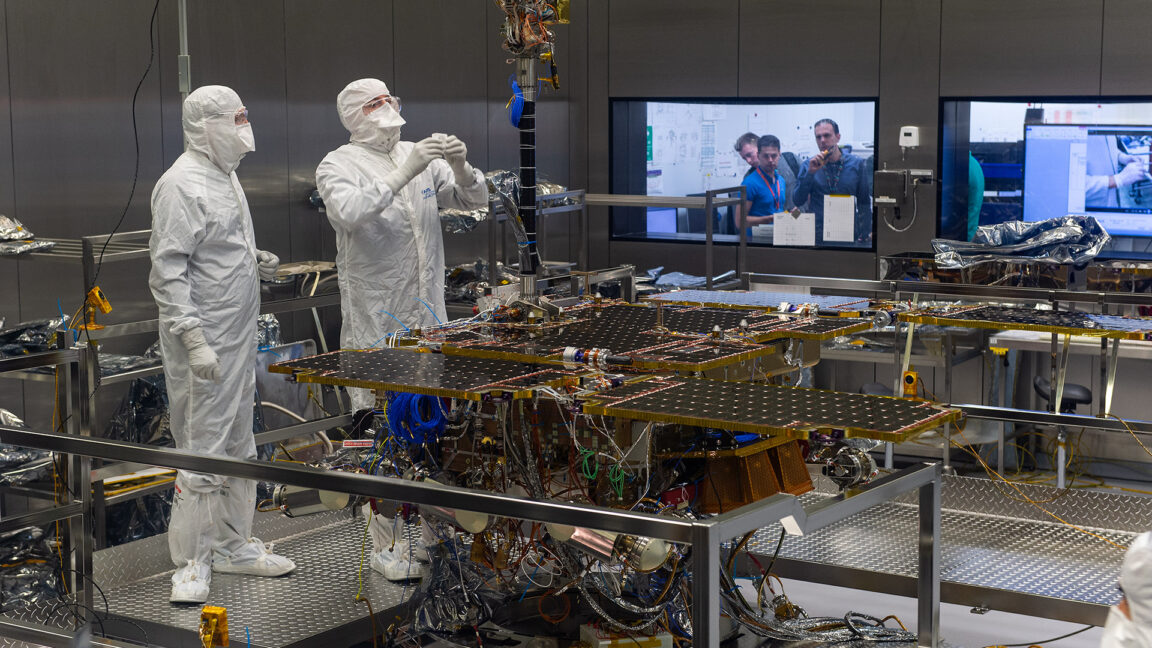
NASA confirmed Thursday that SpaceX will launch the European Space Agency’s Rosalind Franklin Mars rover, perhaps as soon as late 2028, on a Falcon Heavy rocket from Kennedy Space Center, Florida.
So why is NASA deciding which rocket will launch a flagship European Mars mission? It’s a long story involving the search for extraterrestrial life, crippling political hatchets, and of all things, Russia’s invasion of Ukraine.
You can trace the history of Europe’s Rosalind Franklin mission back a nearly a quarter-century. A few years after NASA landed its first rover on Mars in 1997, the European Space Agency came up with a plan to send its own mobile robot to the red planet. The European rover was part of a program named Aurora, and officials hoped to launch it in 2009. Russia would have supplied a Soyuz rocket to send the rover on its way.
“Delays ensued and plans changed,” ESA officials wrote in a 2016 fact sheet on the mission. This has become quite the understatement. What was originally a mostly European project, renamed ExoMars, became the centerpiece of a joint initiative with the United States in 2009, when NASA and ESA signed an agreement to pursue the exploration of Mars together.
The European rover was to fly to Mars in tandem with a similarly-sized US rover in 2018. A landing system based on the Jet Propulsion Laboratory’s “sky crane” architecture would deliver both rovers to the surface of Mars at the same time. A European orbiter designed to sniff out traces of methane in the Martian atmosphere would launch in 2016, two years before the rovers. NASA agreed to launch the 2016 and 2018 missions on a pair of United Launch Alliance Atlas V rockets.
But NASA pulled out of the agreement less than three years later. The Obama administration canceled most of NASA’s participation in ExoMars in 2012, citing budgetary constraints such as cost overruns with the James Webb Space Telescope. ESA had its own funding limitations, and could not afford to replace NASA’s launch and landing system contributions on its own.
Instead, the agency turned to Russia to launch the orbiter and rover on two Proton rockets and provide the descent system to deliver the rover to Mars. In exchange, ESA agreed to add Russian science instruments to the orbiter and rover missions. This was a boon for Russian scientific institutions. Without an international partnership like ExoMars, they lacked any realistic prospect of ever sending their own research payloads to the red planet.
Russia successfully launched the European-built ExoMars Trace Gas Orbiter spacecraft on a Proton rocket in 2016. The orbiter is still operating around Mars today, returning scientific data and serving as a communications relay for NASA’s Curiosity and Perseverance rovers. A small European tech demo probe riding piggyback on the orbiter crash landed upon reaching the red planet.
But there was still one more hurdle to jump. Last year, just 12 months after NASA committed to help ESA with Rosalind Franklin, the Trump administration tried to cancel the US contributions, along with numerous other NASA science missions. Lawmakers rejected Trump’s proposed budget cuts when Congress passed the fiscal year 2026 budget bill for NASA.
Now, NASA has approved the agency’s Rosalind Franklin Support and Augmentation (ROSA) project to begin implementation. This announcement Thursday was accompanied by news of NASA’s decision to award the Rosalind Franklin launch contract to SpaceX. The Falcon Heavy now becomes the fourth rocket officials have planned to use for launching Europe’s first Mars rover. This time, there’s a real contract on the books. It will likely be SpaceX’s first launch to Mars.