
Development
Microsoft, Atom Computing, EeroQ update their quantum computing progress
June 4, 2026 Development Source: Ars Technica
Share this article



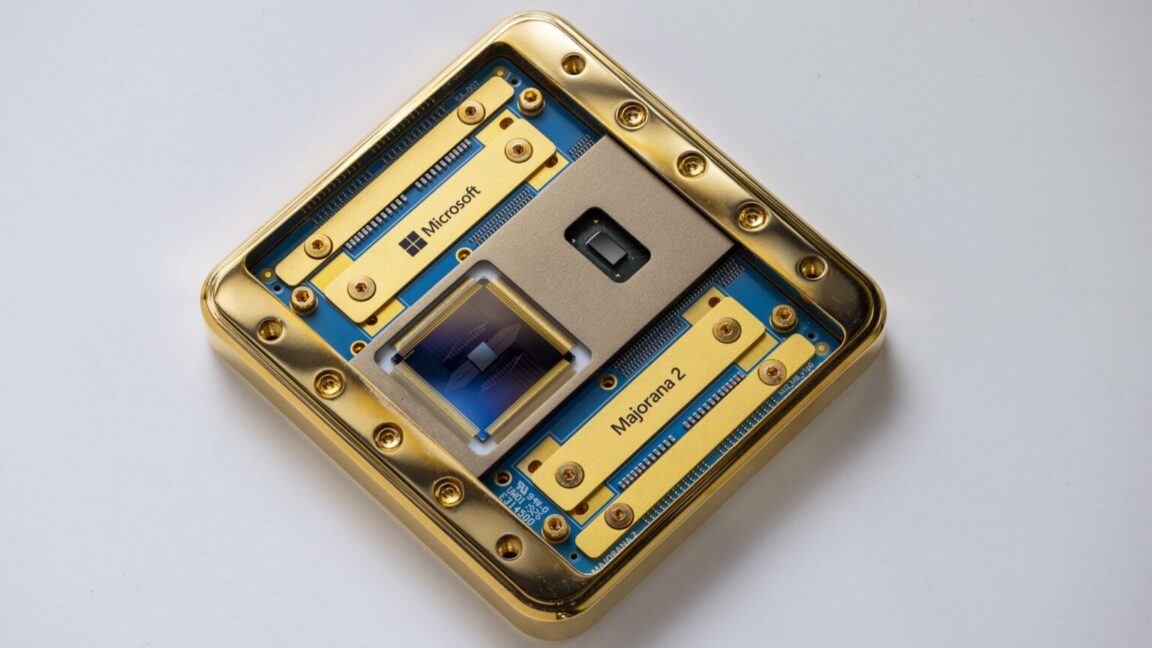
This week, the company released an update reporting much better performance by changing the materials it used to make its qubits. In its earlier version of its hardware, it used aluminum as a superconductor (the devices are kept near absolute zero). That’s been replaced with lead. The underlying semiconductor was also reformulated to include some tin, which improved the spin-orbit coupling between its electrons and those in the lead.
The devices Microsoft is using have two parallel wires and rely on measuring the parity of the pair (both with one extra electron, both without, or a mixed state) using quantum dots. As mentioned, the original system was very noisy and would often spontaneously change parity state every 10 milliseconds or less. With the new materials, a parity state could sometimes exceed 20 seconds. This sort of stability was always the promise of topological qubits, and why Microsoft originally committed to the system.
That said, the company still has a long road ahead. It still needs to demonstrate the ability to manipulate the parity in a way that allows it to perform computational manipulations on individual qubits and pairs of them. Long term, there will be decisions to be made regarding how to link the individual qubits in a way that enables error correction. But if this manuscript holds up during peer review, it seems the hardware bet Microsoft made was a solid one.
That’s not “hardware” in the typical computing sense. Most of the solid material involves lasers and optical guides; the computation is done using the nuclear spins of atoms held suspended by an array of laser light. Still, Atom is developing something akin to an architecture in which there’s a storage region, an operations zone, and a collection of backup atoms that can be brought in if one of the others is lost. A configuration of lasers called “optical tweezers” is used to shuffle atoms among these locations.
In a new manuscript, the company shows just how essential having that reserve of spare atoms can be. To hold their state and keep them in the traps, lasers must be used to cool the atoms, which tend to warm up during operations. The cooling is a slow process, but failure to do so tends to leave the hot atoms able to hop out of the laser traps that hold them in a grid, which obviously introduces errors.
So, Atom had a bit of a catch-22: it needed to perform operations to do error correction, but those operations made errors more probable.
Its solution was identifying that it could do the measurements needed for error correction in a way that would swap a spare, pre-cooled atom in to a logical qubit. Doing tests by repeatedly measuring the state of a logical qubit (a linked collection of data-storing and error-detection qubits) showed this made a big difference. Performing error correction on the logical qubit without swapping in cold atoms caused the probability of an error to rise with each successive measurement. Doing the swap kept the probability roughly constant over time.
That doesn’t mean the error-corrected qubit was fully stable. Eventually, one of the errors that inevitably occurred couldn’t be recovered from because too many of its individual atoms changed state at once. But performing normal error correction could keep some of these logical qubits stable for up to 90 rounds.
Again, that’s not good enough for any sort of sophisticated calculation. But it’s a lot closer than the company was before working out this technique.
EeroQ is a startup with a distinct approach to qubits. A number of companies are looking into using the spin of electrons as their qubits, typically because it’s easy to fabricate chips that can manipulate electrons held in quantum dots. EeroQ is making its chips with lots of tiny pools that can hold a drop of liquid helium. When an electron is placed on that drop, it has nowhere to go because helium hates to carry an extra electron. So, the lone electron just floats on the surface.
Which is great, but it was already well-established physics long before the company launched. The problem was that nobody had figured out a method to interact with the electron in useful ways.
Recently, the company released a manuscript describing a new version of its chip, one with a small resonator next to the helium-filled pool. They showed that this resonator could couple with the movement of the electron, which is kept from hitting the walls of the pool by an electrical field. Since the electron’s motional states are quantized, the resonator adopts one or two states during the experimental procedure, which is the potential building block of a qubit.
Again, that’s nowhere near having functional computing hardware. But again, it’s this sort of incremental work that’s needed if any of these technologies is going to live up to its promise.