
Development
Beans use an immune receptor to call in airstrikes on caterpillars
June 3, 2026 Development Source: Ars Technica
Share this article



The problem was that common bean plants are notoriously difficult to genetically modify, so the usual modern techniques like gene silencing were off the table. Picking an easier-to-modify plant was off the table, too. “We were sort of limited to bean because this receptor we were studying is only present in certain bean species,” Steinbrenner explains. To get around it, his team had to introduce the modifications they needed the old-fashioned way—through selective breeding.
The first step was to find a common bean plant with a muted In11 receptor. What the team needed was a natural mutant that was unable to detect the caterpillar’s saliva. They screened a massive panel of Mesoamerican beans, looking for varieties that failed to produce ethylene gas, a classic plant stress indicator, when exposed to In11. Out of 89 varieties tested, they found two that completely ignored the peptide. Of these two, they picked a Honduran strain called W6 13807.
When the researchers sequenced the genome of this insensitive bean, they found it had a naturally occurring 103-base-pair deletion in the gene that encodes the inceptin receptor. This mutation, they found, deletes a crucial chunk of the receptor, resulting in a truncated, non-functional protein.
To test the effect of this dysfunctional receptor on the plant’s defenses, the team began breeding the plants for their experiment. Through a series of genetic crosses and backcrosses between the mutant and a standard bean variant that was responsive to In11, they created sibling plants that were nearly identical genetically except for the presence or absence of the functional inceptin receptor. “We were just being breeders and that took several years”, Steinbrenner recalls.
When these two siblings were put side by side in the lab and in the field, it turned out the consequences of having a broken inceptin alarm were rather grave for the bean plants.
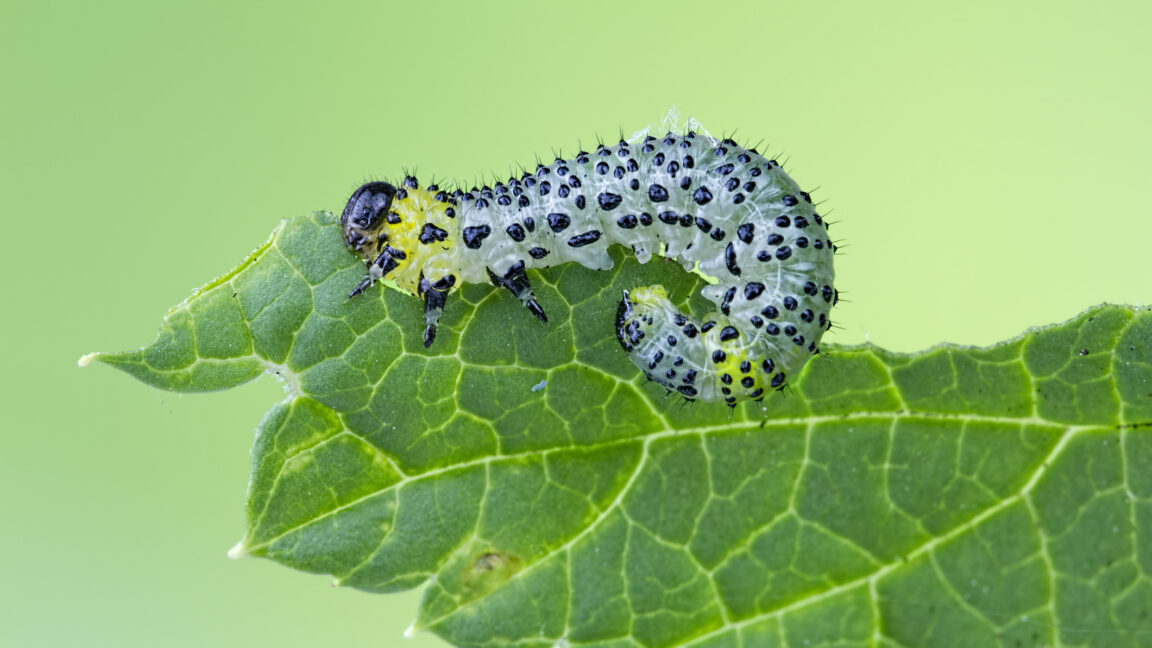
First, the researchers examined direct defenses—the chemical and physical changes the plant undergoes to make its leaves less palatable for caterpillars and thus hamper their growth. When caterpillars fed on the mutant beans with inactive inceptin receptors, though, they had a field day. Over a five-day feeding period, their growth rate was over 70 percent higher than on the plants with a functional receptor.
More detailed analysis revealed exactly why this was the case. In plants that could detect the In11 peptide, a feeding caterpillar triggered the rapid up-regulation of 527 genes, including the ones responsible for anti-herbivore defenses. The plants that were oblivious to the In11 in the caterpillar spit failed to mount this targeted response. Instead, they reacted as if they were just being mechanically wounded by the wind or a passing animal. Without the receptor, they entirely missed that a live, hungry insect was actively eating them.
Another consequence for In11 insensitive beans was that they were unable to summon predatory wasps.
At the same time, the plants unable to detect the molecular signature of the caterpillar’s drool were largely ignored by the wasps. They weren’t completely defenseless, though. “There are other papers that show if you knock out all immune signaling, the caterpillars grow twice as big—they get enormous,” Steinbrenner says. This, he suggests, indicates the immune system had other pathways to deter herbivores like the caterpillars.
While the team connected the broken inceptin receptor to a muted distress call, the exact downstream immune signaling pathway isn’t fully understood. The authors suspect that the highly specific caterpillar detection they saw piggybacks on the plant’s general wound response, potentially triggering secondary internal alarms known as damage-associated molecular patterns, or DAMPs. Exactly how the initial receptor activation ultimately translates into the production of volatile organic compounds remains a puzzle.
Another caveat lies in the choice of the attacker. The Spodoptera exigua, known as the beet armyworm, is a generalist herbivore, meaning it feeds on a wide variety of plants and is rather susceptible to botanical defenses. Specialist herbivores that feed on specific plants likely evolve metabolic countermeasures to detoxify or otherwise bypass chemical defenses of their hosts. In the study, the researchers acknowledge that we’re not yet sure whether a functional inceptin receptor provides broad-spectrum resistance, or if specialized pests can fool this alarm system.
Finally, in the Oaxacan field test, the team showed that predatory wasps use the airborne distress signals to find their prey, but the relative importance of direct leaf defenses versus this indirect wasp recruitment isn’t clear. In their future research, the scientists want to investigate this in more detail. Still, the team hopes their work will help us better protect crops like bean plants from pests.
“Today, we do that with chemicals, with pesticides, but if we could use the best receptors and the best volatiles from lots of different plants, maybe we might be able to confer immunity to most problematic pests or pathogens in a sort of targeted way,” Steinbrenner says. “That’s the big picture, the goal of our lab in the long run. And I think doing that would mean understanding more of these types of receptors and volatiles.”
Science Advances, 2026. DOI: 10.1126/sciadv.aec3229