
Development
If I had a hammer... it might actually be a rhino tooth
June 3, 2026 Development Source: Ars Technica
Share this article



“Obtaining rhinoceros teeth for the experiments proved to be an extremely difficult but indispensable exercise for this study,” wrote Sanz-Royo and her colleagues in their recent paper. But only the real thing would do, “due to the unique structure and exceptional hardness of rhinoceros teeth,” she wrote. In other words, the exact properties that would have made rhino teeth an appealing material for hand tools in the first place.
It was pretty easy to get access to modern-day rhinoceros teeth—if all the researchers wanted to do was look at them. The National Museum of Natural History (MNHN) in Paris has a collection of 236 teeth for comparative anatomy research, which Sanz-Royo and her colleagues examined closely to learn what kinds of marks form on teeth during a lifetime of chewing tough grasses mixed with dust and grit. But for some reason, the museum was oddly reluctant to let a bunch of archaeologists hit their anatomical collection with sharp rocks to document the results.
In the end, Sanz-Royo and her colleagues got 18 white rhino teeth from three French zoos. Expert knapper David Pleurdeau of the MNHN, a co-author of the recent study, then set to work on the teeth with an assortment of quartz and flint tools (knapping is the ancient art of carefully striking a rock with another rock to shape it into a tool). The goal was to see what kind of marks his work—standard steps in making, maintaining, and using stone tools—left on the teeth.
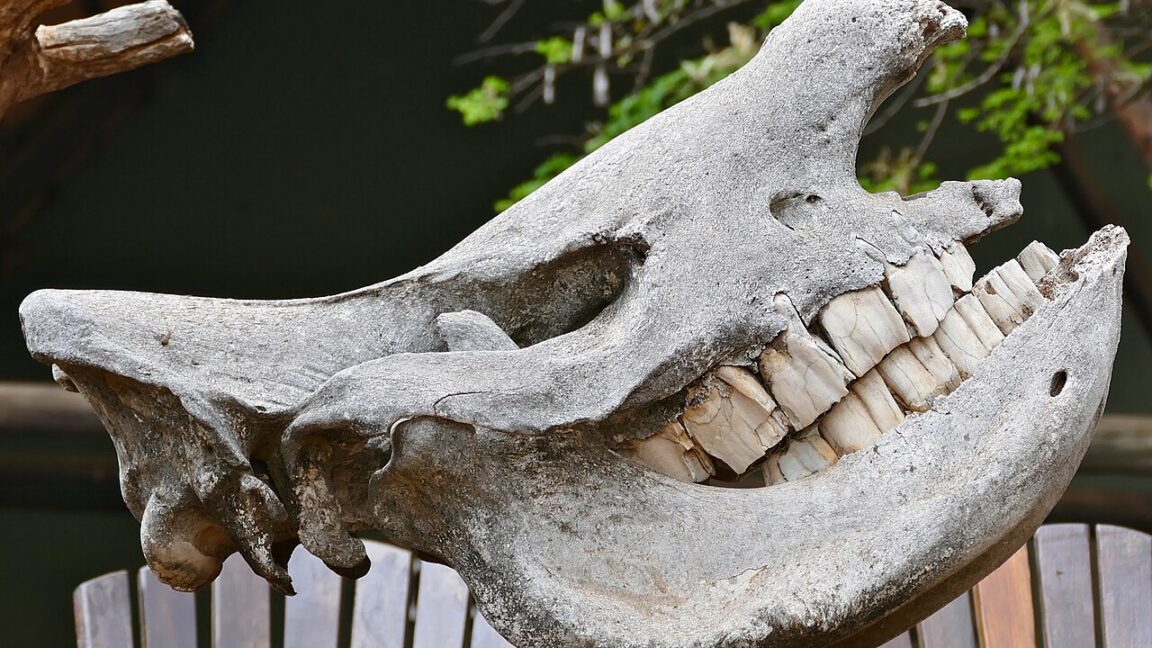
Tooth enamel is the hardest part of the entire mammal skeleton; 97 percent of it is hydroxyapatite, the hard mineral component of bone (most bone tissue is only about 40 to 70 percent hydroxyapatite). That means, compared to bone, enamel is less likely to crack under pressure or the shock of a hard impact, such as whacking a piece of rock with it (we beg you not to try this at home with your own teeth). Rhino enamel is thicker and harder than that of most other animals because it has evolved to do a lot of very tough chewing.
Sanz-Royo and her colleagues say that based on their experiments, Neanderthals at sites across Europe and Asia were apparently using rhinoceros teeth as soft (compared to rock) hammers for knapping or retouching stone tools or as anvils paired with harder stone hammers or cutting tools. It makes sense, especially at sites like Panxian Dadong, where good-quality stone like flint, chert, or quartz may have been hard to come by; basalt and limestone aren’t great for making sharp tools.
During his experiments, Pleurdeau even worked out the most comfortable way to hold a rhino tooth while working, so paleo-ergonomics is officially a thing now. So not only do we know that Neanderthals used rhino teeth to make and maintain their stone tools, but we also know how they probably held them and what that experience would have felt like.
Journal of Human Evolution, 2026. DOI: j.jhevol.2026.103829. (About DOIs).