
Development
In a surprise launch, China debuts another big rocket designed for reusability
June 2, 2026 Development Source: Ars Technica
Share this article



In early April, another relative newcomer to China’s launch sector launched its new medium-class Tianlong 3 rocket. The 7-year-old firm behind the Tianlong 3, named Space Pioneer, said the rocket failed to reach orbit, an outcome not uncommon for brand-new launch vehicles. Tianlong 3’s first stage booster is designed for recovery and reuse, but a landing attempt will have to wait until a future flight.
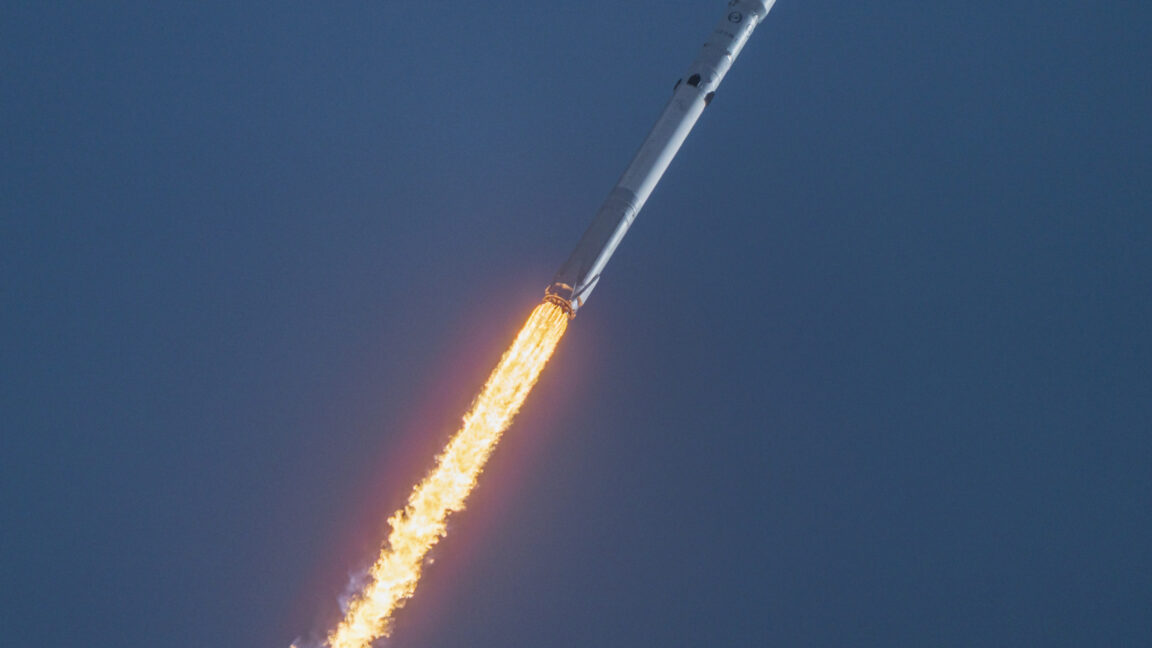
The Long March 12B, the largest and most powerful (potentially) reusable rocket China has launched to date, lifted off Monday from a remote launch pad in the Gobi Desert. The 236-foot-tall (72-meter) rocket took off at 4:40 pm Beijing time (08:40 UTC or 4:40 am EDT).
Unusually, Chinese officials appear not to have announced the launch in advance. The Chinese government did not issue any public notices for pilots to avoid the rocket’s flight path, as is customary for space launches around the world. It’s too soon to know if this was a one-off change or the start of a new policy for Chinese launches. Russia’s government, which has historically also released safety notices for its space launches, has begun issuing such warnings to cover extended periods over many days in a bid to conceal when a launch might actually occur.
The existence of the Long March 12B was not a secret. The rocket completed a test firing on its launch pad in China in January, and a launch was expected in the first half of this year. It was developed by China Commercial Rocket Co. Ltd., or CACL, an opaque business venture set up by China’s sprawling state-owned aerospace enterprise. According to Chinese state media reports, engineers designed and developed the Long March 12B in just 21 months. If the claim is true, it would be a remarkably fast timeline to progress from a clean sheet to an orbital flight.
Monday’s launch did not include any attempt to land the first stage booster, but the rocket carried grid fins and landing legs, important hardware elements for future recovery experiments. A statement released by China Aerospace Science and Technology Corporation (CASC), CACL’s parent company, declared the first flight of the Long March 12B a “complete success” in a post-launch statement.
“This launch adds another high-capacity commercial rocket to [China’s] fleet for large-scale Internet constellation networking missions,” CASC said. “No recovery tests were conducted during this mission; however, first-stage recovery tests are scheduled to be carried out at a later, opportune time.”
Satellites for one of these large-scale Internet constellations rode to space aboard the Long March 12B, which released a batch of Qianfan broadband spacecraft into low-Earth orbit. Qianfan is one of China’s two leading mega-constellations, each seeking to replicate for China what SpaceX’s Starlink does in the United States.
The Long March rocket family dates back to 1970, when China launched its first satellite into orbit using the Long March 1 vehicle derived from Chinese ballistic missiles. Many iterations have followed. The Long March 2, 3, and 4 rockets were China’s workhorses in the 1980s, 1990s, and 2000s. These rockets remain operational but are being replaced by newer models, such as the Long March 5, 6, 7, and 8, which can launch everything from small satellites to massive modules for China’s space station.
Space Pioneer’s Tianlong 3, which failed on its first flight in April, uses the same kerosene-fueled, nine-engine cluster arrangement on the booster, coupled with a single-engine second stage. Its lift capability is a little less than that of the Falcon 9 or Long March 12B, but it is similar in height and thrust.
The Long March 12A and Zhuque 3 are powered by groupings of seven and nine methane-fueled engines, respectively, on their booster stages.
There are sound engineering reasons to use the same approach SpaceX uses with the Falcon 9. A clustered engine configuration on the first stage, usually with seven or nine engines, offers several advantages. It allows a booster stage to provide high thrust during ascent, and a lower power level during propulsive landing burns. In some cases, flying with a cluster of booster engines might allow the rocket to continue its mission even if one of them fails.
There are important, less obvious aspects of a rocket’s design. We have less insight into how closely those elements on China’s rockets match what SpaceX has tried and proven on Falcon 9.
But SpaceX’s architecture clearly works. The first version of Blue Origin’s New Glenn rocket uses seven engines fueled by methane, and the company is looking at going to nine booster engines in the future. Several more US rocket companies are pursuing similar designs for their reusable rockets. Nearly all are going with seven- or nine-engine boosters.