
Development
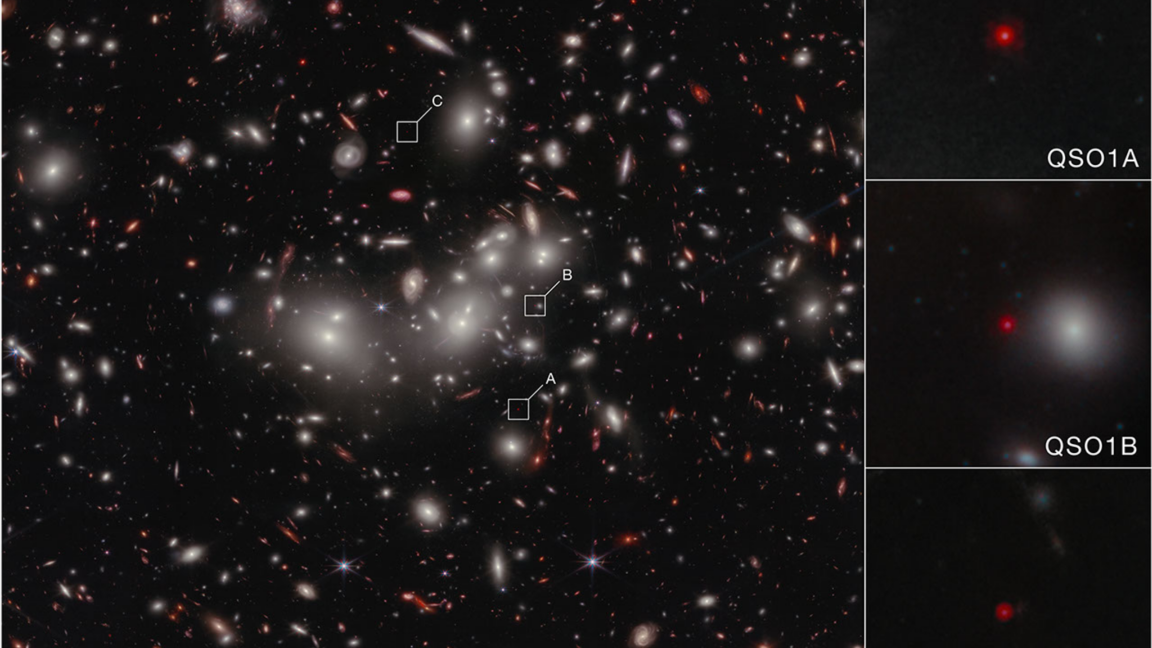
"Little red dot" in early Universe is a naked supermassive black hole
May 28, 2026 Development Source: Ars Technica
Share this article



Other work revealed that most of the material around it was gas that had formed relatively few stars. And, just last month, a detailed look at the spectrum of QSO1 showed that there is very little other than hydrogen present, consistent with the object having produced very few stars by this point in its history.
The big uncertainty in all of this is the relationship between the luminosity of the object and the mass of the black hole. We derive that relationship from the recent Universe, where supermassive black holes are embedded in mature galaxies that provide some structure to the material that the black hole is feeding on. There’s no guarantee that this same relationship would hold this early in the Universe’s history.
Fortunately, thanks to the magnification of the gravitational lensing, QSO1 provides us a fantastic opportunity to find out how far back this relationship holds.
These models placed the black hole’s mass at about 50 million times that of the Sun, which is in line with previous estimates. That suggests the rules governing black hole luminosity haven’t changed in at least 13 billion years.
Attempting to estimate the mass of any stars surrounding the black hole suggested there were very few. “The Keplerian rotation curve leaves little room for any stellar component,” the researchers conclude. Attempts to estimate the total stellar mass in the “galaxy” that the black hole sits in came up with an upper limit of 20 million solar masses—less than half of the mass of the black hole itself.
In other words, over two-thirds of the mass of QSO1 resides in the black hole, with the stars accounting for less than one-third. Which explains why the word ‘galaxy’ is in quotes above. “To our knowledge, this upper limit makes QSO1 the most ‘naked’ massive BH ever found,” the team concludes.
A lot of the paper is dedicated to the consideration of how this particular black hole got so big so early in the Universe’s history. There are three leading ideas for it: primordial black holes formed in the immediate aftermath of the Big Bang; direct collapse of massive gas clouds that skip the formation of stars entirely; or runaway mergers of black holes formed in early, dense star clusters.
Here, the researchers argue that having a supermassive black hole with so few stars around suggests we can ignore option three. If there are no dense stellar clusters, you can’t form enough black holes to merge. This leaves two mechanisms that are entirely theoretical at this point.
That said, the discussion seems to suggest that many of the direct collapse models that currently work require a major source of ultraviolet radiation, and more mass around than we see in QSO1. That would seemingly favor a primordial black hole as the source, although that would likely require it to have grown by a factor of 10 in the 700 million years of its existence. That, in turn, would suggest there were mergers among this population early in the Universe’s history.
All of which makes for an interesting discussion that will certainly not be resolved until we have additional examples of this sort of naked supermassive black hole.
Nature, 2026. DOI: 10.1038/s41586-026-10579-4 (About DOIs).