
Development
Driving Porsche's most powerful car—and no, it's not a 911
May 26, 2026 Development Source: Ars Technica
Share this article



In exchange for the slight range and style boost of the Coupe, you get a roughly one-third reduction in cargo capacity behind the second row, down to 18.9 cubic feet (535 L) total. Otherwise, the performance of the two models is identical, so choose the one that best fits your aesthetic preferences and capacity needs. While the Coupe is doubtlessly shapelier, I wouldn’t call either particularly endearing. The rear bumper seems needlessly busy, and while the upper-half of the Cayenne Electric’s nose looks familiar and compelling, the rest is likewise a bit much.
Go with the Turbo, and you’ll get a few extra frills and gills. Up front, every model has active aerodynamics to regulate airflow, and the Coupe has a pop-up spoiler at the rear. Down low on the bumper, though, you’ll find a pair of extending, vertical planes exclusively on the Turbo. These subtly extend the car’s aerodynamic profile, helping it achieve that 0.23 drag coefficient.
The interior design is much more familiar than current Porsche designs, with one major exception: the radically curved center display. It’s vertically oriented and has a distinct kick up at the bottom; it’s angled to meet a padded wrist rest.
Everything inside the car feels high-quality. I was a big fan of the woven pepita insets in the leather trim, which added some much-needed contrast to the otherwise monotone interior. Headroom in the rear seats was just enough, even on the Coupe, and there’s no shortage of legroom in any chair.
It’s a real game-changer here. Even on the same 22-inch wheels and tires, the turbo felt miles more comfortable on the soft end and yet even sharper and more responsive when dialed up to Sport Plus.
And yes, you can definitely feel the extra power. Press the Sport Response button on the Turbo’s steering wheel for 10 seconds of maximum power. Then warn your passengers to put their heads against the headrest. This car will induce whiplash in the unprepared and expletives from those who have been forewarned.
Predictably, the S sits somewhere in the middle, noticeably quicker than the base car but not as terrifying as the Turbo. The base model is quick enough for me, and at a starting price of $113,800 (plus $2,350 destination), it’s $54,200 cheaper than the Turbo to start.
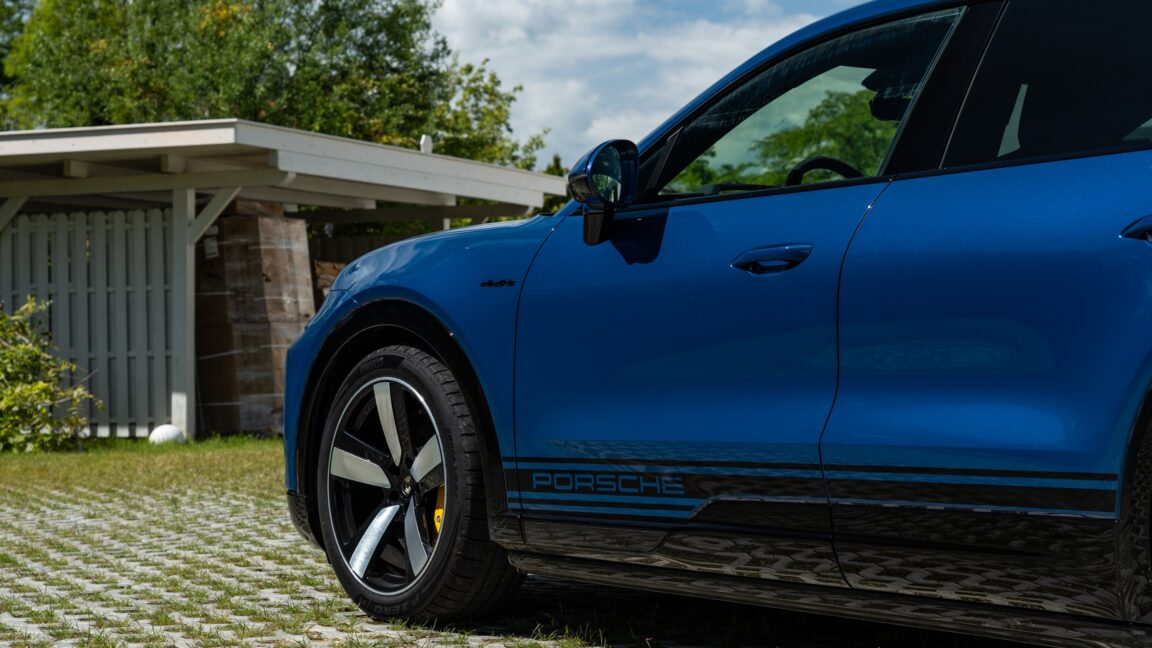
But that’s just to start. The Turbo I drove, the one you see pictured here, included nearly $50,000 in options for a final price of $220,330, including destination fee.
The base Cayenne Coupe Electric has more than enough power and interior comfort to work as a stellar everyday machine, but it’s let down by a ride quality that feels a bit uncouth in an SUV with a six-figure starting price. The Active Ride suspension is infinitely better and well worth the $7,790 upgrade, but to get that, you’ll need to step up to at least the S, which starts at $131,200.
And the Turbo? If you have the financial means and the maniacal desire, by all means, go for it. It’s not only Porsche’s most powerful car yet; it’s also the company’s first SUV that feels truly as bonkers as some of its most storied sports cars.