
Development
Vulcan woes will "absolutely" be a factor in Pentagon's next rocket competition
April 16, 2026 Development Source: Ars Technica
Share this article



Roughly half of the Space Force’s major launches planned over the next four years are assigned to the Vulcan rocket. ULA, a 50-50 joint venture between Boeing and Lockheed Martin, was the Pentagon’s No. 1 launch provider for nearly 20 years after the company’s creation in 2006, building a strong reputation for reliability with its Atlas V and Delta IV rockets. No ULA mission has failed to put its payload into orbit, and the company enjoyed near-perfect performance before the two close calls with Vulcan, the replacement for the Atlas and Delta rocket families.
These spacecraft are more bespoke than GPS satellites, which the Space Force can easily interchange between Vulcan and Falcon 9 without modification. They would also require a launch on SpaceX’s Falcon Heavy, so it wouldn’t be as easy to find an immediate slot in SpaceX’s launch schedule.
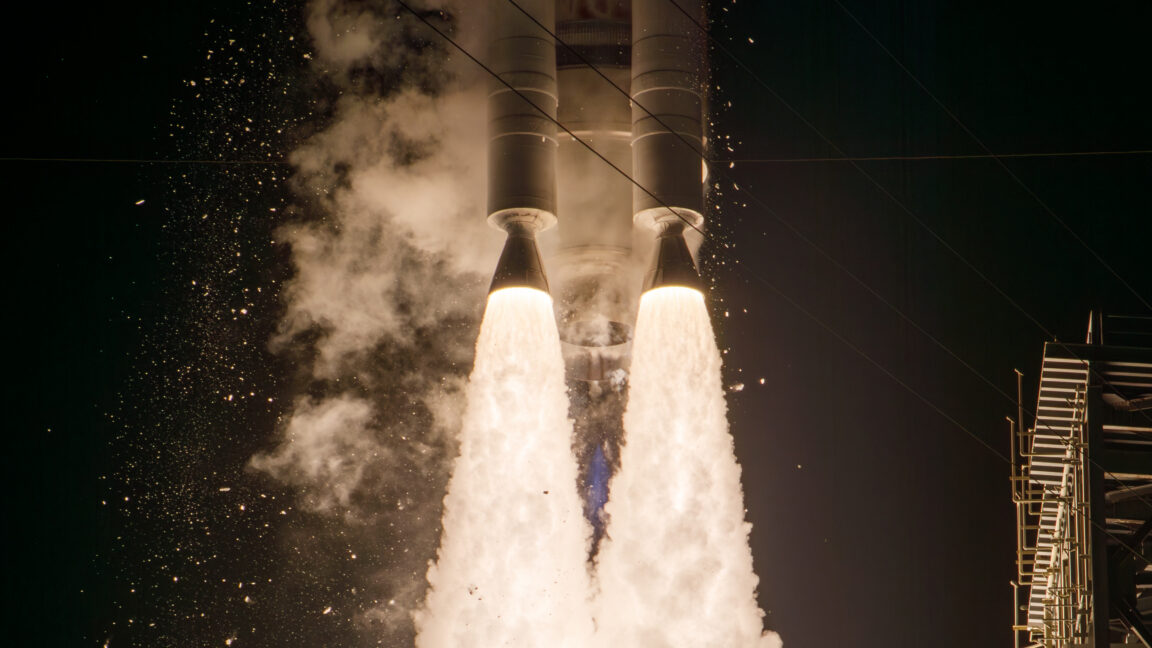
In the meantime, engineers at ULA and Northrop Grumman continue their investigation into the cause of Vulcan’s boosters losing their nozzles. Northrop is planning a test-firing of a new nozzle design in Utah later this month, and Garrant said teams will attempt to recover the solid rocket boosters from the February launch from the floor of the Atlantic Ocean off the coast of Florida. ULA retrieved the boosters from a 2024 Vulcan launch to aid in the investigation of the first nozzle failure. The second nozzle failure suggests the inquiry into the first incident did not find the root cause.
ULA could resume flying Vulcan rockets before the Space Force gives the green light for Vulcan to launch a national security mission. ULA has 38 Vulcan launches in its order book for Amazon’s satellite Internet constellation. Amazon is currently launching satellites on ULA’s last few remaining Atlas V rockets. Once those run out, perhaps in mid-summer, ULA could look at launching Amazon satellites on Vulcan.
The current NSSL contract carries the Space Force through October 1, 2029. Space Systems Command will spend the next 18 to 24 months assessing the launch market, including the performance of the military’s existing launch providers and the status of emerging rockets. The military is likely to begin asking for industry proposals in the next NSSL competition in 2028.
By then, military space officials hope to have a better handle on how much they can rely on ULA’s Vulcan rocket. Is it really flying twice per month, as ULA promises it will? Barring a major setback, Blue Origin’s New Glenn rocket is likely to be certified for NSSL missions before 2028, adding a new option to go alongside SpaceX’s Falcon 9 and Falcon Heavy.
At least some rockets from a roster of new entrants should have completed their initial flights by the end of 2028, but they may not be certified for the Space Force’s highest-priority launches. This list includes Rocket Lab’s Neutron, Stoke’s Nova, Firefly and Northrop’s Eclipse, and Relativity’s Terran R. SpaceX is also expected to propose Starship as a super-heavy-lift option for the Space Force, and the military will likely want to retain the Falcon 9 and Falcon Heavy as options into the 2030s. All have at least some element of reuse in their design.
This scenario gives the Space Force plenty of rockets to choose from, so the pressure is on for United Launch Alliance. With each delay, there’s less time for Vulcan to prove its mettle before the bell tolls on the Space Force’s next big rocket sweepstakes.