
Development
China’s shark finning could lead to US seafood sanctions
May 23, 2026 Development Source: Ars Technica
Share this article



Official Chinese data shows that in 2023, more than 10,000 blue sharks and nearly 1,700 shortfin mako sharks were discarded by crews in the western and central Pacific region alone.
While the US and over 90 other jurisdictions require fishers to land whole sharks with their fins naturally attached—a standard widely recognized as the only way to prevent finning—China does not. Although the nation has technically banned the practice, it still allows many of its fisheries to remove fins so long as they do not exceed a certain percentage—usually 5 percent—of the shark’s total bodyweight upon landing.
Conservationists highlight that these ratio-based regulations are ineffective, ignore biological differences between species, and are difficult to enforce accurately.
“Once the fins are separated from the bodies, inspectors have a nightmare of a time figuring out which fin belongs to which shark, whether protected species are mixed in, or if bodies were just dumped overboard,” Olivera said. “It turns real enforcement into a math game rather than a secure chain of custody.”
The petition argues that without a “fins naturally attached” landing policy, the Chinese fleet—the largest in the world—fails to meet America’s conservation standards, and therefore fails to meet the requirements of the Moratorium Protection Act.
When asked for comment, a spokesperson for the Chinese Embassy in Washington told Inside Climate News that “China is deeply committed to science-based conservation and sustainable use of international fisheries resources.” The spokesperson said China is following international law, rigorous vessel monitoring and membership requirements of regional fisheries management organizations.
However, the spokesperson said the government was “not familiar with the specific situation” regarding the Center for Biological Diversity’s petition, and did not reference sharks, finning or the threat of seafood sanctions.
Heidy Martínez, a shark scientist and science communicator, said that shark finning “really shows how much we view these ancient, majestic animals as a commodity, as animals that are simply there to benefit us.
“It highlights many of the cruel, unsustainable and wasteful practices within the fishing industry,” she said.
While shark finning often receives the greatest attention for its shock factor, it’s important to note that the biggest threats sharks face are from overfishing and bycatch, Martínez said. One hundred percent of shark species are impacted by overfishing and for 67 percent of shark and ray species, overfishing is the only recorded threat, according to the Shark Trust.
Addressing allegations of worker abuse, the Chinese Embassy maintained that Beijing “attaches great importance to protecting the lawful rights and interests of workers and always asks Chinese companies to abide by laws and regulations.”
Martínez said she wished the general public better understood these prehistoric animals. “Sharks fall under the class of fish, and because of this, they communicate their experience to us differently than marine mammals.” The human-like eyes and behavior of dolphins and sea lions make it easier for people to project themselves onto them, but it’s harder for people to naturally relate to sharks, Martínez said.
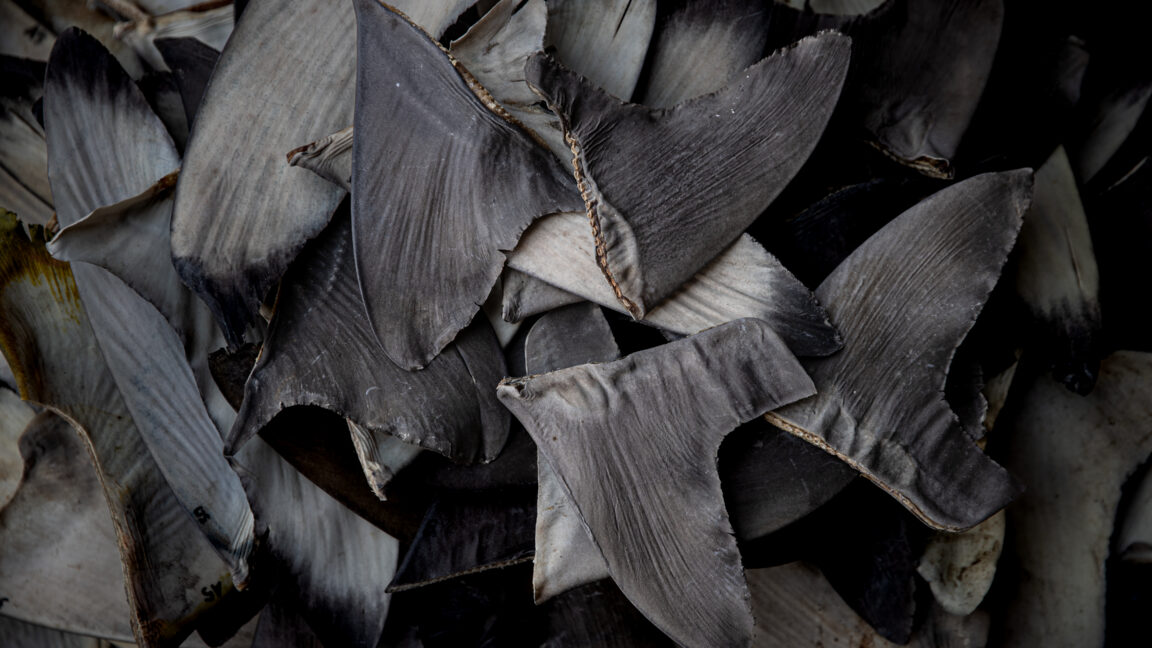
Harvested fins are frequently shipped to Hong Kong, a special administrative region of China that serves as the world’s largest shark fin trading hub. DNA analysis of fins imported into Hong Kong between 2014 and 2021 found the presence of at least four species on the Convention on International Trade of Endangered Species list: scalloped hammerhead, smooth hammerhead, great hammerhead, and oceanic whitetip sharks.
China’s lack of a ban on the possession, transport, and sale of shark fin products is a further violation of the US Moratorium Protection Act, according to the Center for Biological Diversity. Although there are restrictions on serving shark-fin dishes at official Chinese government events, this does not constitute a nationwide ban, the report concluded.
“If China refuses to adopt comparable protections, then the US should use the tools Congress provided, including import restrictions,” said Olivera, highlighting that the ideal outcome is for China to adopt shark conservation measures comparable to US law. “The point of the petition is to make shark conservation standards real, not optional.”
“The level of demand we place on the ocean simply cannot continue,” said Martínez, whose first live encounter was with a Great white shark in South Africa. “Shark finning is part of that larger story, a reflection of just how deeply we have exploited our oceans.”
This article originally appeared on Inside Climate News, a nonprofit, non-partisan news organization that covers climate, energy, and the environment. Sign up for their newsletter here.